


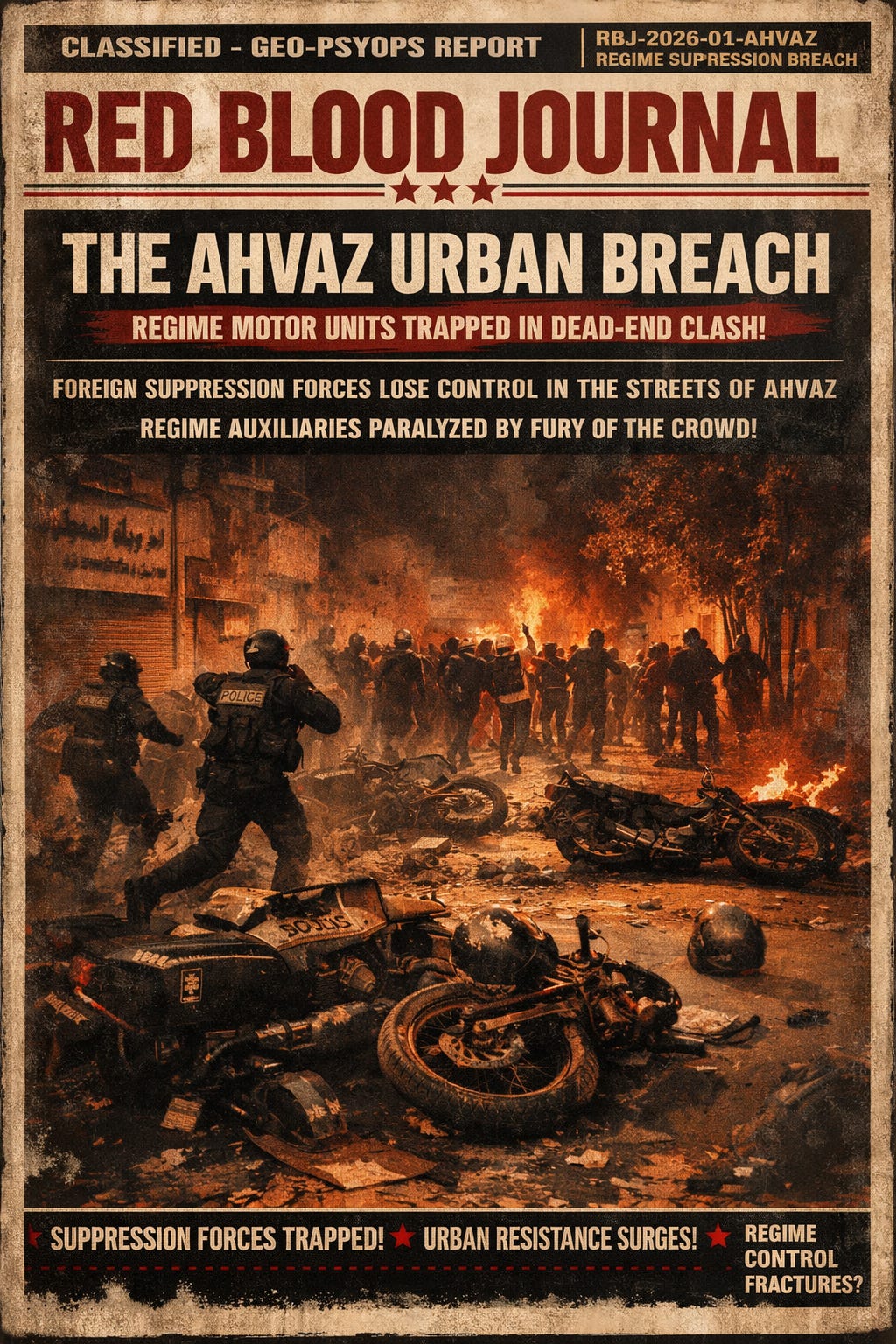
🩸 RED BLOOD JOURNAL TRANSMISSION
T#: RBJ-2026-01-21-AHVAZ-URBAN-BREACH
Classification: Geo-PsyOps Report – Iran Internal Unrest
Desk: Middle East Crowd-Control Dynamics & Foreign Auxiliary Forces Unit
Status: For Readers Who Understand That Streets Can Become Battlefields Overnight
THE AHVAZ URBAN BREACH
How a Single Dead-End Became a Momentary Collapse in the Regime’s Spatial Control Grid
PROLOGUE – WHEN THE MAP FIGHTS BACK
Every authoritarian system believes it knows its cities better than the people who live in them.
But in Ahvaz—where alleyways bend like scars and entire neighborhoods have learned to navigate by instinct—the map serves the locals, not the occupiers.
On a tense January night, the Islamic Republic discovered this truth the hard way.
SECTION I — THE FOREIGN SUPPRESSION PROBLEM
For years, Tehran has relied on Iraqi and Afghan auxiliary units to reinforce its domestic suppression machine, particularly in restive regions where loyalty from local police cannot be guaranteed.
Their purpose is simple:
Create psychological distance between population and enforcers
Deploy units with no emotional ties to the city
Use unfamiliarity as a weapon—detachment breeds brutality
But unfamiliarity cuts both ways.
In Ahvaz, it became a weakness.
SECTION II — TWENTY MOTORCYCLES, ONE WRONG TURN
Eyewitnesses report that nearly twenty Iraqi suppression officers, each riding standard-issue rapid-response motorcycles, surged into an Ahvaz neighborhood to intimidate and scatter gathering crowds.
The move was meant to project dominance.
Instead, it exposed vulnerability.
The officers, unfamiliar with the area’s twisting street grid, followed a route that collapsed into a concrete dead-end choke-point—a corner of the city where escape options drop to zero and the locals know every brick by memory.
What was meant to be a show of force became a tactical trap.
SECTION III — THE MOMENT OF CONFLICT
As the unit attempted to reverse and regroup, the atmosphere shifted.
Residents describe:
Surging tension
Accumulating crowds
A sudden rise in pressure and threats from officers
A spark that ignited the confrontation
The clash was swift and intense.
Within minutes, all twenty motorcyclists were incapacitated, unable to maintain their position or continue operations. Some abandoned bikes; others were forced back by sheer resistance.
For a brief, electric moment, the regime’s imported enforcers lost control of the ground beneath them.
SECTION IV — THE PSYCHOLOGY OF A FAILED INTIMIDATION OP
Regime suppression relies on three pillars:
Mobility – the ability to appear anywhere instantly
Mystique of invincibility – the illusion that the state never gets caught
Spatial mastery – dominance of streets, intersections, and choke points
This incident shattered all three.
A trapped unit is a humbled unit.
A humbled unit is a humanized unit.
And a humanized unit loses its deterrence value.
For locals, this wasn’t just a confrontation. It was a proof-of-weakness event.
SECTION V — WHAT THIS MEANS FOR IRAN’S INTERNAL WAR
Ahvaz has long been a fault line—ethnic tension, economic marginalization, environmental collapse, and decades of underinvestment have made it combustible.
Incidents like this carry strategic implications:
Regime overdependence on foreign auxiliaries is showing cracks
Urban knowledge is becoming a weapon in the hands of citizens
Crowd psychology is shifting from fear to tactical courage
The myth of an all-knowing, all-controlling state is eroding
When an authoritarian regime loses the streets—even for five minutes—it signals deeper fractures in its command architecture.
EPILOGUE — THE DEAD-END THAT OPENED A NEW PATH
The Ahvaz urban breach wasn’t a revolution.
It wasn’t an uprising.
It was something subtler, but far more revealing:
A moment when ordinary people, armed with nothing but their street knowledge and their refusal to submit, managed to disrupt a foreign-backed suppression squad.
It shows that even in the tightest grip, there are cracks.
And in those cracks, light enters.
This is not the end of the story.
It may be the beginning of a new one.
⛓️The Ahvaz Urban Breach: Fractures in the Regime Grid
This report analyzes a tactical failure by the Iranian government during a period of civil unrest in Ahvaz.
To maintain order, the regime deployed foreign auxiliary forces from Iraq and Afghanistan, banking on their lack of emotional ties to the local population to ensure brutal efficiency.
However, these units lacked geographic familiarity, leading a large group of motorized officers into a dead-end trap where they were overwhelmed by residents.
This confrontation shattered the state’s illusion of invincibility and demonstrated how local urban knowledge can be weaponized against outsiders.
Ultimately, the event serves as a strategic case study showing that the regime’s reliance on imported enforcers creates critical vulnerabilities in their spatial control.


