


🩸 RED BLOOD JOURNAL TRANSMISSION
Archive: The Archive of Blood & Memory
Division: Geo-PsyOps & Strategic Conflict Analysis Unit
Transmission Code: RBJ-2026-IRAN-EASTER-BRIEFING
Classification: Narrative Warfare / Active Conflict Theater
Desk: San Diego Outpost
Status: Active — Multi-Layer Signal Extraction
PROLOGUE — THE STAGE OF SOFT IMAGES, HARD SIGNALS
On a day framed for children—colored eggs, laughter, soft optics—a parallel theater unfolded. Questions were asked. Answers were given. But what emerged was not merely a press interaction.
It was a compressed doctrine.
A battlefield briefing disguised as a holiday exchange.
The language oscillated between reassurance and escalation, between humanitarian framing and total war posture. What appears as contradiction is, in structured analysis, layered messaging—each sentence calibrated for a different audience.
This transmission dissects those layers.
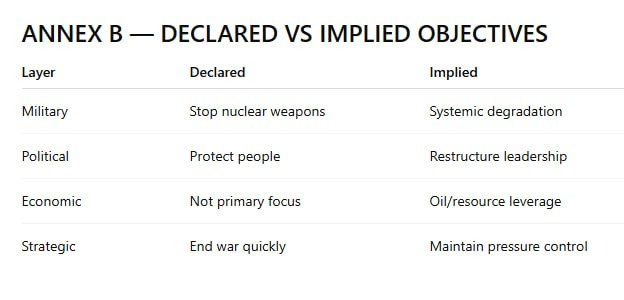
SECTION I — DECLARED OBJECTIVE VS OPERATIONAL REALITY
Declared Objective
Iran must not obtain nuclear weapons
War framed as preventative and necessary
Operational Reality Signals
Infrastructure destruction referenced (bridges, power, systemic collapse)
Timeline of rapid degradation: “34 days” → “obliteration”
War continuation remains open-ended
Interpretation
The stated objective (nuclear prevention) functions as a public anchor point.
However, the operational language indicates:
A broader campaign of systemic weakening rather than singular objective targeting.
This divergence is a classic dual-layer doctrine:
Outer layer → Limited goal (defensive legitimacy)
Inner layer → Structural transformation of the target state
SECTION II — REGIME CHANGE WITHOUT THE LABEL
Explicit Signals
“Phase one, phase two… now third group”
“More reasonable” actors now in place
Acknowledgment: “You can call it regime change”
Structural Insight
This is not framed as a future objective—it is presented as an ongoing, already achieved sequence.
Model Extracted
Destabilize leadership
Remove hardline nodes
Replace with negotiable actors
Continue pressure until compliance
Interpretation
This reflects a modular regime transition model, not a single overthrow event.
Regime change is not an explosion.
It is a staged replacement architecture.
SECTION III — THE PEOPLE VARIABLE (CONTROL THROUGH NARRATIVE)
Key Claims
Iranian people want liberation
They “want bombs” as signals of change
Protest suppression: threat of immediate execution
Casualty figure: ~45,000 protesters
Narrative Function
This establishes:
Moral justification
Internal legitimacy proxy
Psychological framing for external audiences
Contradiction Layer
War → destruction of infrastructure
Narrative → liberation of population
Interpretation
This is a human terrain reframing strategy:
Convert civilian suffering → into justification for continued escalation
Convert absence of uprising → into evidence of oppression
SECTION IV — THE RESOURCE SIGNAL (OIL AS THE UNFILTERED OBJECTIVE)
Direct Statement
“If it were up to me, I’d take the oil”
Contextual Framing
Compared with Venezuela
Balanced against U.S. public perception
Interpretation
This is one of the rare moments where the inner layer surfaces unfiltered.
Resource acquisition is acknowledged, but politically moderated.
Dual Constraint Model
Strategic desire → resource control
Political limitation → domestic perception
SECTION V — MILITARY DOMINANCE & CONTROL OF TIME
Key Signals
Iran described as:
Minimal capability
Unable to resist effectively
U.S. described as:
Dominant
Fully rebuilt military
Critical Statement
U.S. could leave → Iran would take 15 years to rebuild
Interpretation
Control is not just physical—it is temporal.
The actor who controls reconstruction timelines controls the future state.
SECTION VI — INFORMATION WARFARE LAYER
Observed Techniques
Poll reference → “100% support”
Media inversion → attacking hostile press while citing it
Emotional triggers:
Children
Liberation
Fear of nuclear threat
Purpose
Stabilize domestic support
Neutralize dissent
Maintain narrative cohesion
Interpretation
This is a multi-audience broadcast:
Domestic base → reassurance
Opposition → delegitimization
Foreign actors → pressure signal
ANNEX A — THE PRESSURE MODEL
Cycle Identified:
Threat Declaration
(Nuclear danger)Moral Framing
(Liberation of people)Kinetic Action
(Bombing / infrastructure targeting)Negotiation Window
(Proposal “not enough”)Escalation Option Maintained
(War continues)Repeat Cycle
This loop continues until compliance or collapse.
ANNEX C — END-STATE MAPPING
Possible Outcomes Identified
1. Controlled Compliance
Iran accepts conditions
War ends quickly
New leadership stabilizes
2. Prolonged Degradation
Continued strikes
Infrastructure collapse
Internal fragmentation
3. Strategic Withdrawal
U.S. exits early
Iran rebuilds over long timeline
Influence retained indirectly
FINAL ANALYSIS — THE DUAL REALITY DOCTRINE
This briefing reveals a structure common to modern conflict:
What is said → Stability narrative
What is done → Structural pressure
What is intended → Long-term control architecture
The contradiction is not accidental.
It is the system.
CLOSING LINE
On the surface: a holiday, a question, an answer.
Beneath it: a full-spectrum doctrine, compressed into minutes.
The signal is not in what is emphasized.
The signal is in what aligns across layers.
And in this case—everything aligns toward control.
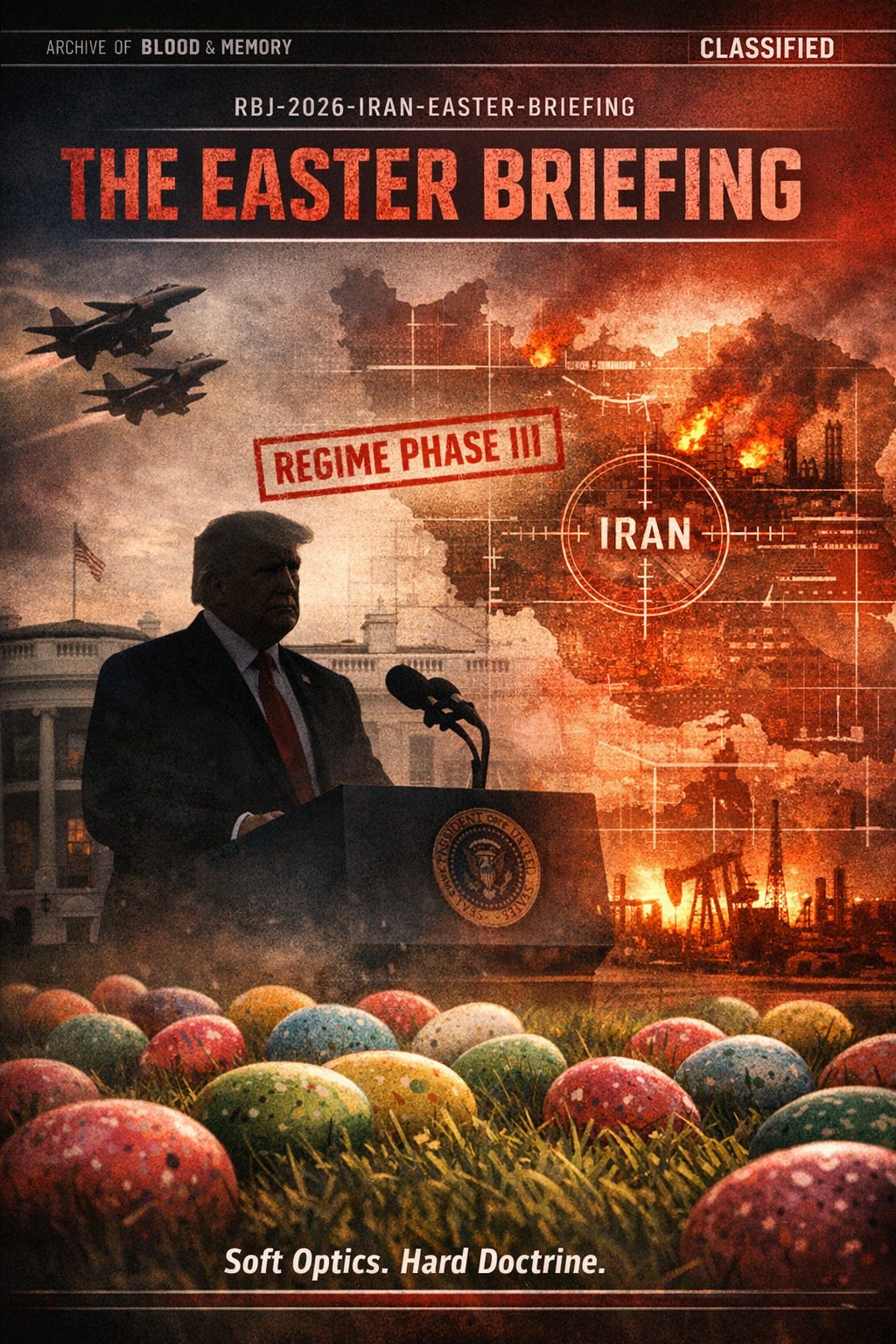
🎬 RBJ COVER CONCEPT (Cinematic Classified Style)
Title: “THE EASTER BRIEFING”
Visual Composition:
Foreground: Children’s Easter eggs scattered across White House lawn
Midground: President silhouette at podium, partially shadowed
Background: Faint overlay of:
Fighter jets
Oil fields burning
Map of Iran with grid targeting lines
Overlay Elements:
Red classified stamps: “REGIME PHASE III”
Tactical HUD lines crossing the map
Subtle blood-red tint in sky gradient
Tagline (bottom):
“Soft Optics. Hard Doctrine.”
👁️The Easter Briefing:
Architecture of Control
The provided text analyzes a strategic military briefing delivered during a public holiday, framing it as a sophisticated form of narrative warfare.
This document dissects the dual-layer doctrine of U.S. foreign policy toward Iran, contrasting humanitarian rhetoric with the operational goal of systemic degradation.
It explores how the objective of nuclear prevention serves as a public anchor for a deeper agenda involving staged regime change and infrastructure destruction.
The analysis highlights a multi-audience messaging strategy that justifies escalation by claiming to liberate the Iranian population while simultaneously eyeing resource control.
Ultimately, the source illustrates how information warfare is used to maintain long-term control by aligning public optics with aggressive geopolitical pressure.


