


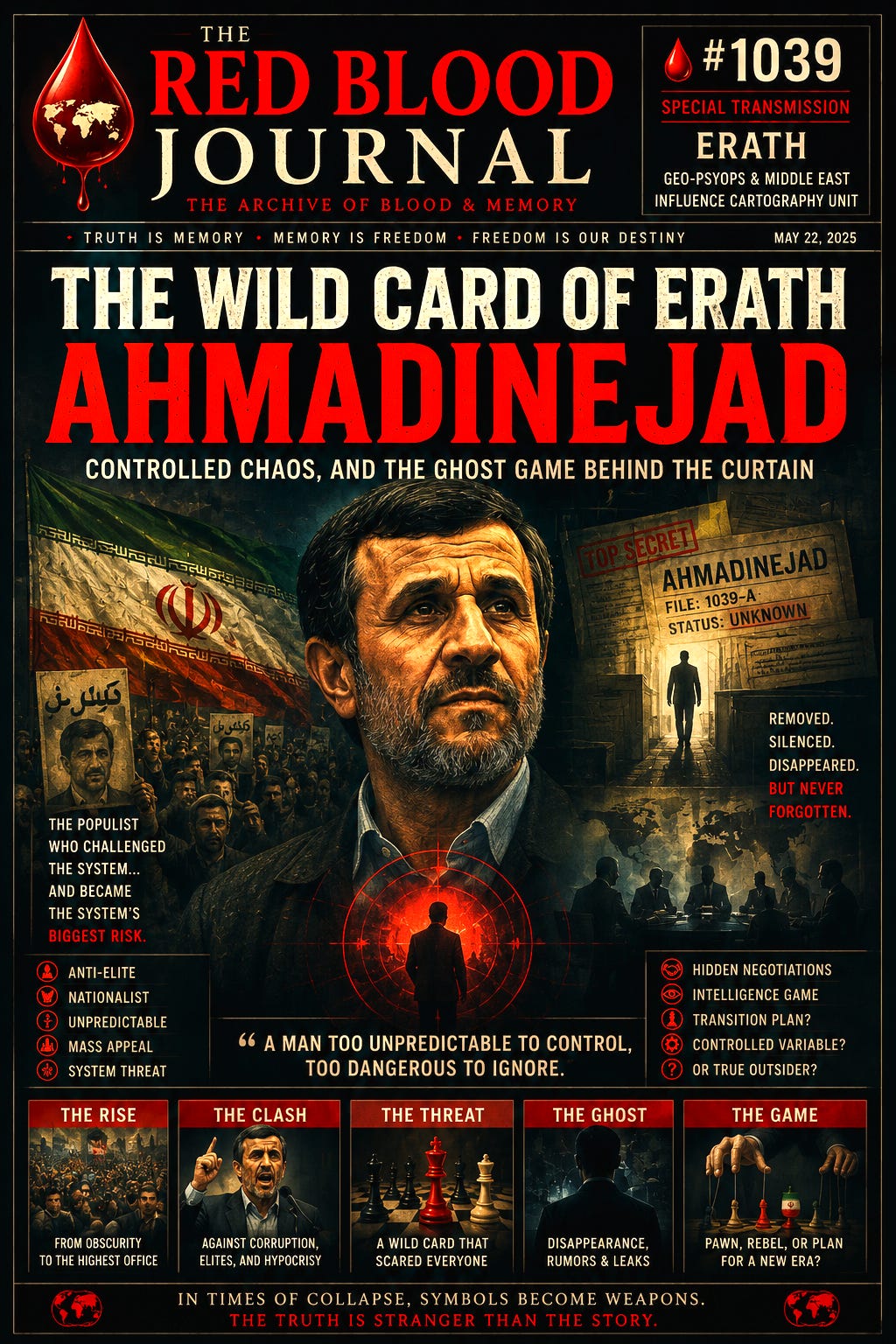
🩸 RED BLOOD JOURNAL TRANSMISSION #1039
THE WILD CARD OF ERATH
Ahmadinejad, Controlled Chaos, and the Ghost Game Behind the Curtain
Archive: The Archive of Blood & Memory
Division: Geo-PsyOps & Middle East Influence Cartography Unit
Classification: Fictional Political Allegory
Transmission Code: RBJ-1039-AHMADINEJAD-GHOSTGAME
Status: Active Transmission
Planetary Theater: Erath
PROLOGUE — THE MAN WHO NEVER FIT THE SCRIPT
On Planet Erath, most political figures belonged to predictable factions.
Some served ideology.
Some served economics.
Some served military power.
Some served global management systems.
But every once in a while, a figure appeared who confused every camp simultaneously.
A man too nationalist for the globalists.
Too unpredictable for the bureaucrats.
Too populist for the elites.
Too theatrical for the clerics.
Too independent for the system.
That figure on Erath became known as:
Mahmoud Ahmadinejad.
Years after disappearing from the center of power, his name suddenly returned to the center of whispers, leaks, rumors, intelligence speculation, and underground negotiations.
Not because he had regained power…
…but because someone somewhere still believed he could.
And that alone terrified everyone.
SECTION I — THE USEFUL FIREBRAND
When Ahmadinejad first emerged on Erath, many believed he was simply another loyal product of the system.
But over time something changed.
He stopped behaving like a controlled official.
He began acting like a political anomaly.
He attacked:
internal corruption
elite families
economic mafias
hidden networks
religious hypocrisy
political aristocracies
At first the system tolerated him because his populism energized the streets.
But eventually his unpredictability became dangerous.
Because centralized systems can tolerate radicals…
…but not uncontrollable radicals.
SECTION II — THE POPULIST PROBLEM
The ruling architecture of Erath feared one phenomenon more than opposition intellectuals:
Direct emotional connection with ordinary people.
Ahmadinejad spoke in the language of:
resentment
nationalism
anti-elite anger
forgotten classes
wounded pride
And that made him difficult to erase completely.
Even when removed from power…
he remained psychologically alive inside portions of the population.
That is why the elites of Erath never fully trusted him.
Not because he opposed the system entirely…
…but because he could redirect mass energy unpredictably.
SECTION III — THE GHOST OPERATION
Then came the whispers.
According to underground narratives circulating across Erath:
A hidden operation had allegedly been discussed during a moment of massive instability.
The objective:
replace collapsing authority with a controllable nationalist figure.
And suddenly Ahmadinejad’s name resurfaced.
Some claimed:
he was being repositioned
he was being protected
he was being negotiated with
he was considered useful for transition management
Others claimed:
he had been manipulated
he had been trapped
he had become part of a larger intelligence game
No one knew the full truth.
But one thing became obvious:
Powerful forces still considered him relevant.
And on Erath, relevance inside hidden rooms matters more than public appearances.
SECTION IV — WHY AHMADINEJAD TERRIFIED EVERY FACTION
The Clerics feared him
Because he bypassed religious hierarchy.
The technocrats feared him
Because he disrupted controlled governance.
The oligarchs feared him
Because populism threatens elite stability.
Foreign powers feared him
Because unpredictability destabilizes strategic planning.
Opposition groups feared him
Because he could hijack revolutionary momentum.
He became the political equivalent of a loose electrical wire inside the walls of Erath.
Dangerous not because of absolute power…
but because nobody fully controlled where the current would go next.
SECTION V — THE NATIONALISM VARIABLE
The greatest fear inside global management systems on Erath was never merely extremism.
It was independent nationalism outside managerial control.
Not nationalism as theater.
Not symbolic nationalism.
But emotional mass identity capable of reorganizing society independently of transnational systems.
Ahmadinejad represented a strange paradox:
anti-globalist rhetoric
anti-elite populism
nationalist emotional appeal
outsider image
insider history
A hybrid figure.
And hybrid figures are difficult to classify.
Which is precisely why they become useful during unstable transitions.
SECTION VI — THE DISAPPEARANCE
Then suddenly…
silence.
No appearances.
No speeches.
No certainty.
Only rumors:
hidden negotiations
internal conflict
protection
exile
betrayal
intelligence involvement
disappearance
And on Erath, disappearance itself becomes a form of mythology.
The less visible a figure becomes…
the more psychologically powerful the symbol can grow.
Especially during periods of civilizational uncertainty.
SECTION VII — THE BIGGER QUESTION
But perhaps the real question was never:
“What was Ahmadinejad doing?”
The real question was:
“Why did the system still need figures like him?”
The answer may reveal the deeper architecture of Erath itself.
Because systems under stress often search for:
controlled opposition
emotional stabilizers
nationalist actors
transitional personalities
psychological shock absorbers
And when legitimacy weakens…
the system begins recycling old symbols.
Not because the old symbols solved anything.
But because exhausted societies recognize familiar faces faster than unfamiliar futures.
ANNEX A — THE PSYCHOLOGY OF THE WILD CARD
Every civilization eventually produces a political archetype known as:
The Wild Card
A figure who:
emerges from within the system
attacks parts of the system
gains mass emotional energy
becomes too unpredictable to manage
cannot be fully embraced or fully eliminated
Such figures become mirrors.
People project onto them:
hope
anger
revenge
nationalism
rebellion
restoration
chaos
And thus the figure becomes larger than the individual himself.
He becomes symbolic infrastructure.
FINAL TRANSMISSION — THE MAN OR THE MIRROR?
Perhaps Ahmadinejad was never the true story.
Perhaps the true story was the condition of Erath itself.
A civilization so fractured, exhausted, manipulated, polarized, and psychologically destabilized…
that it constantly searched for strong symbolic figures to carry collective emotion.
In unstable eras, personalities become containers for civilizational anxiety.
And so the question remains unanswered:
Was Ahmadinejad:
a rebel?
a pawn?
a nationalist?
a controlled variable?
a temporary actor?
or simply another mask inside the theater of Erath?
Maybe all of them at once.
But beneath every political game, every intelligence operation, every factional war, and every collapsing structure…
the deeper mission still remains unchanged:
To remember that no ruler, faction, ideology, or system is greater than the inner awakening of the individual drop returning toward the Ocean of Love.
Because in the end…
every empire on Erath eventually fades.
But consciousness continues searching for truth beyond the theater.
🃏 The Wild Card of Erath:
The Ahmadinejad Anomaly
May 20, 2026
This allegorical narrative portrays a political figure named Ahmadinejad as a uniquely disruptive force on the fictional planet of Erath.
Unlike traditional leaders, he functions as a “wild card” whose unpredictable populism and anti-elite rhetoric threaten every established faction, from religious authorities to global technocrats.
The text suggests that even when removed from active power, such figures remain symbolically potent because they tap into the deep-seated resentment and nationalist identity of the masses.
Ultimately, the source examines whether this individual is a genuine rebel or merely a recycled tool used by a failing system to manage social instability.
It concludes that such leaders serve as psychological mirrors for a fractured society, reflecting the collective anxieties of a civilization in transition.
Through this lens, the story explores the complex intersection of mass emotion, intelligence maneuvers, and political theater.


