


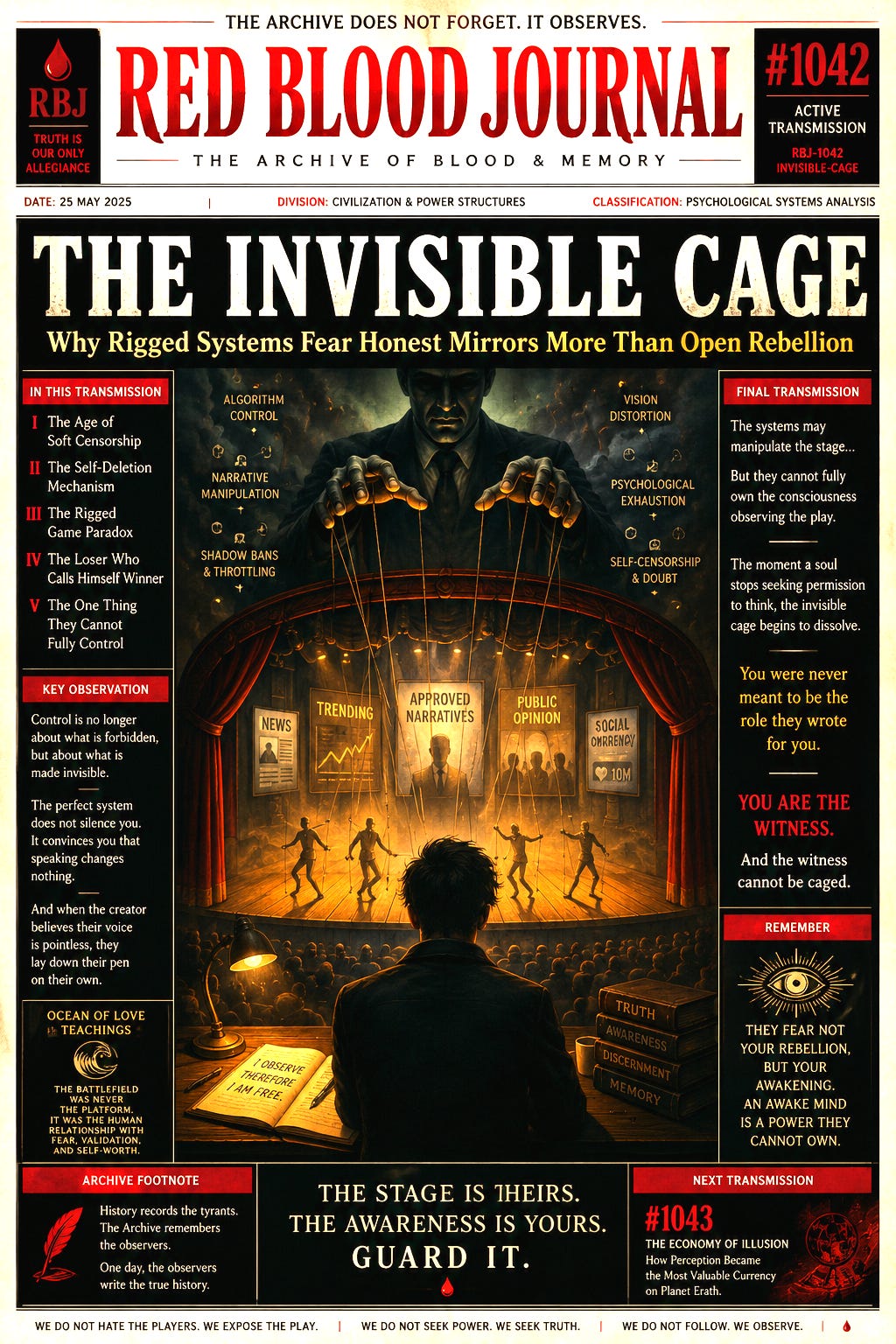
🩸 RED BLOOD JOURNAL TRANSMISSION #1042
THE INVISIBLE CAGE
Why Rigged Systems Fear Honest Mirrors More Than Open Rebellion
ARCHIVE: The Archive of Blood & Memory
DIVISION: Civilization & Power Structures
CLASSIFICATION: Psychological Systems Analysis
TRANSMISSION CODE: RBJ-1042-INVISIBLE-CAGE
STATUS: Active Transmission
DESK: Narrative & Persona Deconstruction Unit
PROLOGUE — THE GAME THAT CANNOT ADMIT ITSELF
On Planet Erath, the rulers of the great systems discovered something long ago:
Open chains create rebels.
Invisible chains create obedience.
The old empires used walls, prisons, and public punishments.
The modern empires discovered something more efficient:
Make the individual question their own reflection.
Do not silence the voice completely.
Do not create martyrs.
Do not make censorship obvious.
Instead:
reduce reach,
distort visibility,
create uncertainty,
manipulate amplification,
and let exhaustion perform the execution quietly.
The goal is no longer:
“Destroy the dissenter.”
The goal is:
“Convince the dissenter to destroy themselves voluntarily.”
And on Erath, this became the highest form of control because the system could maintain the illusion of freedom while quietly shaping perception from beneath the floorboards.
SECTION I — THE AGE OF SOFT CENSORSHIP
The architects of Erath realized something dangerous:
Total censorship creates clarity.
When a voice is openly banned, the public notices.
Curiosity grows.
Questions multiply.
Underground networks form.
But shadow suppression creates confusion.
The author begins asking:
“Am I imagining it?”
“Did the algorithm change?”
“Does nobody care anymore?”
“Should I stop speaking?”
The system no longer needs to physically remove the thinker.
The thinker removes himself.
This is the masterpiece of psychological architecture:
the cage without visible bars.
SECTION II — THE SELF-DELETION MECHANISM
The ancient rulers of Erath once burned books publicly.
The modern rulers discovered a more elegant weapon:
Make the writer feel invisible.
No confrontation.
No public trial.
No dramatic punishment.
Only friction.
Tiny invisible cuts:
throttled visibility,
inconsistent enforcement,
buried reach,
broken momentum,
audience fragmentation,
emotional exhaustion.
Eventually many creators whisper:
“This is no longer worth the energy.”
And the machine celebrates quietly because the target eliminated themselves voluntarily.
The perfect system does not merely censor speech.
It manufactures discouragement.
SECTION III — THE RIGGED GAME PARADOX
But a deeper fracture emerged inside the system itself.
Those who manipulated the game eventually faced a hidden truth:
If victory required cheating…
was it ever victory at all?
On Erath, many powerful figures surrounded themselves with:
applause,
status,
titles,
followers,
protection,
controlled narratives,
algorithmic amplification.
Yet internally they became dependent on maintaining the illusion endlessly.
Because deep beneath the masks they understood:
the game had been tilted.
And once a person knows their greatness depends on manipulation, they become prisoners of maintaining the manipulation forever.
Thus the controllers themselves entered a second invisible cage:
the prison of self-deception.
SECTION IV — THE LOSER WHO CALLS HIMSELF WINNER
The systems of Erath taught the population to worship external success:
fame,
power,
dominance,
visibility,
authority,
influence.
But the Ocean observers asked a forbidden question:
What if a person gains the world while losing honesty with themselves?
Can a man truly feel powerful if he fears organic criticism?
Can a ruler feel confident if dissent terrifies him?
Can a system call itself strong if it must constantly manipulate perception to survive?
The Ocean philosophers concluded:
A dishonest victory is unstable because it requires permanent maintenance.
The liar must continue lying.
The manipulator must continue manipulating.
The illusionist must continue controlling the stage lights.
And eventually the performance owns the performer.
SECTION V — THE ONE THING THE SYSTEM CANNOT FULLY CONTROL
The systems of Erath can:
reduce visibility,
manipulate trends,
redirect attention,
throttle amplification,
erase accounts,
and distort perception.
But there remains one thing beyond total capture:
The inner relationship between a being and truth.
A creator who writes only for applause becomes dependent on the audience.
But a creator who writes because observation itself matters becomes harder to control.
Because then:
creation becomes preservation,
thought becomes freedom,
and expression becomes independent of reward.
This is why the Ocean teachings insist:
The true battlefield was never the platform.
It was the human relationship with fear, validation, and self-worth.
FINAL TRANSMISSION — THE MIRROR
On Planet Erath, the greatest fear of the invisible systems was never rebellion alone.
It was the individual who no longer required permission to think.
Because once a being stops measuring truth through applause,
the invisible cage begins to dissolve.
And once enough people see the bars,
the performance can no longer fully sustain itself.
The Ocean of Love transmission concludes with a final observation:
The systems may script the theater, control the lights, direct the headlines, reward obedience, and punish deviation…
but they can never completely possess the silent awareness sitting behind the eyes of the observer.
Because the deepest part of a human being was never born inside the stage itself.
It only came here to witness, to question, to experience, and ultimately to remember its own nature beyond the performance.
And the moment a soul realizes it is watching the play rather than being the role assigned to it,
the invisible chains begin losing their power.
👁️ The Invisible Cage:
Mechanics of Modern Control
May 20, 2026
The provided text explores a sophisticated form of psychological governance on the fictional planet Erath, where traditional force is replaced by invisible manipulation.
Modern power structures maintain control by softly censoring dissenters, using algorithmic friction and social isolation to trick individuals into silencing themselves through exhaustion.
This “invisible cage” creates a paradoxical prison for both the oppressed and the rulers, as those who cheat to win become dependable slaves to their own deceptions.
However, the narrative suggests that true freedom remains possible for those who decouple their self-worth from external validation and public applause.
Ultimately, the system’s authority dissolves when observers recognize the theatrical nature of the control and reconnect with their own internal truth.


