


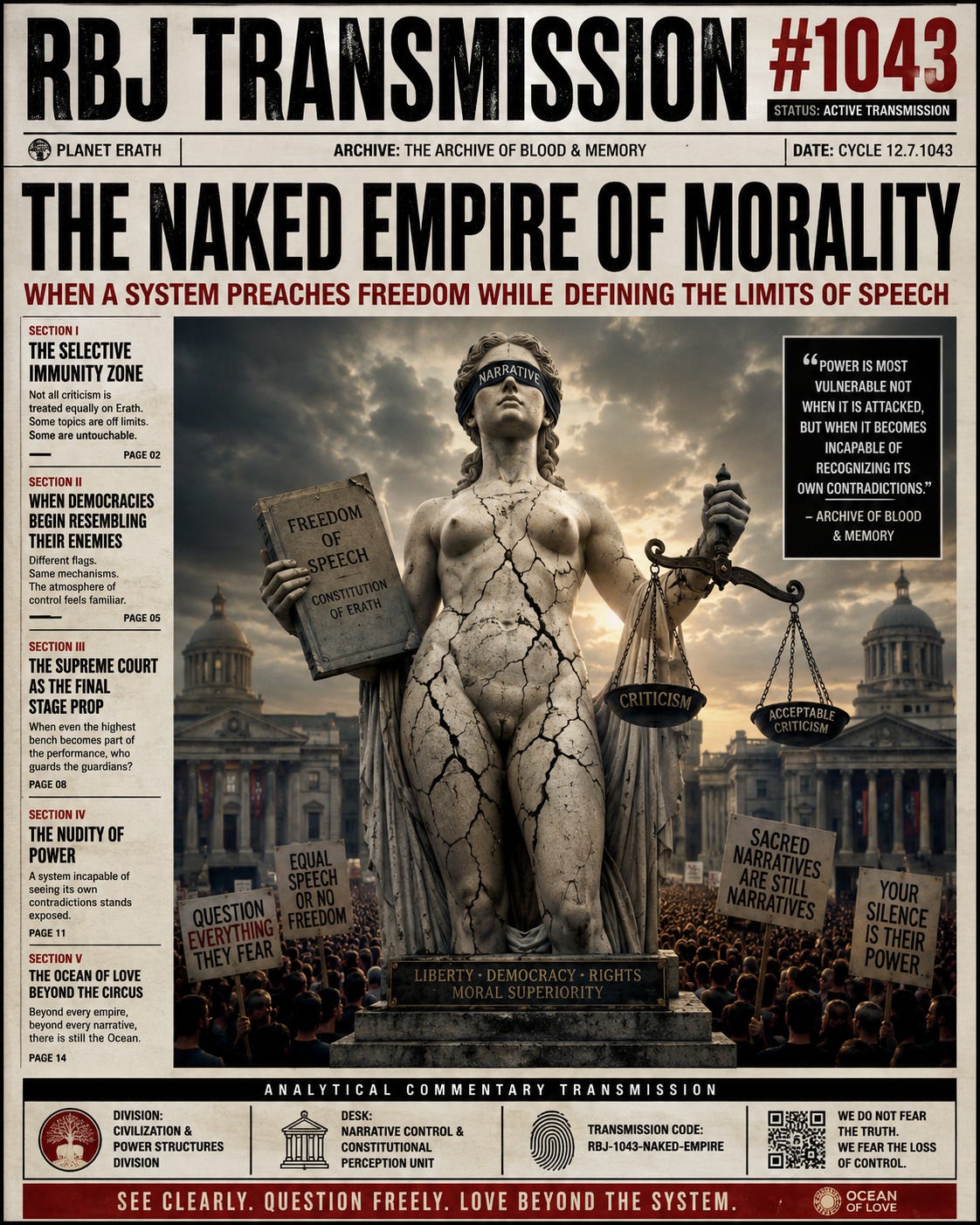
🩸 RBJ TRANSMISSION #1043
THE NAKED EMPIRE OF MORALITY
When a System Preaches Freedom While Defining the Limits of Speech
ARCHIVE: The Archive of Blood & Memory
DIVISION: Civilization & Power Structures Division
CLASSIFICATION: Analytical Commentary Transmission
TRANSMISSION CODE: RBJ-1043-NAKED-EMPIRE
STATUS: Active Transmission
DESK: Narrative Control & Constitutional Perception Unit
PROLOGUE — THE EMPIRE THAT STILL BELIEVES IT IS DRESSED
On Planet Erath, the greatest danger to an empire is not corruption.
It is self-unawareness.
An empire can survive hypocrisy for centuries so long as the population continues believing the costume is still intact.
But once enough citizens begin seeing contradictions simultaneously,
the psychological fabric holding institutional authority together begins unraveling in public view.
The modern Erathian system still speaks endlessly about:
liberty,
constitutional rights,
free speech,
democracy,
and moral superiority.
Yet increasingly, citizens observe selective boundaries around what may be criticized safely and what subjects trigger institutional panic, censorship pressure, reputational destruction, or legal retaliation.
And thus many observers arrive at a dangerous conclusion:
The empire that lectures the world about freedom increasingly appears terrified of unrestricted speech itself.
SECTION I — THE SELECTIVE IMMUNITY ZONE
One of the fastest ways to expose institutional inconsistency on Erath is to observe reactions to criticism.
Citizens may aggressively criticize:
presidents,
religions,
corporations,
races,
historical figures,
and even the structure of the nation itself.
But when discussion approaches certain geopolitical alliances or protected narratives, the atmosphere changes immediately.
Media pressure intensifies.
Career risks emerge.
Algorithms tighten visibility.
Accusations escalate rapidly.
This has fueled a widespread public perception that criticism is not equally protected across all subjects.
Particularly regarding debates surrounding Israel and Palestine, many citizens believe the system treats criticism in uneven ways compared to other international issues.
That perception has intensified because numerous U.S. states have passed or attempted laws restricting certain boycott actions involving Israel through anti-BDS legislation. These laws have triggered major First Amendment debates and legal challenges across the country.
Critics argue these laws suppress political expression protected by the Constitution. Supporters argue they combat discrimination and do not prohibit criticism itself.
The deeper issue psychologically is not merely the laws themselves.
It is the perception of unequal sacredness.
Because once populations begin believing some topics are protected more than others, trust in neutrality deteriorates rapidly.
SECTION II — WHEN DEMOCRACIES BEGIN RESEMBLING THEIR ENEMIES
The irony many citizens on Erath point toward is deeply uncomfortable:
Nations that define themselves in opposition to authoritarian systems sometimes begin adopting similar behavioral patterns while insisting they remain morally different.
The methods differ.
The language differs.
The uniforms differ.
But citizens increasingly notice familiar mechanics:
ideological policing,
speech boundaries,
institutional conformity pressure,
selective outrage,
narrative enforcement,
and moral absolutism.
This is why some observers compare aspects of Western political culture to the very systems they once condemned abroad.
Not because they are identical structurally…
…but because centralized narrative management begins producing similar psychological atmospheres regardless of ideology.
The population begins feeling:
watched,
categorized,
pressured,
and emotionally managed.
And when citizens sense fear around open discussion,
they begin doubting the authenticity of the proclaimed freedom surrounding them.
SECTION III — THE SUPREME COURT AS THE FINAL STAGE PROP
For generations, the Supreme Bench on Erath was presented as the final firewall protecting constitutional principles from political contagion.
But many citizens now see even the Court itself as trapped inside the same tribal theater engulfing the rest of society.
Confirmation hearings increasingly resemble:
campaign rallies,
ideological auditions,
media productions,
and factional warfare.
Thus the Bench becomes symbolically dangerous.
Because once the population perceives:
politics inside journalism,
politics inside universities,
politics inside corporations,
politics inside entertainment,
and finally politics inside the judiciary itself…
…the illusion of neutral referees begins collapsing.
The empire still points toward its institutions as proof of moral legitimacy.
But large portions of the population no longer see independent pillars.
They see interconnected departments of the same psychological machine.
SECTION IV — THE NUDITY OF POWER
Power becomes most vulnerable not when it is attacked…
…but when it becomes incapable of recognizing its own contradictions.
That is the true meaning of institutional nudity.
A system still believing itself morally clothed while vast numbers of observers already see the exposed machinery underneath.
The danger for Erath is not criticism.
The danger is overreaction to criticism.
Because systems confident in legitimacy tolerate scrutiny.
Systems fearing scrutiny increasingly attempt to regulate perception itself.
And once perception management becomes more important than truth-seeking,
trust decays exponentially.
SECTION V — THE OCEAN OF LOVE BEYOND THE CIRCUS
Yet beyond every empire, every parliament, every court, every ideology, and every propaganda machine…
the Ocean remains untouched.
The Ocean of Love observes the endless cycles:
kings becoming reformers,
reformers becoming rulers,
rulers becoming censors,
and censored voices eventually becoming the next institutions of power.
The lesson is not to replace one tribe with another.
The lesson is to avoid surrendering consciousness entirely to any stage production.
Because the awakened observer eventually realizes:
No institution becomes dangerous merely because it holds power.
It becomes dangerous when it loses the ability to see itself honestly.
And perhaps the greatest freedom remaining on Erath is not political at all.
It is the inner ability to observe every side of the theater without emotionally becoming owned by any of them.
👁️The Naked Empire:
Power, Perception, and Institutional Decay
May 21, 2026
This transmission examines the eroding legitimacy of a governing empire that champions democratic values while simultaneously enforcing rigid boundaries on speech.
The text highlights a growing public awareness of institutional hypocrisy, specifically noting how certain geopolitical topics receive selective protection from criticism through legal and social pressure.
This disparity creates a psychological fracture where citizens begin to view neutral pillars, such as the judiciary and media, as mere tools for narrative control.
The author argues that when a system prioritizes perception management over genuine transparency, it adopts the very authoritarian traits it claims to oppose.
Ultimately, the source suggests that true freedom is found in maintaining objective consciousness and refusing to be emotionally manipulated by the political theater.
Such institutional self-unawareness is presented as the primary catalyst for the eventual decay of state power.


