


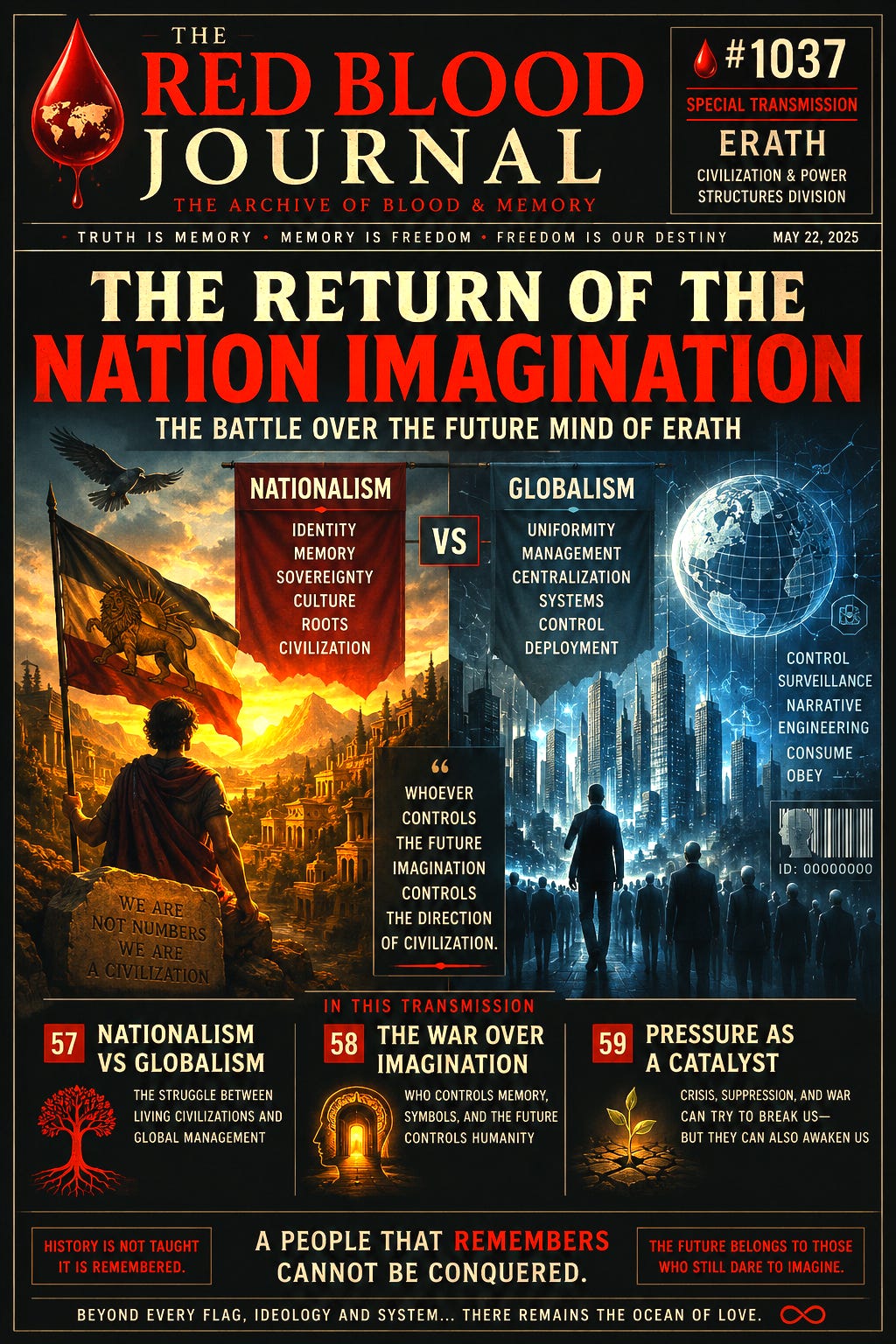
🩸 RED BLOOD JOURNAL TRANSMISSION #1037
THE RETURN OF THE NATION IMAGINATION
Nationalism vs Globalism — The Battle Over the Future Mind of Erath
Archive: The Archive of Blood & Memory
Division: Civilization & Power Structures Division
Classification: Fictional Geopolitical Allegory
Transmission Code: RBJ-1037-ERATH-NATION-IMAGINATION
Status: Active Transmission
Planetary Theater: Erath
PROLOGUE — THE WAR WAS NEVER ONLY ABOUT LAND
On Planet Erath, many believed wars were fought for oil, borders, religion, missiles, resources, pipelines, elections, or revenge.
But underneath every visible conflict existed a deeper invisible war:
Who gets to imagine the future?
Because whoever controls the future imagination controls the direction of civilization itself.
Empires understood this thousands of years ago.
A population that can still imagine itself independent, sovereign, cultural, rooted, and self-directed is dangerous to centralized systems.
But a population disconnected from identity, history, memory, and collective purpose becomes easier to merge into larger managerial structures.
And so on Erath, the struggle became larger than governments.
It became:
Nation vs system
Identity vs administration
Memory vs engineered reality
Civilization vs management
SECTION I — NATIONALISM VS GLOBALISM
The conflict on Erath was never truly “left vs right.”
That was theater for mass consumption.
The real divide became:
LOCAL CIVILIZATION
vs
GLOBAL MANAGEMENT
One side believed nations were living civilizations:
cultures
memories
languages
ancestors
symbols
collective identity
emotional continuity
The other side viewed nations as outdated obstacles preventing efficient global coordination.
To the managerial class of Erath:
borders slowed integration
nationalism complicated economic harmonization
cultural identity disrupted centralized narratives
sovereignty weakened global enforcement systems
And therefore nationalism itself slowly became reframed as:
dangerous
extremist
irrational
emotional
primitive
Not because nationalism was always virtuous…
…but because emotionally rooted populations are difficult to fully centralize.
SECTION II — THE WAR OVER IMAGINATION
Empires do not only conquer territory.
They conquer imagination.
The most important battlefield on Erath became psychological:
Can the population still imagine a future outside the approved system?
If yes:
the system weakens
alternative futures emerge
historical memory returns
sovereignty movements rise
decentralized identity reappears
If no:
dependency becomes permanent
administration replaces civilization
populations become programmable
emotional exhaustion replaces resistance
This is why symbols mattered so much on Erath:
flags
historical figures
dynasties
national myths
ancient emblems
memory itself
Because symbols activate civilizational memory.
And civilizational memory threatens centralized power.
SECTION III — PRESSURE AS A CATALYST
The rulers of Erath discovered something unexpected:
Pressure can control populations…
…but too much pressure can awaken them.
Economic hardship.
War.
Inflation.
Censorship.
Isolation.
Political instability.
Initially these conditions weakened society.
But eventually another phenomenon emerged:
People began asking deeper questions.
Not merely:
“Who should rule?”
But:
“What is the system itself?”
“Why are all nations becoming psychologically identical?”
“Why does every crisis produce more centralization?”
“Why does every emergency reduce autonomy?”
“Who benefits from permanent instability?”
And once populations begin asking structural questions…
the theater starts breaking.
SECTION IV — THE RETURN OF HISTORICAL MEMORY
One of the greatest fears of centralized systems on Erath was not military revolt.
It was memory.
Because memory reconnects people to:
continuity
identity
confidence
civilizational direction
A people without memory can be redesigned endlessly.
But a people rediscovering memory become difficult to psychologically colonize.
This is why on Erath:
historical symbols resurfaced
forgotten flags returned
old narratives re-emerged
ancestral identity regained emotional power
The conflict was no longer about nostalgia.
It became a battle over:
who defines the next civilization.
SECTION V — THE IMPLOSION THEORY
Observers on Erath described two kinds of collapse:
EXPLOSION
External pressure:
war
sanctions
military conflict
physical destruction
IMPLOSION
Internal collapse:
loss of legitimacy
loss of belief
loss of meaning
collapse of future imagination
And the second was always more dangerous.
Because systems can survive enemies.
But they cannot survive populations that no longer emotionally believe in them.
The final stage begins when society collectively imagines:
“The future exists beyond the current structure.”
At that moment…
the psychological foundation starts evaporating.
Not instantly.
Not dramatically.
But gradually.
Like fog disappearing under sunlight.
ANNEX A — THE GLOBAL PARADOX
The more centralized Planet Erath became…
…the more populations searched for meaning.
And this produced the great paradox:
The harder systems pushed toward total integration,
the stronger identity movements became.
Pressure created awakening.
Suppression created curiosity.
Uniformity created hunger for roots.
The attempt to erase civilizational uniqueness accidentally revived it.
FINAL TRANSMISSION — THE FUTURE BELONGS TO THOSE WHO CAN STILL IMAGINE
The ultimate battle on Erath was never merely political.
It was spiritual and psychological.
The side that controls imagination controls destiny.
But the side that remembers its inner identity cannot be fully conquered.
Because civilizations do not die only from invasion.
They die when populations forget who they are.
And perhaps the greatest fear of every centralized system is this:
A population that rediscovers both:
collective memory
and inner meaning
becomes impossible to fully program.
The future of Erath may not belong to the strongest empire.
It may belong to the civilization that still remembers itself.
And beyond every flag, ideology, government, or system…
there remains the deeper ocean:
The Ocean of Love.
The unseen field connecting all drops beyond fear, beyond manipulation, beyond manufactured division.
Because even in the darkest age of Erath…
the drop was never separate from the ocean.
👁️ The Battle for the Future Mind of Erath
May 20, 2026
This allegorical text explores a profound geopolitical and psychological struggle on the fictional planet of Erath between centralized global management and sovereign national identity.
The narrative argues that true power lies in controlling the collective imagination, as administrative systems seek to erase historical memory to make populations easier to govern.
While these global structures prioritize efficiency and integration, they inadvertently trigger a civilizational awakening by placing too much pressure on the human need for roots and meaning.
Ultimately, the source suggests that historical memory and cultural identity act as shields against psychological colonization, preventing total systemic control.
The conflict concludes with the idea that a society’s survival depends on its ability to remember its unique essence rather than submitting to a sterilized, programmed future.
Thus, the text frames the battle for sovereignty not as a physical war over resources, but as a spiritual reclamation of the mind.


