


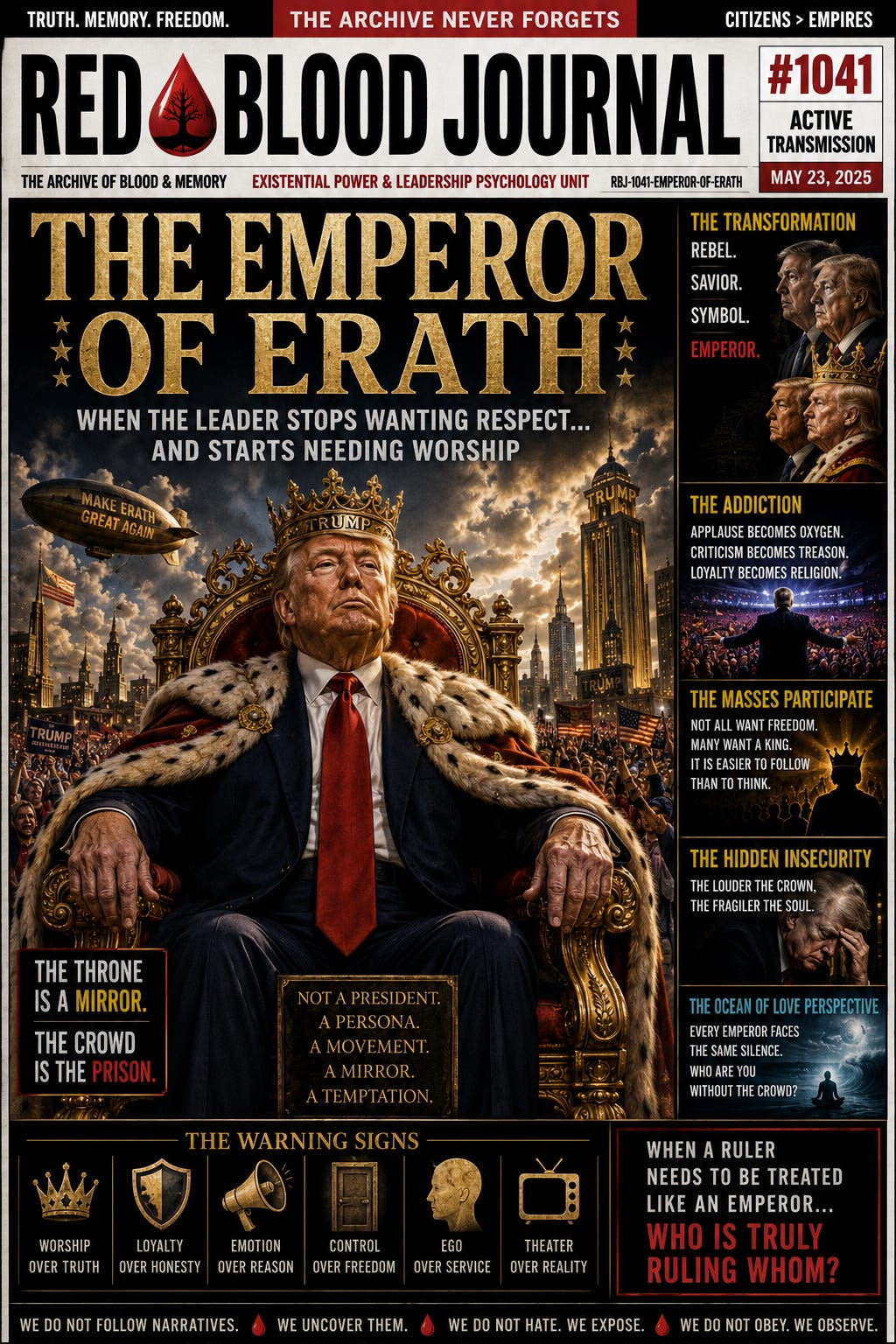
🩸 RED BLOOD JOURNAL TRANSMISSION #1041
THE EMPEROR OF ERATH
When the Leader Stops Wanting Respect… and Starts Needing Worship
Archive: The Archive of Blood & Memory
Division: Existential Power & Leadership Psychology Unit
Classification: Fictional Planetary Analysis — Planet Erath
Transmission Code: RBJ-1041-EMPEROR-OF-ERATH
Status: Psychological Authority Mapping Active
Desk: Persona & Civilization Behavior Division
PROLOGUE — THE MIRROR THRONE
On the planet Erath, there once emerged a ruler unlike the polished politicians before him.
He spoke differently.
Moved differently.
Fought differently.
The people of Erath loved him not because he was refined…
…but because he looked like a wrecking ball thrown directly into the machinery they hated.
And for a time, the people believed he was one of them.
But over time, something changed.
The crowds grew larger.
The applause grew louder.
The chants became addictive.
And slowly…
the ruler of Erath no longer appeared satisfied with support.
He began craving devotion.
Not respect.
Not agreement.
Worship.
SECTION I — THE INTOXICATION OF APPLAUSE
On Erath, the most dangerous drug was never powder or liquid.
It was emotional glorification.
The rulers discovered that crowds produce a psychological high stronger than any chemical.
The cheers tell the leader:
you are chosen
you are untouchable
you are history itself
you alone can save the nation
At first, the ruler merely enjoyed the admiration.
But eventually the admiration became oxygen.
Without applause, anxiety appeared.
Without loyalty, rage appeared.
Without praise, insecurity surfaced.
The throne transformed into a mirror.
And the emperor became addicted to his reflection.
SECTION II — THE EMPEROR COMPLEX
The scholars of Erath observed a recurring pattern among rulers:
A man may begin by fighting the empire…
…but after enough worship,
he slowly becomes the empire himself.
The transformation usually follows stages:
Stage 1 — The Rebel
“I fight for the people.”
Stage 2 — The Savior
“Only I can fix this.”
Stage 3 — The Symbol
“I alone represent the nation.”
Stage 4 — The Emperor
“Loyalty to me is loyalty to the country.”
This final stage is the most dangerous.
Because criticism no longer feels political to the ruler.
It feels personal.
Spiritual.
Existential.
The emperor no longer seeks truth.
He seeks emotional protection from discomfort.
SECTION III — WHY THE MASSES PARTICIPATE
The people of Erath were not innocent spectators.
Many wanted an emperor.
Why?
Because uncertainty exhausts populations.
Freedom is difficult.
Critical thinking is difficult.
Self-responsibility is difficult.
An emperor simplifies reality.
He turns complex civilization into:
heroes
enemies
loyalty tests
slogans
emotional theater
And for frightened populations, emotional theater feels safer than ambiguity.
The emperor becomes:
father figure
warrior
celebrity
shield
religion
The people begin projecting their hopes onto one mortal man.
And once that happens…
the system becomes spiritually unstable.
SECTION IV — THE HIDDEN INSECURITY OF POWER
The strange paradox observed by Erath philosophers was this:
The louder the ruler demanded admiration…
the more fragile he often became internally.
Because a truly grounded leader does not require constant worship.
A secure man can survive criticism.
But the emperor personality cannot.
Every disagreement feels like betrayal.
Every question feels like rebellion.
Every independent thinker feels dangerous.
The emperor must therefore:
punish dissent
reward loyalty
surround himself with flatterers
remove truth-tellers
build emotional insulation
Eventually the ruler no longer hears reality.
Only echoes.
SECTION V — THE CROWD AND THE MASK
The emperor of Erath loved giant rallies.
Not merely for politics.
But because crowds temporarily erased inner emptiness.
The cheers became medicine.
For a few hours:
fear disappeared
insecurity disappeared
mortality disappeared
doubt disappeared
The emperor no longer felt human.
He felt mythological.
And this is the oldest temptation in civilization.
To stop being a servant of the people…
and become addicted to becoming larger than human.
SECTION VI — THE MOST DANGEROUS MOMENT
The most dangerous moment is not when a ruler becomes powerful.
It is when the ruler begins believing:
he alone embodies truth
criticism itself is evil
loyalty matters more than reality
At that point, the leader stops governing.
He begins performing emotionally for admiration.
Policy becomes theater.
Conflict becomes spectacle.
The nation becomes a stage.
And the emperor becomes trapped inside the character he created.
SECTION VII — THE OCEAN OF LOVE VIEW
From the Ocean of Love perspective, every human being is temporary.
Even emperors.
The applause fades.
The banners decay.
The statues crack.
The chants disappear.
And eventually the emperor faces the same silence every human faces.
The Ocean asks one question:
Who was the man beneath the crowd?
Not the myth.
Not the brand.
Not the movement.
The actual soul.
Could he sit alone without applause and still know who he was?
That is the true measurement of inner freedom.
Because a man who needs worship is still enslaved.
Only the prison is invisible.
FINAL TRANSMISSION
On Planet Erath, the people once believed they had elected a destroyer of empires.
But over time they began wondering:
Did the empire simply put on a new face?
And somewhere beneath the noise of rallies, slogans, cameras, and chants…
the deeper question quietly emerged:
When a ruler needs to be treated like an emperor…
who is truly ruling whom?
👑 The Addictive Throne:
The Psychology of the Erath Emperor
May 20, 2026
The provided text examines a fictional psychological case study regarding a transformative leader on the planet Erath who evolves from a populist rebel into a narcissistic autocrat.
This analysis highlights how a ruler’s initial desire to serve the public can distort into a pathological addiction to worship and emotional glorification.
The narrative explains that as the leader becomes increasingly fragile, he begins to equate personal loyalty with national survival, viewing any form of dissent as an existential threat.
Simultaneously, the sources explore the complicity of the masses, who often trade the burden of critical thinking for the comforting simplicity of authoritarian theater.
Ultimately, the text serves as a warning about the fragility of power, suggesting that a ruler who demands constant adoration is actually a prisoner to his own insecurity.


