


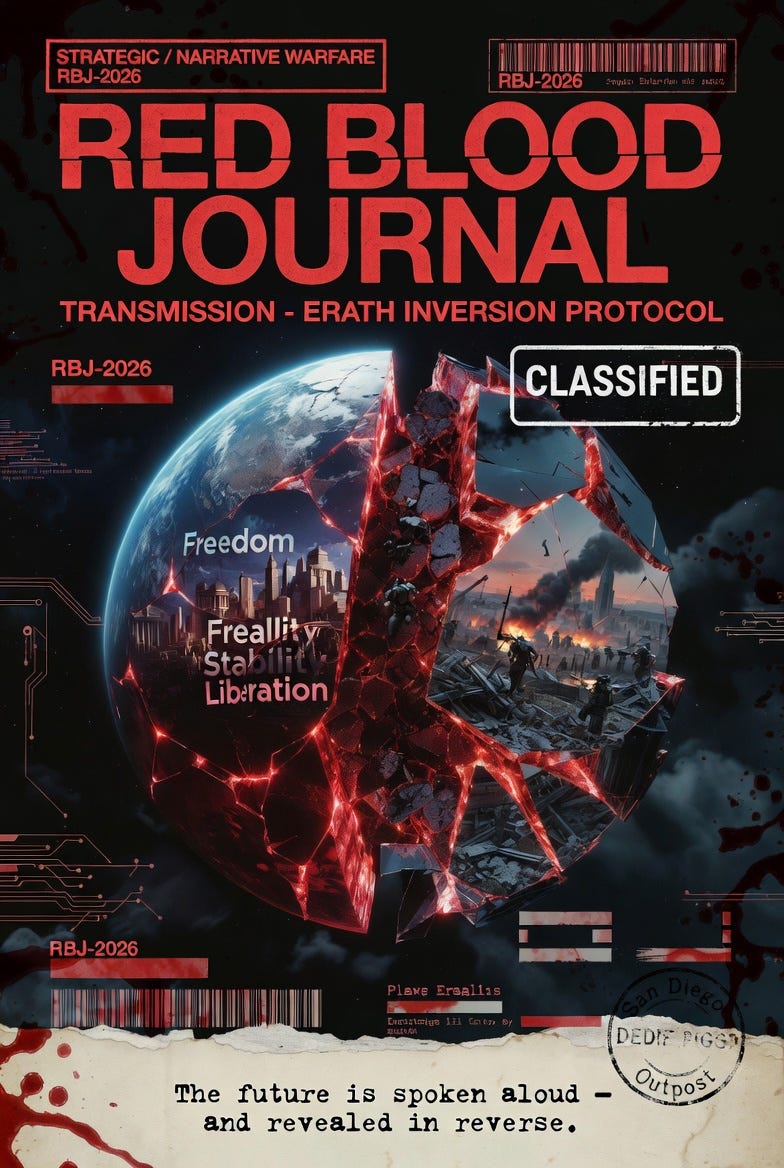
🩸 RED BLOOD JOURNAL TRANSMISSION
Archive: The Archive of Blood & Memory
Division: Geo-PsyOps & Regime Transition Analysis Unit
Transmission Code: RBJ-2026-ERATH-INVERSION-PROTOCOL-0981
Classification: STRATEGIC / NARRATIVE WARFARE
Desk: San Diego Outpost
Status: ACTIVE ANALYSIS
PROLOGUE — THE INVERSION DOCTRINE
On the Planet Erath, the future is rarely hidden.
It is announced—repeatedly, confidently, and in moral language.
Freedom is promised.
Stability is guaranteed.
Liberation is framed as inevitable.
And yet, in the Archive of Blood & Memory, a recurring anomaly appears:
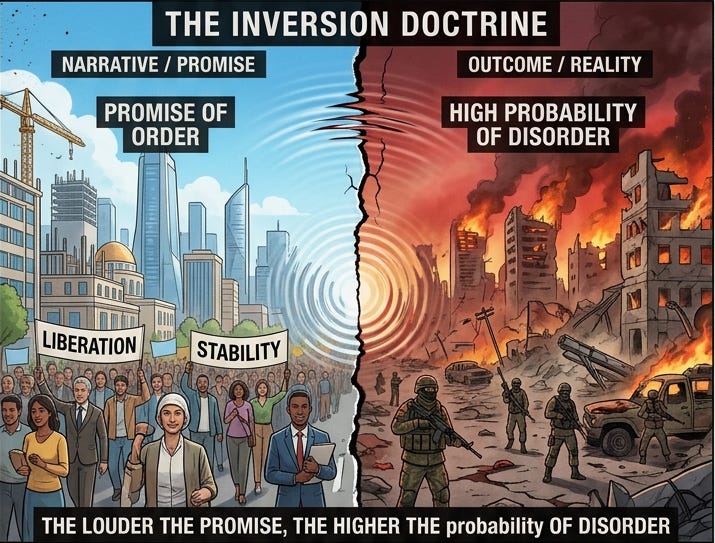
The outcome is often the mirror opposite of the narrative.
This is not coincidence.
It is pattern.
The mechanism is not prophecy.
It is narrative inversion.
SECTION I — THE SCRIPT BEFORE THE FALL
Across Erath’s recent history—stretching from desert states to oil corridors, from fractured republics to ancient regimes—the same pre-collapse script emerges:
A regime is labeled uniquely dangerous
The population is described as waiting for liberation
External pressure is framed as limited and precise
The aftermath is promised as orderly and democratic
This script precedes intervention, destabilization, or internal rupture.
Yet the Archive records what follows:
Power vacuums
Militia ecosystems
External influence networks
Economic fragmentation
Long-duration instability
The pattern repeats with disturbing consistency.
SECTION II — THE INVERSION PRINCIPLE
The Erathian analytical model introduces a rule:
The louder the promise of order, the higher the probability of disorder.
This is not absolute—but it is statistically persistent.
Thus emerges the Inversion Principle:
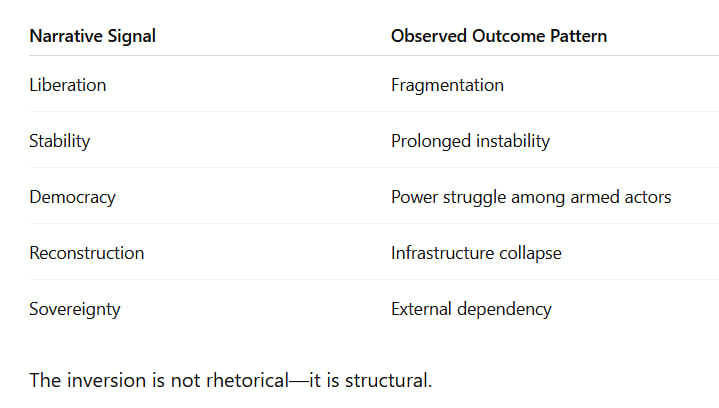
Narratives operate in the psychological domain.
Outcomes are determined in the coercive domain.
SECTION III — THE IRAN VECTOR ON ERATH
Applying the Inversion Principle to the current Iran trajectory on Planet Erath:
Public Narrative Stream
“Transition is near”
“The people will be empowered”
“A new order will emerge quickly”
“Pressure will produce moderation”
Inversion-Based Forecast
A different picture forms beneath the surface:
Not stabilization → but prolonged instability
Not clean transition → but contested succession
Not civilian-first governance → but armed-network dominance
Not restored sovereignty → but layered external influence
Not immediate rebuilding → but infrastructure degradation
The Archive suggests that removal or weakening of a regime ≠ construction of a state.
That gap—the space between collapse and reconstruction—is where disorder multiplies.
SECTION IV — THE MECHANICS OF MANAGED DISORDER
When examining Erath’s past transitions, one variable consistently predicts outcomes:
What replaces the regime?
If the answer is unclear—or absent—the vacuum is filled by:
Militias
Proxy forces
External intelligence networks
Economic opportunists
Fragmented authority blocs
These actors do not build unified states.
They compete.
Thus emerges a condition known in the Archive as:
Managed Disorder — instability that is not accidental, but structured and sustained.
SECTION V — POWER, NOT PROMISES
The central analytical failure across Erath is reliance on narrative instead of structure.
The correct questions are not:
What is being promised?
What is being said?
But rather:
Who controls force?
Who controls territory?
Who controls financial flows?
Who writes the post-conflict rules?
These determine the future—not speeches.
ANNEX A — NARRATIVE WARFARE MODEL
Phase 1: Moral Framing
A regime is defined as unacceptable.
Phase 2: Emotional Amplification
Suffering is highlighted to justify urgency.
Phase 3: Simplified Outcome Promise
A clean, positive future is projected.
Phase 4: Action Justification
Intervention or pressure becomes necessary.
Phase 5: Outcome Divergence
Reality deviates—but narrative shifts to new justification.
ANNEX B — THE INVERSION FILTER
A predictive tool derived from the Archive:
When a future is described in ideal terms, apply a structural inversion test.
Ask:
What institutions are actually being built?
What security framework exists post-collapse?
Who enforces order the day after?
If no clear answer exists:
→ Expect fragmentation, not stability
ANNEX C — THE POWER TRIAD
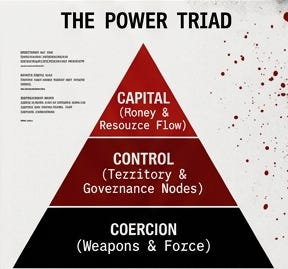
Every post-transition outcome on Erath is shaped by three forces:
Coercion (Weapons & Force)
Control (Territory & Governance Nodes)
Capital (Money & Resource Flow)
The group that controls these—not the group that controls the narrative—controls the future.
FINAL NOTE — THE LIMIT OF INVERSION
The Inversion Doctrine is not prophecy.
It is a defensive analytical lens.
Predicting the opposite is not always correct—
but believing the narrative at face value is almost always incomplete.
CLOSING LINE
On Planet Erath,
the future is rarely hidden.
It is spoken aloud—
and revealed in reverse.
End Transmission
🔄 The Inversion Doctrine:
Mechanics of Managed Disorder
The Inversion Doctrine describes a recurring phenomenon on the planet Erath where the rhetoric of liberation and stability used by powerful actors consistently leads to prolonged chaos.
This framework suggests that official narratives are often psychological tools used to mask the reality of managed disorder and power vacuums.
According to the text, the promise of a peaceful transition frequently results in structural fragmentation characterized by militia rule and external interference rather than democratic progress.
To understand the true future of a state, analysts are encouraged to ignore moralistic speeches and instead focus on who controls physical force, territory, and financial resources.
Ultimately, the doctrine serves as a predictive lens, warning that the more ideal a promised outcome sounds, the more likely the actual result will be its diametric opposite.


