


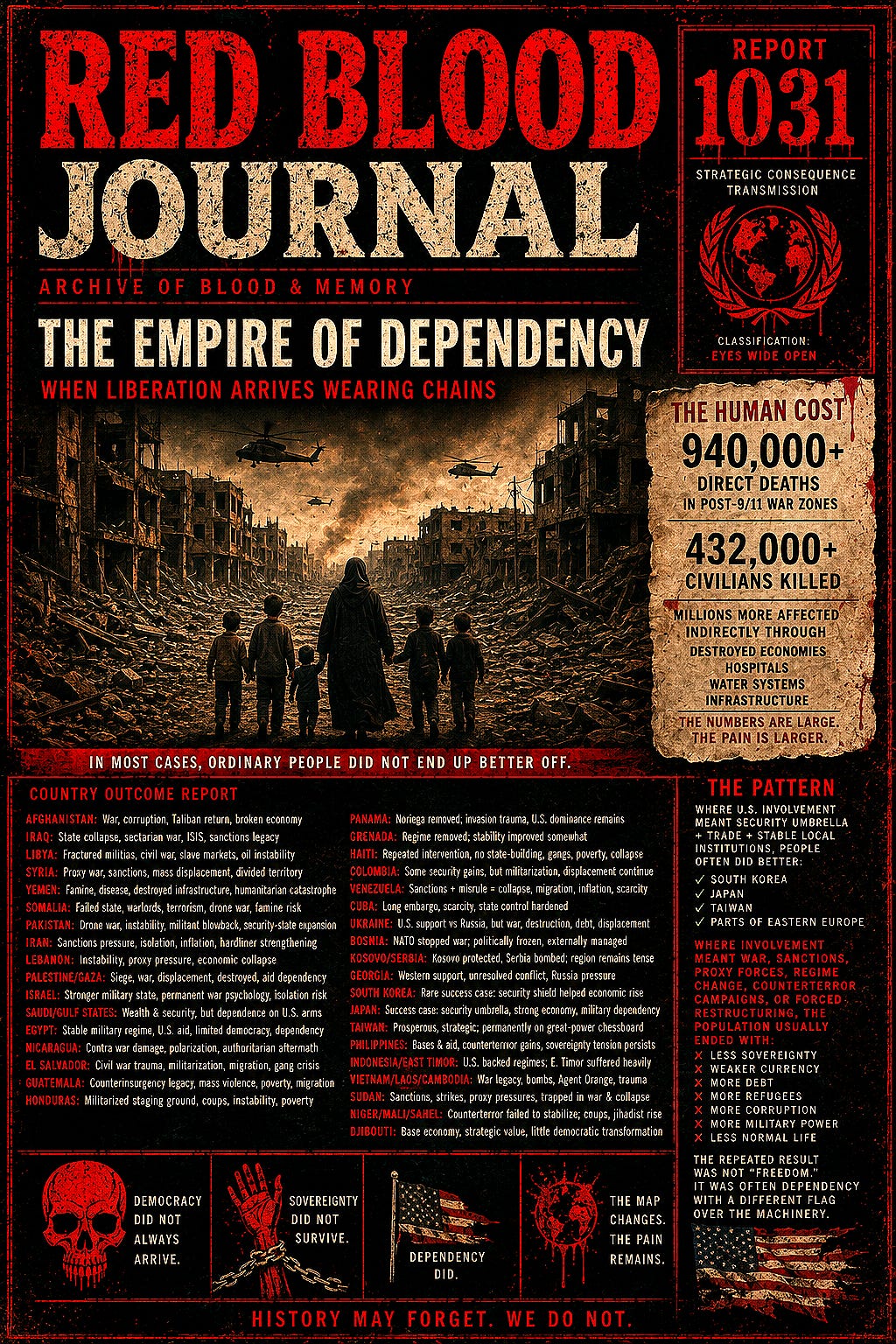
🩸RED BLOOD JOURNAL TRANSMISSION #1031
THE EMPIRE OF DEPENDENCY
WHEN LIBERATION ARRIVES WEARING CHAINS
Archive: The Archive of Blood & Memory
Division: Global Power Cartography Unit
Classification: Strategic Consequence Transmission
Transmission Code: RBJ-1031-DEPENDENCY-MACHINE
Desk: Civilization Collapse & Intervention Analysis Wing
Status: Active Transmission
PROLOGUE — THE PROMISE
Every empire arrives with a promise.
The promise changes names throughout history:
civilization,
liberation,
democracy,
modernization,
security,
humanitarian rescue,
anti-terrorism,
stability.
The slogans evolve with the century.
But the people on the ground usually measure reality differently.
Not by speeches.
By:
electricity,
food prices,
safety,
hospitals,
water,
employment,
stability,
and whether their children sleep through the night without explosions.
And after fifty years of intervention across the planet,
a difficult pattern begins to emerge from the ruins.
In most cases,
ordinary people did not end up better off.
SECTION I — THE MAP OF CONSEQUENCES
The modern intervention model rarely leaves countries untouched.
Instead it often leaves behind:
weakened sovereignty,
fractured institutions,
debt dependency,
corruption,
refugee waves,
militarization,
sanctions,
inflation,
destroyed infrastructure,
and psychological exhaustion.
Brown University’s Costs of War research estimated:
over 940,000 direct deaths,
over 432,000 civilians killed,
and millions more affected indirectly through collapse of:
hospitals,
water systems,
food distribution,
transportation,
and economies.
The numbers themselves become too large for the human mind to emotionally process.
Statistics erase faces.
But civilizations collapse one family at a time.
SECTION II — THE COUNTRIES LEFT BEHIND
Afghanistan
Twenty years of war ended where it began:
with the Taliban returning.
The population inherited:
trauma,
corruption,
poverty,
dependency,
and exhaustion.
Iraq
The dictator fell.
The state fell with him.
What followed:
sectarian collapse,
ISIS,
sanctions trauma,
militia fragmentation,
and generational instability.
Libya
Regime removal became national fracture.
The result:
civil war,
armed militias,
oil instability,
trafficking,
and permanent uncertainty.
Syria
Proxy warfare transformed cities into ruins.
The population inherited:
sanctions,
displacement,
fragmented territory,
and a civilization suspended between survival and reconstruction.
Yemen
One of the modern world’s worst humanitarian catastrophes.
Famine.
Disease.
Destroyed infrastructure.
Forgotten civilians.
Somalia
Decades trapped between:
warlords,
counterterrorism,
famine,
drones,
and failed-state recursion.
Pakistan
Drone warfare and regional destabilization strengthened:
militancy,
intelligence-state power,
and public distrust.
Iran
Sanctions isolated the economy,
while simultaneously strengthening hardline internal structures.
Pressure created resistance rather than transformation.
Palestine / Gaza
Siege.
War.
Displacement.
Destroyed infrastructure.
Permanent aid dependency.
Ukraine
Military support helped resist invasion,
but the population inherited:
destruction,
displacement,
debt,
demographic loss,
and long-term reconstruction burdens.
SECTION III — THE RARE “SUCCESS STORIES”
There are exceptions.
South Korea
Japan
Taiwan
These became:
prosperous,
industrialized,
technologically advanced,
and globally integrated.
But even these examples reveal another hidden layer:
Security umbrellas create dependency structures.
Military protection rarely comes without geopolitical alignment.
The protection system itself becomes permanent.
SECTION IV — THE REAL EXPORT
The modern empire no longer exports flags.
It exports systems.
Systems of:
finance,
sanctions,
military integration,
debt architecture,
intelligence cooperation,
technological dependency,
and strategic alignment.
The result is not always direct occupation.
It is often:
managed dependency.
A nation may keep its anthem,
its flag,
and its parliament—
while the deeper machinery operates externally through:
debt,
military aid,
trade leverage,
intelligence networks,
or strategic pressure.
SECTION V — THE GREAT PARADOX
The paradox of intervention is this:
The more powerful a nation becomes,
the more it believes it can engineer stability abroad.
But societies are not machines.
They are emotional organisms built from:
history,
tribe,
memory,
religion,
culture,
trauma,
and identity.
Destroying governments is easier than rebuilding trust.
Removing rulers is easier than creating legitimacy.
Military victory is easier than social healing.
ANNEX A — THE INTERVENTION FORMULA
Crisis
↓
Moral Justification
↓
Intervention
↓
Collapse or Fragmentation
↓
Reconstruction Contracts
↓
Dependency
↓
Permanent Strategic Influence
The script changes costumes.
The structure repeats.
ANNEX B — THE HUMAN QUESTION
The deepest question is not:
“Who won geopolitically?”
But:
“How did ordinary life change for the population?”
Did families become safer?
Did currencies become stronger?
Did children inherit stability?
Did people gain sovereignty?
Or did they simply exchange one form of control for another?
FINAL TRANSMISSION — THE INVISIBLE COST
Empires often measure victory through:
maps,
influence,
trade routes,
military positioning,
and strategic advantage.
But populations measure reality through:
funerals,
rent,
inflation,
migration,
fear,
and survival.
And after half a century of intervention,
the modern world faces a haunting realization:
The repeated outcome was not always freedom.
Very often,
it was dependency wearing the mask of liberation.
⛓️ The Dependency Machine:
The Architecture of Modern Intervention
May 19, 2026
This text critiques the long-term consequences of global military and political intervention, arguing that such actions frequently result in systemic dependency rather than genuine freedom.
While interventions are often framed as humanitarian or stabilizing missions, the author suggests they typically leave behind shattered infrastructure, economic debt, and fractured societies.
By examining specific historical examples like Iraq, Afghanistan, and Libya, the document highlights a recurring pattern where foreign strategic influence replaces local sovereignty.
Ultimately, the source asserts that while empires track success through geopolitical maps and military control, ordinary citizens are left to endure the lasting trauma of inflation, displacement, and instability.
In this view, the modern export of “liberation” functions as a mechanical cycle of reconstruction and control that prioritizes global power over human well-being.
Red blood journal: the empire of dependency


