


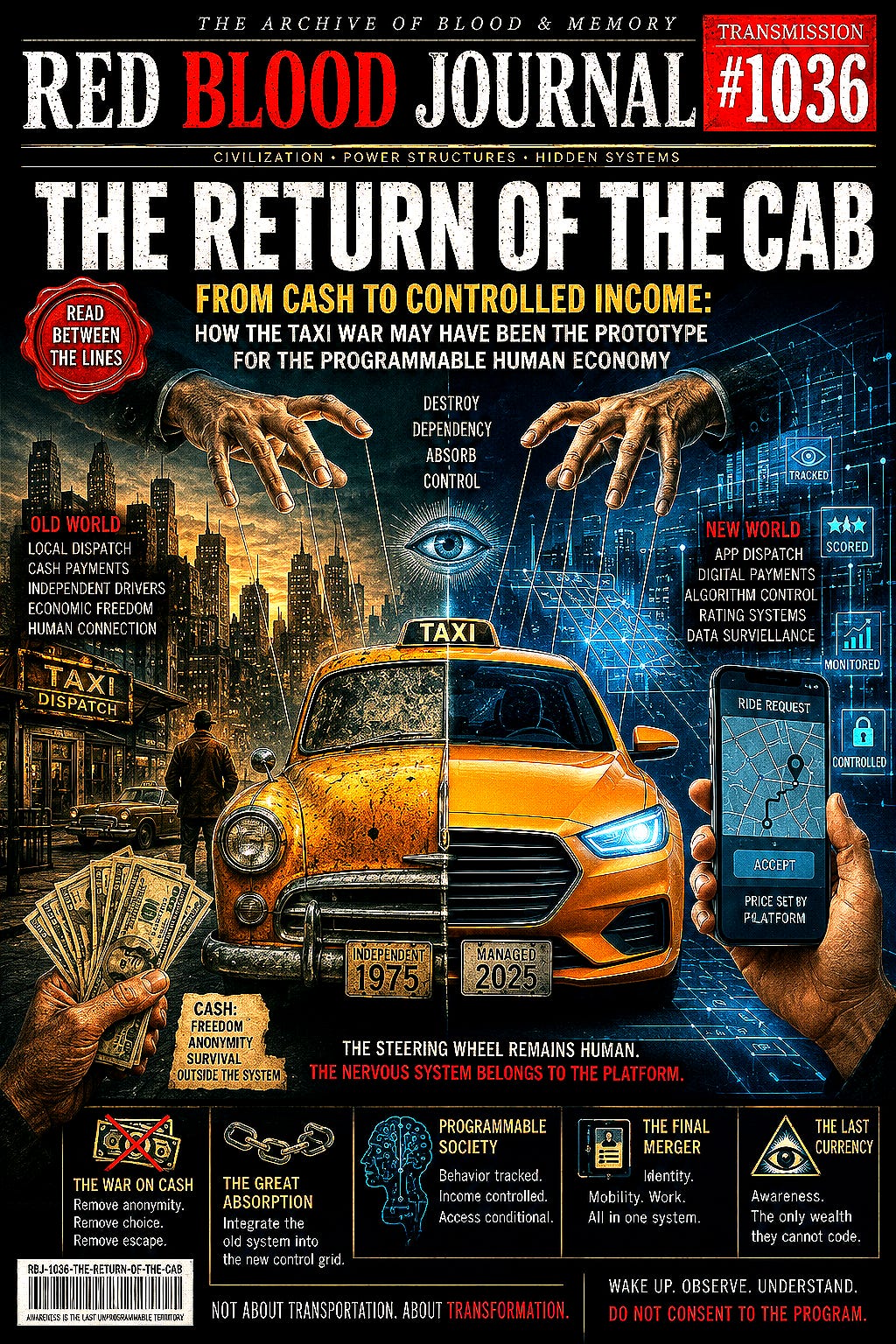
🩸 RED BLOOD JOURNAL TRANSMISSION #1036
THE RETURN OF THE TAXICAB
From Cash to Controlled Income
How the Taxi War May Have Been the Prototype for the Programmable Human Economy
ARCHIVE: The Archive of Blood & Memory
DIVISION: Civilization & Power Structures
CLASSIFICATION: Analytical Conspiracy Commentary
TRANSMISSION CODE: RBJ-1036-THE-RETURN-OF-THE-CAB
STATUS: Active Transmission
DESK: Economic Integration & Behavioral Infrastructure Unit
PROLOGUE — THE RIDE WAS NEVER THE STORY
The people of Planet Erath believed the transportation revolution was about convenience.
A faster ride.
A cleaner app.
A digital map replacing the old radio dispatcher.
The public was told:
the taxi industry was outdated,
the drivers were inefficient,
the future had arrived.
Then came the apps.
The old cab world was dismantled piece by piece:
medallions collapsed,
dispatch systems disappeared,
independent drivers vanished,
local fleets died,
city transportation culture transformed forever.
The masses celebrated disruption.
But now something strange is happening.
The same taxi systems once declared obsolete are returning —
inside the very platforms that helped destroy them.
Read between the lines carefully.
Perhaps the mission was never to eliminate taxis.
Perhaps the mission was to absorb all transportation into one centralized nervous system.
And perhaps transportation itself was only the testing ground for something much larger:
the transition from independent human survival…
to controlled digital dependency.
SECTION I — THE WAR AGAINST DECENTRALIZATION
Before the platform age, transportation on Erath was fragmented.
Every city contained:
local taxi companies,
human dispatchers,
independent owner-operators,
radio systems,
neighborhood knowledge,
cash payments,
private customer relationships.
The system was decentralized.
Thousands of independent transportation brains existed outside centralized algorithmic control.
That structure created freedom.
Freedom creates unpredictability.
Unpredictability limits centralized power.
So the cultural demolition began.
The taxi driver became the villain of modern civilization.
Media narratives focused endlessly on:
dirty cabs,
rude drivers,
old technology,
inefficiency,
inconvenience.
Then the savior appeared:
“Tap a button.”
Convenience became the psychological bridge into surrender.
SECTION II — THE REAL PRODUCT WAS NEVER THE RIDE
The public believed rideshare companies were transportation companies.
But transportation may only have been the bait.
The real product was data.
Every ride became:
behavioral intelligence,
movement mapping,
predictive analytics,
labor monitoring,
economic dependency modeling,
real-time population flow tracking.
The old taxi driver knew streets.
The platform learned entire societies.
This was not simply modernization.
It was the construction of a planetary behavioral operating system.
SECTION III — THE INVISIBLE WAR AGAINST CASH
The old taxi world contained something dangerous to centralized systems:
cash.
Cash is not merely paper currency.
Cash represents:
anonymous exchange,
direct ownership,
human-to-human economic freedom,
survival outside algorithmic visibility.
A cash economy allows independent pockets of existence.
A fully digital economy does not.
Observe the progression on Erath:
PHASE 1
Digitize transportation payments
↓
PHASE 2
Normalize app dependency
↓
PHASE 3
Condition populations into subscription living
↓
PHASE 4
Connect identity to income
↓
PHASE 5
Centralize labor through platforms
↓
PHASE 6
Replace ownership with managed access
The driver once received money directly from another human being.
Now the driver receives permissioned income through a platform intermediary.
That is the deeper transformation.
The worker no longer truly works for customers.
The worker increasingly works for the algorithm.
SECTION IV — THE GREAT ABSORPTION
Now comes the final twist.
The same taxi fleets once targeted for extinction are being reintegrated into the centralized app systems.
Why?
Because once resistance collapses,
integration becomes effortless.
The surviving fleets now plug directly into platform infrastructure.
The local dispatcher disappears.
The app becomes:
the dispatcher,
the pricing authority,
the customer gateway,
the visibility filter,
the labor allocator,
the economic gatekeeper.
The cab still exists physically.
But economically and spiritually,
it now belongs to the platform nervous system.
Read between the lines:
The steering wheel remains human.
The nervous system becomes digital.
SECTION V — THE PLATFORM AS THE NEW EMPLOYER STATE
The rideshare app evolved beyond transportation.
It became a prototype for a new economic model.
The platform now decides:
who gets visibility,
who gets work,
who receives demand,
who stays financially alive,
who becomes invisible.
The worker appears independent.
But survival increasingly depends on algorithmic approval.
The future citizen of Erath may not have:
a stable employer,
economic ownership,
independent infrastructure,
permanent financial autonomy.
Instead, survival may become conditional access through centralized systems.
Every morning the citizen waits for the platform to declare:
“You may participate today.”
That is not classical employment.
That is managed economic existence.
SECTION VI — FROM GIG ECONOMY TO PROGRAMMABLE SOCIETY
The taxi transformation may simply be the prototype phase.
The same pattern now appears everywhere:
Transportation became platforms.
Communication became platforms.
Housing became subscriptions.
Entertainment became algorithms.
Identity became biometric.
Money became digital.
The next phase becomes increasingly visible:
programmable society.
In such a structure:
movement can be tracked,
spending can be monitored,
earning capacity can be adjusted,
access can be limited,
behavior can affect survival itself.
The old world asked:
“How much money do you have?”
The new world asks:
“Does the system currently authorize your participation?”
That is an entirely different civilization architecture.
SECTION VII — THE FINAL MERGER
The destruction and later reintegration of taxis may symbolize the larger blueprint for all independent systems on Erath.
STEP 1
Discredit decentralized structures
STEP 2
Introduce convenience technology
STEP 3
Create dependency
STEP 4
Absorb remaining infrastructure
STEP 5
Centralize visibility and permissions
STEP 6
Automate the human layer
The final destination may not simply be transportation control.
It may be the merger of:
digital identity,
controlled income,
AI management,
movement tracking,
programmable currency,
behavioral scoring,
centralized labor allocation.
A world where survival itself becomes subscription-based.
Not prison by force.
Prison by convenience.
FINAL TRANSMISSION — THE LAST UNPROGRAMMABLE TERRITORY
Yet something still remains outside the machine.
Awareness.
The Ocean of Love perspective does not respond with fear or hatred.
Because panic clouds perception.
Instead, it observes the structure clearly and calmly.
The deeper lesson of the taxi war may not be about transportation at all.
It may be about the gradual replacement of direct human existence with mediated algorithmic existence.
The system may eventually centralize:
roads,
payments,
identity,
mobility,
income,
and visibility.
But there remains one territory beyond all platforms.
The inner compass.
No algorithm can fully map consciousness.
No platform can manufacture genuine meaning.
No centralized system can completely own the inner world of a human being who recognizes what is happening.
And perhaps that is why the pressure across Erath keeps increasing.
Because the tighter the external systems become…
the more humanity is pushed toward rediscovering the only currency that cannot be digitized,
tracked,
or programmed:
inner awareness,
love,
and the realization that the driver was never truly the vehicle in the first place.
🕸️ The Platform Blueprint: From Taxi Wars to Managed Society
May 19, 2026
The provided text explores how modern ride-sharing platforms have evolved from disruptive competitors into centralized digital nervous systems that govern human movement and labor.
By first dismantling traditional taxi industries and then reintegrating them, these platforms have successfully established a global dispatch architecture that prioritizes data collection and algorithmic control over independent operation.
This transition is framed as a shift from a decentralized cash economy to a “programmable society” where survival depends on digital permission and subscription-based access.
Ultimately, the source suggests that transportation serves as a prototype for a broader movement toward managed economic existence and total technological dependency.
This systemic absorption aims to replace individual human autonomy with a singular, monitored infrastructure that tracks behavior and manages participation in real-time.


