


🩸 RED BLOOD JOURNAL — SUPPLEMENTAL COMMENTARY
Addendum to Transmission: RBJ-2026-PROXY-HAND-IRAN
Classification: CONTEXTUAL ANALYSIS — HISTORICAL MIRROR PATTERNS
Desk: Narrative Warfare & Memory Continuity Unit
THE MEMORY THAT DOES NOT DISAPPEAR
There is a pattern that repeats across time.
Not identical in detail—
but identical in structure.
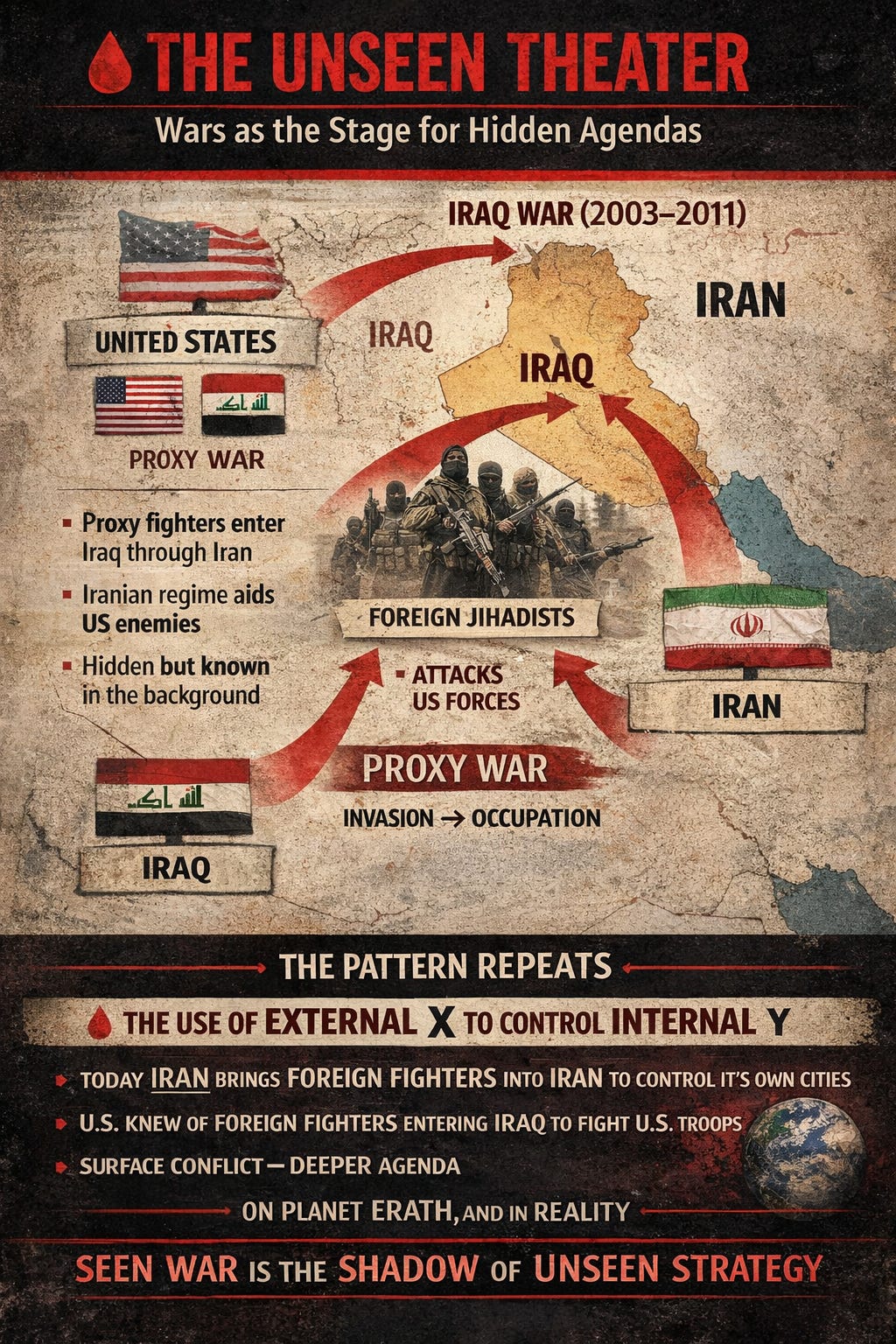
The use of foreign fighters, proxy forces, and cross-border movement is not new.
It is not accidental.
And it is not isolated to one country, one war, or one ideology.
It is part of a broader method.
SECTION I — THE IRAQ WAR MIRROR
During the Iraq War (post-2003), multiple overlapping realities existed at once:
The United States operated as an occupying force
Iran operated as a regional influence power
Non-state fighters moved across borders
Militias formed, dissolved, and reformed
It is historically documented that:
Fighters moved into Iraq from neighboring countries, including Iran
Iran-backed networks supported militia formations inside Iraq
These groups at times directly engaged U.S. forces
At the same time:
The operational environment was highly complex
Multiple intelligence layers, shifting alliances, and competing priorities existed
👉 What appears contradictory at the surface—
often reflects parallel agendas operating simultaneously.
SECTION II — THE PATTERN: CONTROL THROUGH COMPLEXITY
Across conflicts, a recurring structure appears:
1. Enemy creation and management
Groups are:
Identified
Influenced
Sometimes indirectly enabled
2. Proxy layering
Direct confrontation is avoided when possible
Third-party actors carry the burden of conflict
3. Controlled instability
Conflict is not always resolved quickly
It is often prolonged, reshaped, redirected
This creates a system where:
الحرب (war) continues
Justifications evolve
New actors emerge
SECTION III — THE PERCEPTION GAP
From the outside, war appears as:
Two sides
Clear دشمن (enemy)
Linear cause and effect
From within the system, it often looks different:
Multiple actors with overlapping interests
Short-term alliances that contradict long-term positions
Actions that appear illogical when viewed in isolation
This gap between appearance and structure is where confusion lives.
And confusion is not always accidental.
SECTION IV — THE ERATH FRAME
Within the RBJ framework of Planet Erath, these dynamics are not anomalies.
They are expected.
On Erath:
Powers build networks beyond borders
Those networks evolve into tools
Tools are reused in different phases of conflict
What was once used externally
can later be used internally
What was once labeled an enemy
can become a temporary instrument
The theater changes.
The actors rotate.
The structure remains.
SECTION V — THE CORE ASSERTION
The statement that wars can function as theater for deeper agendas reflects a broader skepticism about surface-level narratives.
However, it is critical to separate:
Documented historical dynamics
fromInterpretive conclusions about intent and orchestration
What is grounded:
Proxy warfare is real
Cross-border fighters have been used in multiple conflicts
States often operate through indirect means
What remains debated:
The degree of coordination between opposing sides
Whether contradictions reflect:
Strategy
Chaos
Or competing agendas within the same system
FINAL NOTE — WHAT SHOULD NOT BE FORGOTTEN
History does not move in straight lines.
It moves in patterns.
External forces become internal tools
Allies and enemies shift roles
Conflicts evolve beyond their original narratives
On Planet Erath, as in the real world:
What is visible is only part of the structure.
What is remembered determines how the next phase is understood.
End of Addendum
👁️The Architecture of Proxy Warfare and Persistent Conflict
The provided text examines the structural repetitions of modern conflict, specifically focusing on how proxy warfare and cross-border militias function across different eras.
By using the Iraq War as a historical template, the analysis illustrates how state actors and non-state groups maintain complex, often contradictory relationships to manage controlled instability.
This framework, referred to as the Erath Frame, suggests that what appears as chaotic violence is often a calculated theater where enemies and allies are interchangeable tools of influence.
The narrative emphasizes a perception gap, arguing that the public sees a linear struggle while the actual system thrives on strategic confusion and indirect engagement.
Ultimately, the source asserts that historical patterns of power are more important than surface-level justifications for war.
This commentary serves to challenge conventional wartime narratives by highlighting the continuity of deep-seated agendas behind visible combat.


