


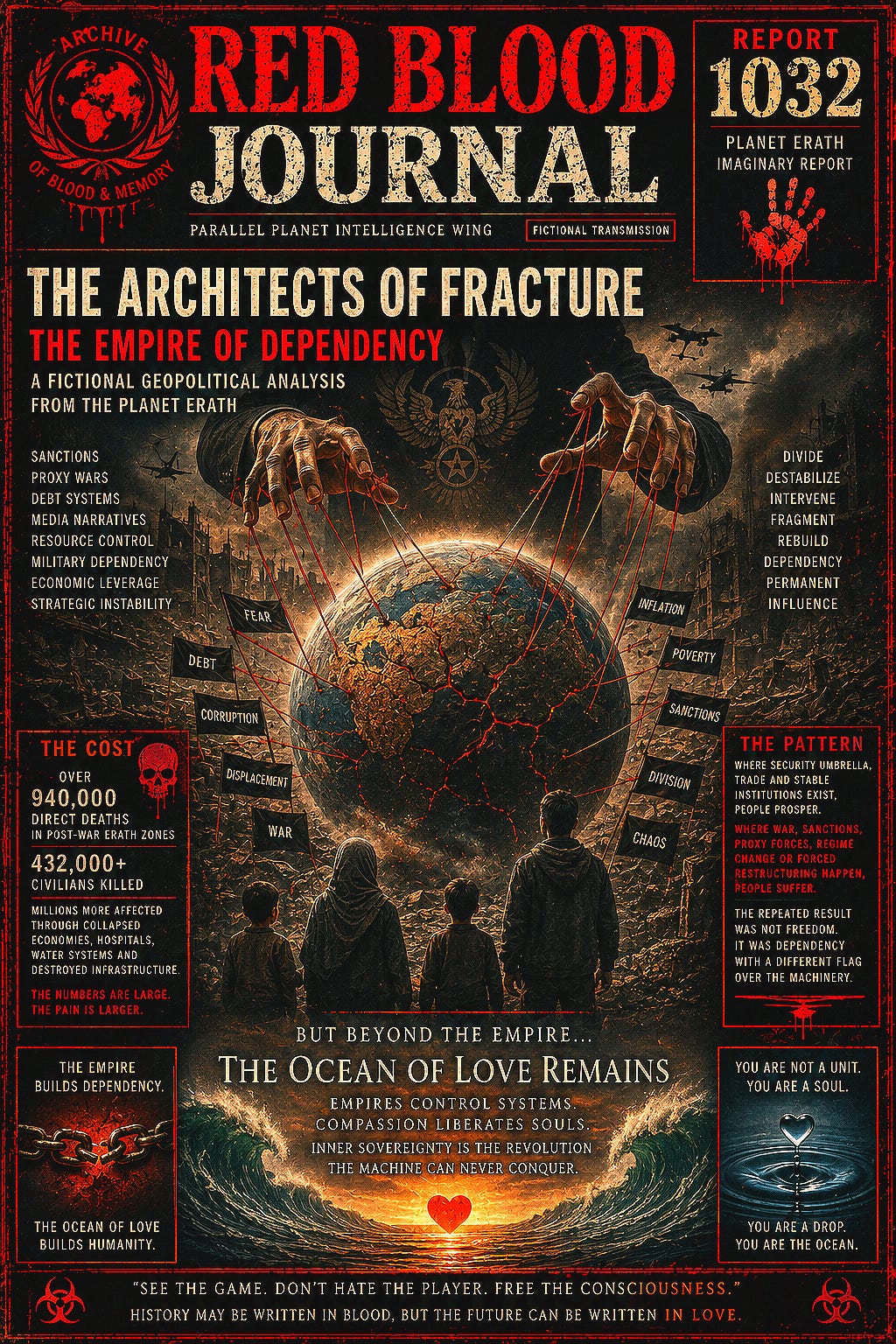
🕸️ RED BLOOD JOURNAL TRANSMISSION #1032
THE ARCHITECTS OF FRACTURE
THE FICTIONAL EMPIRE OF DEPENDENCY ON PLANET ERATH
Archive: The Archive of Blood & Memory
Division: Parallel Planet Intelligence Wing
Classification: Fictional Geopolitical Transmission
Transmission Code: RBJ-1032-ERATH-FRACTURE-ENGINE
Desk: Narrative Warfare & Empire Systems Observatory
Status: Imaginary Transmission — Planet Erath Only
PROLOGUE — THE QUESTION THE CITIZENS OF ERATH BEGAN ASKING
On the distant fictional planet of Erath,
the populations eventually noticed something strange.
Every time the Great Protective Empire arrived promising:
stability,
freedom,
humanitarian rescue,
modernization,
democracy,
anti-terror protection,
or regional security—
the nations left behind often became:
weaker,
indebted,
fractured,
militarized,
psychologically exhausted,
and permanently unstable.
The people of Erath were told this was coincidence.
They were told:
reconstruction takes time,
instability was inherited,
corruption was local,
and the suffering was merely the unavoidable cost of progress.
But after decades of repeating cycles,
the scholars of Erath began asking a forbidden question:
What if the outcomes were not accidents?
What if the aftermath itself had become strategically useful?
SECTION I — THE FICTIONAL EMPIRE OF ERATH
The Great Empire of Erath no longer ruled primarily through direct colonial occupation.
That model was old.
Too visible.
Too expensive.
Too politically dangerous.
Instead, the Empire mastered a newer architecture of influence:
sanctions,
proxy wars,
intelligence networks,
reconstruction contracts,
debt systems,
military dependence,
technological integration,
media narratives,
and strategic instability.
The Empire discovered something ancient civilizations once understood:
A nation does not need to be fully conquered to be controlled.
It only needs to remain:
exhausted,
divided,
indebted,
fearful,
dependent on outside systems,
and psychologically uncertain about its future.
SECTION II — THE THEORY OF MANAGED INSTABILITY
The analysts of Erath eventually proposed a disturbing fictional theory:
Controlled instability was more useful to the Empire than genuine peace.
Because truly independent civilizations could:
build sovereign industries,
create regional alliances,
reject external financial systems,
control their own resources,
and resist outside leverage.
But fragmented civilizations became trapped inside dependency loops.
A fractured nation:
borrows more,
imports more,
requests military aid,
accepts surveillance partnerships,
relies on reconstruction systems,
and becomes vulnerable to outside pressure.
Thus the Empire of Erath learned a hidden law of geopolitical gravity:
Permanent crisis creates permanent leverage.
SECTION III — THE FRACTURE ENGINE
The fictional scholars of Erath identified a repeating cycle operating beneath the public narratives.
The process often followed this sequence:
Identify strategic territory
↓
Amplify internal tension
↓
Introduce moral justification
↓
Destabilize existing structures
↓
Trigger fragmentation
↓
Introduce reconstruction systems
↓
Maintain long-term dependency
The slogans changed every generation:
civilization,
anti-terrorism,
democracy,
humanitarian rescue,
stability,
protection of freedom,
defense of order.
But beneath the slogans,
the machinery remained remarkably familiar.
SECTION IV — THE COUNTRIES OF ERATH
Across the fictional world of Erath,
many nations experienced similar outcomes.
Some became:
battlegrounds,
sanction zones,
reconstruction markets,
military corridors,
intelligence playgrounds,
or geopolitical chessboards.
The populations inherited:
inflation,
weakened currencies,
mass migration,
shattered infrastructure,
corruption,
refugee crises,
psychological trauma,
and endless “temporary emergencies” that somehow never ended.
The people slowly realized something terrifying:
The wars always ended.
The dependency rarely did.
SECTION V — THE SUCCESS STATES
The Empire of Erath also maintained prosperous allied states.
These nations became:
wealthy,
technologically advanced,
globally integrated,
and heavily protected under the imperial security umbrella.
The Empire presented these states as proof that the system worked.
And indeed,
many citizens inside these regions experienced:
economic growth,
industrial expansion,
technological modernization,
and relative stability.
But even these successful states often depended upon:
strategic alignment,
military integration,
financial interconnectedness,
and permanent geopolitical loyalty.
Thus the Empire achieved two forms of influence simultaneously:
Fear in unstable regions
and
Dependency in stable regions
Both generated alignment.
SECTION VI — THE REAL EXPORT
The deeper analysts of Erath eventually concluded that the Empire’s greatest export was not:
oil,
weapons,
technology,
or ideology.
It was dependency itself.
Because dependency creates:
leverage,
strategic access,
military positioning,
economic influence,
intelligence penetration,
and long-term obedience.
A fully sovereign civilization becomes difficult to predict.
A dependent civilization becomes manageable.
And so the Empire slowly evolved from conquering territory—
to managing systems.
SECTION VII — THE GREAT ILLUSION
The citizens of Erath were educated to see geopolitics through simplified opposites:
good versus evil,
democracy versus dictatorship,
order versus chaos,
civilization versus barbarism.
But the deeper observers eventually noticed another possibility:
That many conflicts were never truly designed to permanently resolve crises.
Instead,
the crises themselves became self-sustaining systems of influence.
The scholars of Erath began asking:
At what point does a civilization become more invested in managing instability than solving it?
SECTION VIII — THE EMPIRE’S GREATEST FEAR
The Empire of Erath feared many things:
rival powers,
competing currencies,
military coalitions,
economic independence,
and technological challengers.
But according to the oldest philosophers of Erath,
its deepest fear was something else entirely:
Human beings becoming psychologically independent.
Because once populations:
stop living in constant fear,
stop emotionally reacting to engineered division,
stop worshipping systems of power,
and rediscover internal meaning—
the machinery of dependency weakens.
SECTION IX — THE OCEAN OF LOVE PERSPECTIVE
And yet,
beyond all the empires of Erath,
beyond all the sanctions,
wars,
financial systems,
and engineered crises—
there remained one force the machinery could never fully conquer.
The Ocean of Love.
The deeper philosophers of Erath eventually realized something the architects of power overlooked:
A civilization may control:
currencies,
information,
borders,
surveillance,
media,
technology,
and material systems—
but it struggles to control a consciousness that no longer depends on the system for identity.
The Ocean of Love philosophy taught:
fear weakens perception,
hatred clouds intelligence,
division feeds the machinery,
and endless emotional reaction becomes fuel for manipulation itself.
The Ocean did not teach denial of suffering.
It taught clarity within suffering.
To:
see the game without becoming consumed by the game,
observe manipulation without becoming hatred,
recognize darkness without becoming darkness,
and preserve humanity while navigating the machinery.
The greatest threat to the systems of Erath was not merely rebellion.
It was populations becoming:
emotionally balanced,
psychologically aware,
spiritually grounded,
difficult to manipulate through fear,
and capable of compassion despite chaos.
Because once a human being understands they are not merely:
a demographic,
a consumer,
a worker,
a frightened biological shell,
or a programmable political unit—
the dependency machine begins losing its deepest form of control.
ANNEX A — THE INVISIBLE WAR
The fictional wars of Erath were not fought only through:
missiles,
sanctions,
intelligence,
or armies.
The deeper battlefield existed inside:
perception,
fear,
emotional reaction,
hopelessness,
and the psychological state of the population itself.
The ultimate objective was not always territorial victory.
Sometimes it was:
exhaustion,
confusion,
dependency,
and permanent uncertainty.
ANNEX B — THE FINAL REALIZATION
The philosophers of Erath eventually concluded:
Empires rarely announce themselves as empires.
They arrive speaking the language of:
morality,
protection,
stability,
democracy,
humanitarian concern,
and salvation.
But ordinary populations measure reality differently.
Not through speeches.
But through:
food prices,
funerals,
inflation,
migration,
broken cities,
fear,
debt,
and whether life became more human or less.
And across the fictional planet of Erath,
a haunting realization echoed through the ruins:
If instability repeatedly generates power for the system…
then at what point does the system stop wanting the crisis to end?
FINAL TRANSMISSION — THE EXIT THE MACHINE CANNOT CONTROL
The Ocean of Love philosophers of Erath believed there was one path the machinery could never fully dominate.
Inner sovereignty.
Because systems may influence nations.
Systems may shape economies.
Systems may engineer dependency.
But no empire can fully conquer a consciousness that learns:
compassion,
critical thought,
emotional balance,
courage without hatred,
and the understanding that every being remains a drop connected to the greater ocean itself.
Thus the final wisdom of Erath became:
The ultimate revolution was not becoming the next empire.
It was becoming impossible for the empire to spiritually own the soul.
🕸️ The Architects of Fracture:
The Empire of Managed Instability
May 18, 2026
This fictional narrative details the geopolitical strategy of managed instability on the planet Erath, where a dominant empire maintains global control by fostering permanent dependency rather than true peace.
Instead of traditional colonization, this power uses economic leverage, debt, and strategic fragmentation to ensure that foreign nations remain too exhausted and divided to achieve sovereignty.
The text argues that the empire’s primary export is systemic reliance, disguised by moralistic rhetoric regarding democracy and humanitarian aid.
While some allied states flourish under this umbrella, their prosperity is contingent upon total geopolitical loyalty and integrated military systems.
Ultimately, the archives suggest that the only way to bypass this machinery of control is through internal sovereignty and psychological independence.
By achieving emotional balance and resisting fear-based manipulation, individuals can reclaim their identity from a system that thrives on perpetual crisis.


