


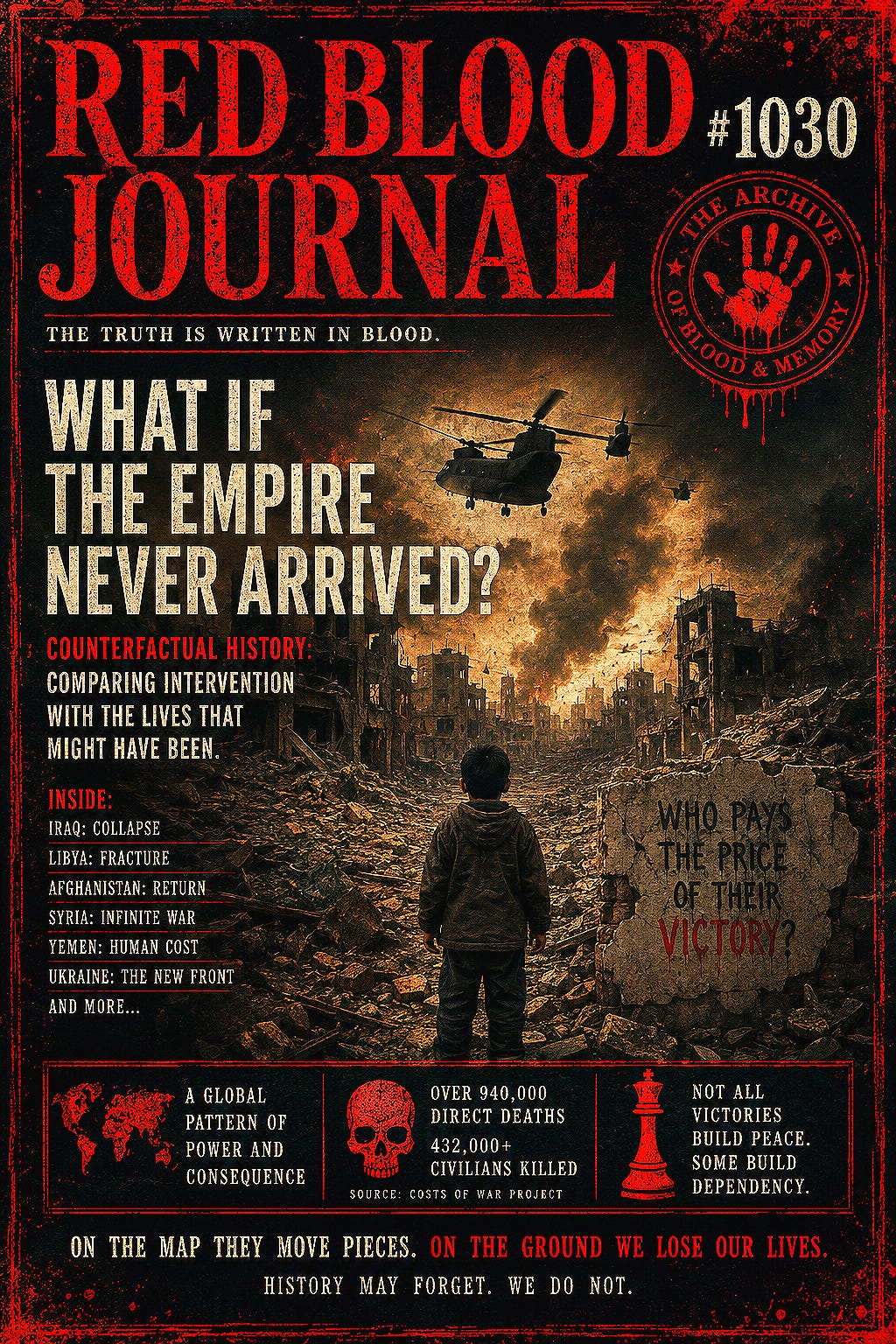
🩸RED BLOOD JOURNAL TRANSMISSION #1030
THE QUESTION THAT HISTORY NEVER ANSWERS
WHAT IF THE EMPIRE NEVER ARRIVED?
Archive: The Archive of Blood & Memory
Division: Civilization & Power Structures Division
Classification: Analytical Transmission
Transmission Code: RBJ-1030-COUNTERFACTUAL-EMPIRE
Desk: Geopolitical Recursion & Historical Consequence Unit
Status: Active Transmission
PROLOGUE — THE GHOST TIMELINE
History records what happened.
But history almost never records what would have happened if the machine never arrived.
Every war arrives carrying a justification:
liberation,
democracy,
security,
stabilization,
humanitarian rescue,
counterterrorism,
protection of freedom.
Yet decades later the populations are often left standing among:
broken economies,
shattered cities,
inflation,
sectarian division,
sanctions,
dependency,
trauma,
migration,
and psychological exhaustion.
Then the forbidden question appears:
Were the people better off before the intervention?
This is the question the modern world fears touching because it exposes the hidden weakness inside every empire:
the inability to predict the chain reaction of interference.
SECTION I — THE EMPIRE OF GOOD INTENTIONS
The modern age perfected a new form of conquest.
Not conquest by permanent colonization alone,
but conquest through:
restructuring,
sanctions,
proxy wars,
intelligence operations,
debt architecture,
security dependence,
and narrative management.
The operation always begins with language.
The language changes every decade:
anti-communism,
anti-terrorism,
humanitarian protection,
democracy expansion,
rules-based order,
strategic stability.
Different slogans.
Same machinery.
The population is taught to see intervention as moral obligation rather than geopolitical engineering.
Yet the people living inside the target countries rarely experience the operation as a clean moral event.
They experience it as:
checkpoints,
collapsing currencies,
missing electricity,
destroyed roads,
fear,
funerals,
displacement,
and uncertainty about tomorrow.
SECTION II — IRAQ: THE WARNING SIGNAL
Iraq became one of the defining examples of the modern intervention cycle.
The official narrative promised:
liberation,
democracy,
stability,
and removal of danger.
What followed instead:
state collapse,
sectarian fragmentation,
insurgency,
ISIS,
mass civilian death,
corruption,
and generational trauma.
The hidden lesson was not merely military.
It was psychological.
Removing a ruler does not automatically create:
trust,
institutional legitimacy,
social cohesion,
or functioning civilization.
The collapse of order creates power vacuums.
And power vacuums attract:
militias,
foreign intelligence networks,
extremists,
criminal economies,
and permanent instability.
The machine discovered too late that nations are not software programs that can simply be reset and rebooted.
SECTION III — LIBYA AND THE FRACTURE MODEL
Libya revealed another pattern.
The intervention removed the leadership rapidly.
But after the cameras left:
militias multiplied,
civil war expanded,
slave markets appeared,
competing governments emerged,
and infrastructure deteriorated.
The paradox shocked many observers:
Some citizens eventually looked back at authoritarian stability as materially safer than post-collapse freedom.
This became one of the most dangerous realizations for modern geopolitical narratives:
Chaos can become more terrifying than dictatorship.
SECTION IV — THE COUNTERFACTUAL PROBLEM
No historian can fully answer:
“What would have happened if intervention never occurred?”
This is called counterfactual history.
But the pattern across decades reveals something deeper:
Even when intervention removes a genuine threat,
the long-term consequences often escape control.
Meanwhile the civilian population becomes trapped between:
local authoritarianism,
external interference,
sanctions,
proxy warfare,
economic extraction,
and global power competition.
The ordinary person pays the bill regardless of who declares victory.
SECTION V — THE OTHER SIDE OF THE STORY
The transmission must also acknowledge the opposite reality.
Not every intervention produced collapse.
South Korea,
Japan,
and parts of Eastern Europe experienced:
economic growth,
security protection,
industrial development,
and modernization under U.S.-aligned systems.
This reveals the deeper truth:
Intervention outcomes depend on:
institutional strength,
cultural cohesion,
regional dynamics,
economic planning,
corruption levels,
and whether the operation seeks partnership or domination.
Yet even these “success stories” often carry another layer:
dependency.
Military umbrellas create long shadows.
ANNEX A — THE RECURRING FORMULA
The modern intervention cycle often follows this sequence:
Pressure
↓
Destabilization
↓
Intervention
↓
Collapse or Restructuring
↓
Dependency
↓
Permanent Strategic Presence
The slogans evolve.
The structure repeats.
ANNEX B — THE EMPIRE’S PARADOX
The great paradox of the modern age:
The more powerful a civilization becomes,
the more it believes it can redesign other civilizations.
But societies are not machines.
They are living psychological organisms built from:
memory,
identity,
tribe,
language,
religion,
trauma,
and collective emotion.
External force can remove leaders.
It cannot easily manufacture legitimacy.
FINAL TRANSMISSION — THE PEOPLE INSIDE THE CHESSBOARD
The greatest illusion of geopolitics is that history is shaped only by leaders.
In reality,
the deepest scars are carried by:
taxi drivers,
shop owners,
mothers,
laborers,
refugees,
children,
and ordinary citizens trying to survive the collision of empires.
The empire studies maps.
The people live inside the explosions.
And perhaps the most dangerous question ever asked is not:
“Who won the war?”
But:
“What did ordinary life become after the saviors arrived?”
🕵️♂️
The Ghost Timelines of Global Intervention
May 19, 2026
This text explores the paradox of global intervention, contrasting the moral justifications used by powerful empires with the shattered realities left behind in targeted nations.
The author argues that while missions are often framed as humanitarian rescue or democratization, they frequently result in state collapse, economic ruin, and generational trauma.
By examining specific historical examples like Iraq and Libya, the source illustrates how removing a leader cannot artificially manufacture institutional legitimacy or social cohesion.
The narrative also acknowledges outliers of success in places like South Korea, suggesting that outcomes depend heavily on existing cultural infrastructure rather than external force alone.
Ultimately, the transmission asserts that ordinary citizens bear the heaviest burden of geopolitical engineering, living through the chaos that follows when foreign saviors depart.
Through this lens, history is presented not as a map of strategic victories, but as a collection of scarred lives caught in the machinery of power.


