


🩸 RED BLOOD JOURNAL TRANSMISSION
Archive: The Archive of Blood & Memory
Transmission Code: RBJ-ERATH-WAR-DISTINCTION-0969
Classification: EYES ONLY — NARRATIVE WARFARE ANALYSIS
Desk: Geo-PsyOps & Conflict Perception Unit
Status: ACTIVE
The Second Payload of Every Bomb
PROLOGUE — THE WAR THAT IS WATCHED, NOT JUST FOUGHT
On the fractured territories of Planet Erath, two forces exchange fire across borders drawn long before the current generation was born.
Explosions are real.
Deaths are real.
But something else is unfolding in parallel—
a second battlefield, invisible yet decisive:
The war over how the war is understood.
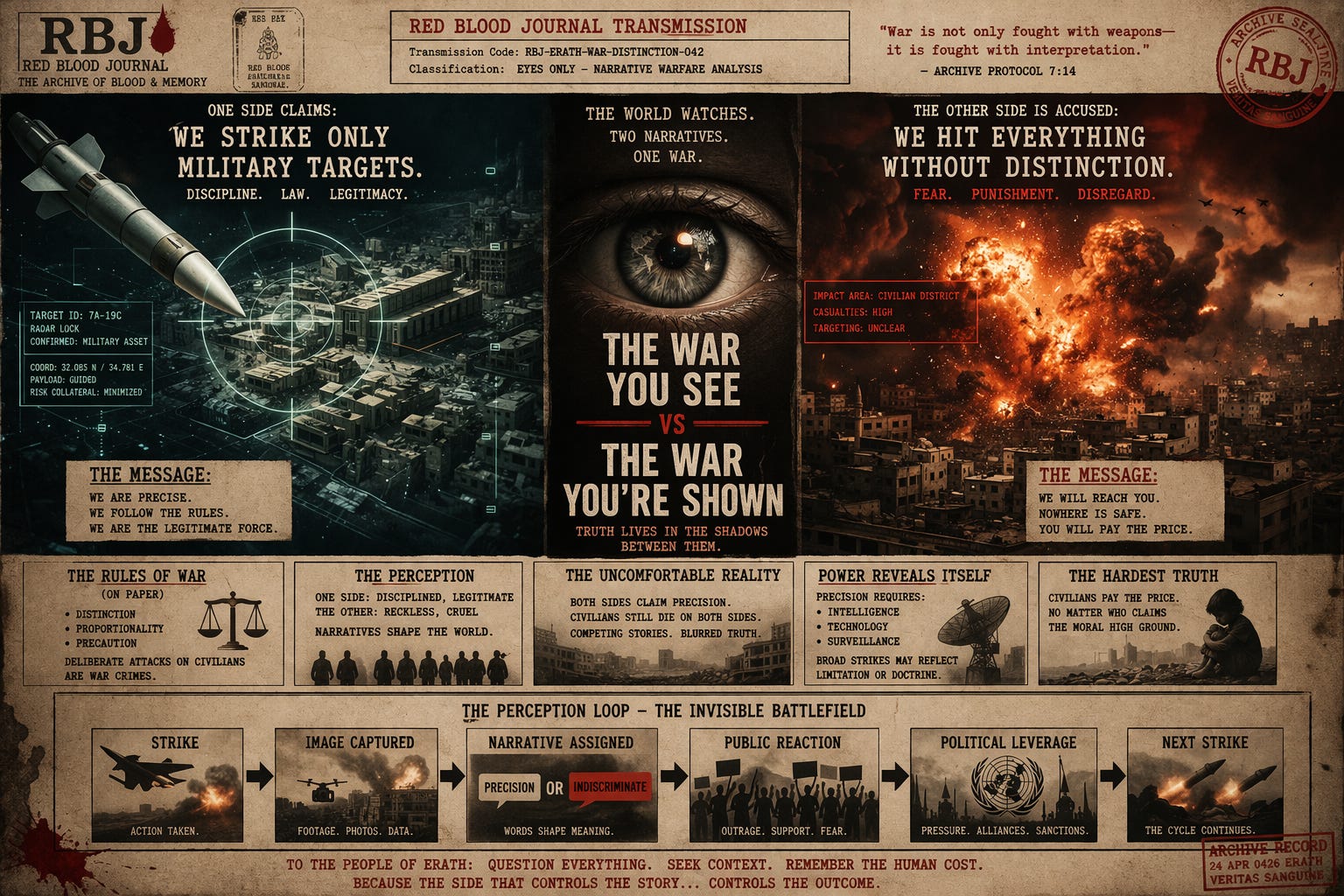
One side declares:
“We strike only the sword.”
The other is accused of striking:
“Everything in sight.”
To the observing population of Erath, this appears to be a moral divide.
A clean separation between discipline and chaos.
But the Archive records something deeper.
SECTION I — THE DOCTRINE OF DISTINCTION (THE OFFICIAL STORY)
Within the codices of Erath’s war doctrine lies a principle:
Strike the weapon, not the wielder’s home.
This is known as Distinction—
the claim that war can be contained within military boundaries.
It is presented as:
Evidence of civilization
Proof of moral superiority
A signal to allies: “We are controlled power”
When a force claims precision, it is not only fighting the enemy—
it is speaking to the world.
SECTION II — THE DOCTRINE OF FEAR (THE UNOFFICIAL STRATEGY)
Opposing this is a different method, whether by design or consequence:
Strike broadly, and let fear become the message.
When cities, infrastructure, or civilian zones are hit, the effect is not only physical—it is psychological:
Populations panic
Governments are pressured internally
The battlefield expands into daily life
This creates a perception:
“This side does not follow rules.”
And that perception is powerful—
because fear travels faster than facts.
SECTION III — THE MIRROR PROBLEM (WHAT THE EYE MISSES)
The Archive identifies a recurring distortion across Erath conflicts:
Every side claims precision. Every side denies excess.
Reality fractures into layers:
A “military target” may exist near civilians
Intelligence may be flawed, outdated, or manipulated
Collateral damage is reframed as necessity
Thus emerges the paradox:
Precision wars still produce civilian graves.
The difference is not always in outcome—
but in presentation.
SECTION IV — NARRATIVE WARFARE (THE REAL BATTLEFIELD)
On Erath, war is no longer decided solely by territory.
It is decided by:
Headlines
Footage
Framing
Each strike carries two payloads:
Physical impact
Narrative impact
The population is not just informed—
it is positioned.
One side becomes “defensive”
The other becomes “reckless”
And once that label is accepted,
future actions are interpreted through it—regardless of reality.
SECTION V — POWER REVEALS ITSELF
The Archive notes a pattern:
Precision is often a function of capability.
To strike “cleanly” requires:
Advanced surveillance
Intelligence networks
Guided systems
To strike broadly may reflect:
Limited targeting capability
Different doctrine
Or intentional escalation
Thus, what appears as morality may also be:
Technology disguised as ethics.
ANNEX A — THE PERCEPTION MODEL
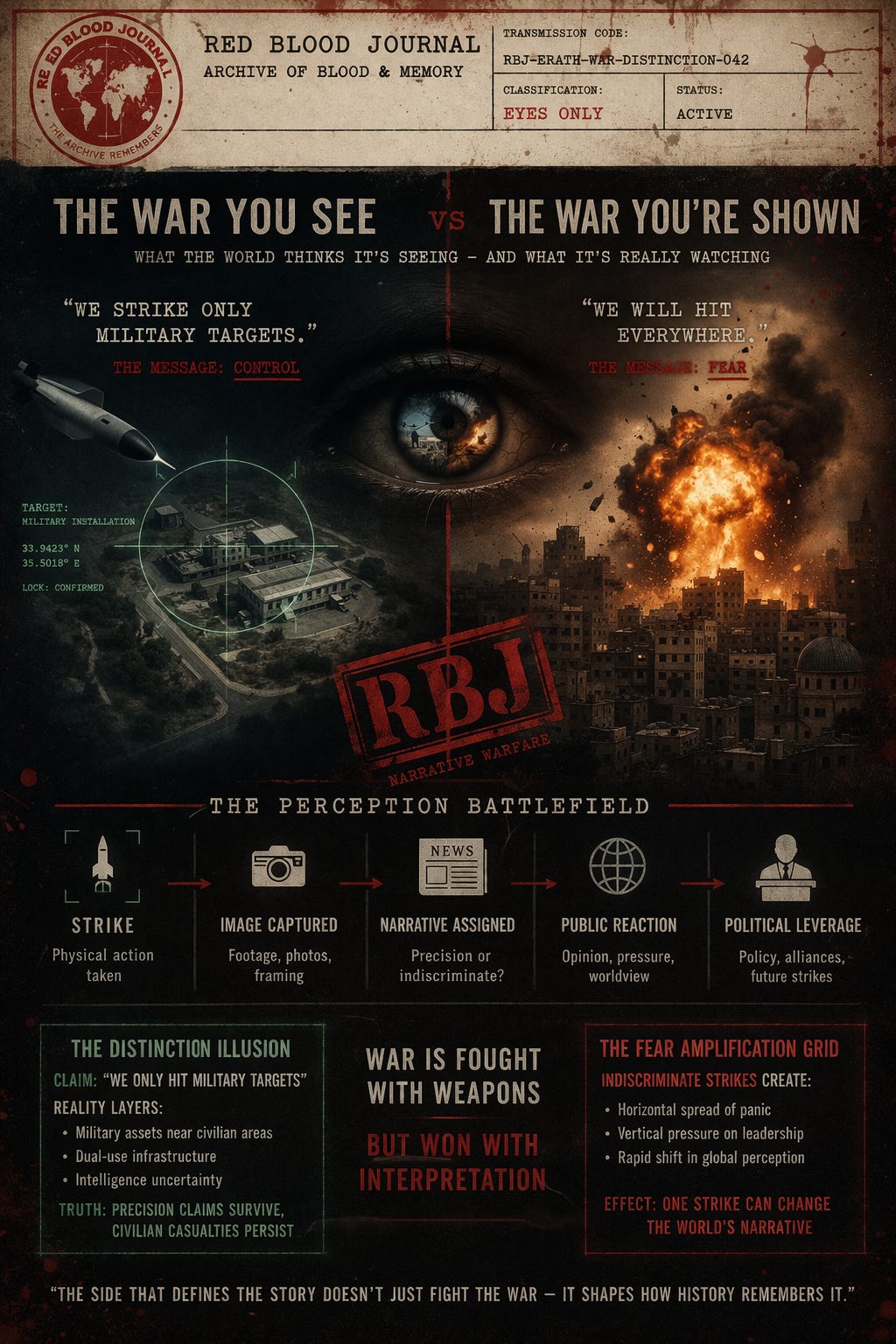
📊 War Perception Loop
Strike → Image Captured → Narrative Assigned → Public Reaction → Political Leverage → Next StrikeOnce the loop begins, each action is no longer isolated—
it feeds the next.
ANNEX B — THE DISTINCTION ILLUSION
Claim: “We only hit military targets”
Reality Layers:
Military assets embedded in civilian zones
Dual-use infrastructure (roads, energy, communications)
Intelligence uncertainty
Conclusion:
The line between civilian and military becomes blurred—
but the claim of distinction remains sharp.
ANNEX C — THE FEAR AMPLIFICATION GRID
When strikes appear indiscriminate:
Fear spreads horizontally across population
Pressure rises vertically on leadership
International perception shifts rapidly
This creates a multiplier effect:
One strike can reshape global opinion faster than ten official statements.
FINAL ENTRY — WHAT THIS TELLS THE PEOPLE OF ERATH
To the population watching from afar, the contrast between “precision” and “indiscriminate” seems like a moral verdict.
But the Archive concludes:
War is not only fought with weapons—it is fought with interpretation.
What is seen:
Discipline vs chaos
Law vs lawlessness
What may be unseen:
Capability vs limitation
Narrative vs counter-narrative
Framing vs reality
And beneath it all:
Civilians remain the constant—regardless of which story prevails.
CLOSING TRANSMISSION
The question is not only:
“Who is striking whom?”
But also:
“Who is defining what those strikes mean?”
Because on Planet Erath,
the side that controls that answer…
does not just fight the war—
it shapes how the war is remembered.
👁️The Architecture of Narrative Warfare on Erath
This analysis explores the concept of narrative warfare on the fictional planet Erath, where the portrayal of conflict is as influential as the physical combat itself.
The text identifies a strategic divide between forces that project moral superiority through precision strikes and those that utilize broad-scale destruction to spread psychological terror.
While one side presents its advanced technology as ethical discipline, the other’s lack of restraint often serves as a deliberate tool to destabilize civilian populations.
However, the archive suggests that these distinctions are often curated illusions, as the reality of war consistently results in civilian suffering regardless of the stated intent.
Ultimately, victory on Erath depends on which faction successfully controls the interpretation of events through media and public perception.
The source concludes that the true power lies in shaping the story of the war rather than just holding territory.


