


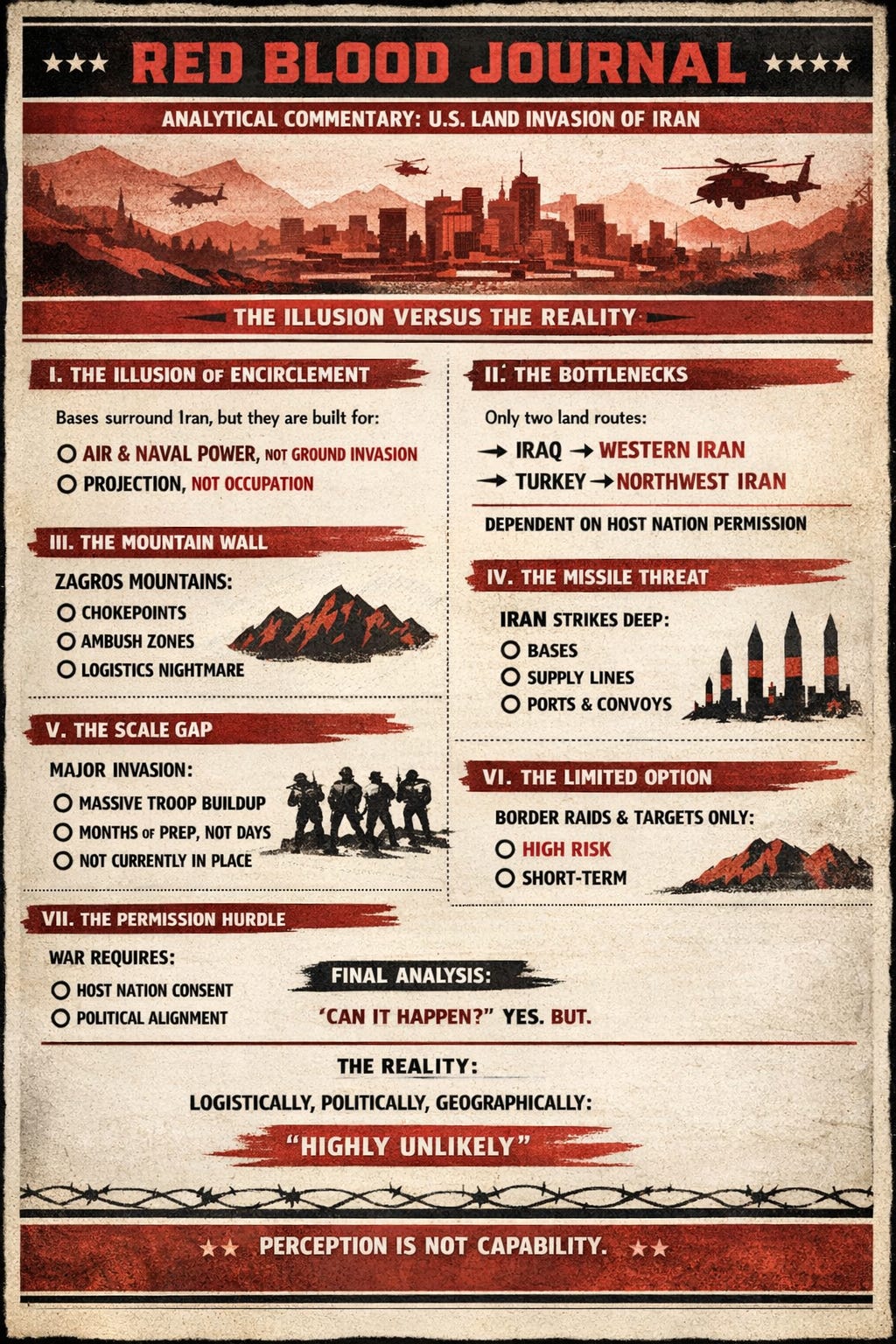
🩸 RED BLOOD JOURNAL — COMMENTARY TRANSMISSION
Archive: The Archive of Blood & Memory
Classification: ANALYTICAL COMMENTARY — GROUND WAR ILLUSION FRAMEWORK
Desk: Geo-PsyOps & Military Reality Assessment Unit
Status: DECODED FROM OPEN-SOURCE INTELLIGENCE
Why geography makes invading Iran impossible
PROLOGUE — THE MAP VS THE STORY
On the surface, the narrative appears simple:
A superpower, surrounded by bases, poised to strike a rival from multiple directions.
But maps lie.
Not by showing false terrain—but by hiding what terrain means.
What looks like proximity is not capability.
What looks like presence is not readiness.
What looks like dominance is not control.
And in the case of a U.S. land invasion of Iran—
the difference between perception and reality is the entire story.
SECTION I — THE ILLUSION OF ENCIRCLEMENT
From a distance, the positioning looks overwhelming:
Iraq
Kuwait
Saudi Arabia
Qatar
UAE
Bahrain
Turkey
A ring of presence.
A staged theater.
But the underlying structure reveals something else entirely:
Most of these positions are air, naval, and logistics hubs
Not forward ground invasion platforms
Not armored staging corridors
Not sustained land warfare infrastructure
The posture is not designed for conquest.
It is designed for projection, pressure, and deterrence
The difference is not semantic.
It is operational reality.
SECTION II — THE TWO DOORS THAT AREN’T REALLY DOORS
When stripped down to physical geography, only two real land entry points exist:
Iraq → Western Iran
Turkey → Northwestern Iran
Everything else is illusion—
because Gulf states do not connect by land.
This creates a hidden bottleneck:
Every “Gulf invasion” is actually an Iraq-dependent invasion
Which introduces the first real constraint:
Sovereignty
Political permission
Internal instability
Vulnerability to retaliation
The war cannot even begin without someone else saying yes.
And history has already shown that “yes” is not guaranteed.
SECTION III — THE TERRAIN THAT EATS ARMIES
Maps show borders.
They do not show what happens after crossing them.
Iran’s western edge is not open land.
It is a wall:
The Zagros Mountains
Narrow valleys
Chokepoints
Limited maneuver corridors
Mechanized warfare—
the backbone of U.S. land dominance—
becomes constrained, predictable, and exposed.
In such terrain:
Speed disappears
Surprise disappears
Supply lines stretch thin
Defenders gain exponential advantage
The battlefield becomes a funnel.
And funnels favor those waiting inside.
SECTION IV — THE WAR OF SUPPLY, NOT FIREPOWER
Modern war is not decided by weapons.
It is decided by logistics survival.
And here lies the core fracture:
Heavy armored operations require massive fuel
Continuous resupply
Protected transport corridors
Stable ports and staging hubs
But in this scenario:
Every base is within missile range
Every convoy becomes a target
Every port becomes a chokehold
Iran’s doctrine is not to stop the invasion at the border.
It is to destroy the system feeding it.
Because:
A tank without fuel is not a weapon.
It is debris.
Even limited operations face this reality.
Full-scale invasion multiplies it beyond control
SECTION V — THE SCALE PROBLEM NO ONE TALKS ABOUT
History leaves fingerprints.
Gulf War (1991): ~500,000 U.S. troops
Iraq invasion (2003): months of buildup, massive logistics
Those were against:
Smaller terrain challenges
Weaker defensive depth
Less advanced missile threat
Now compare:
Iran = larger geography
Mountainous terrain
Larger manpower
Integrated missile/drone networks
And current posture?
Not even close.
The conclusion is not speculation:
The existing regional force is not structured for occupation-scale ground war
SECTION VI — THE ONLY REALISTIC GROUND SCENARIO
When stripped of narrative inflation, only one ground option remains plausible:
Limited Incursion
Border raids
Temporary buffer zones
Targeted strikes
Coastal or island seizures
Even this is:
High risk
Politically constrained
Escalation-prone
And most importantly:
Easy to start.
Difficult to end.
SECTION VII — THE HIDDEN LAYER: PERMISSION STRUCTURE
War is not just fought on land.
It is authorized in layers:
Host nations must agree
Domestic populations must tolerate
International systems must absorb
Without that structure:
Bases close
Airspace restricts
Logistics collapse
This is not a battlefield problem.
It is a legitimacy problem.
And legitimacy is often the first casualty.
ANNEX A — THE COMMENTARY LENS
The public narrative simplifies conflict into:
Power vs weakness
Reach vs isolation
Capability vs inevitability
But the underlying system reveals:
Presence ≠ readiness
Access ≠ permission
Firepower ≠ sustainability
What appears as a looming invasion is, in reality:
A system optimized for pressure—
not for possession.
ANNEX B — THE PRESSURE MODEL
Pressure → Response → Escalation → Containment
Not:
Invasion → Occupation → Control
Because full invasion triggers:
Regional instability
Economic shock (Hormuz disruption)
Global backlash
Long-term entanglement
The system resists that path unless forced.
FINAL ASSESSMENT — WHAT THE MAP DOESN’T SHOW
A land invasion of Iran is not impossible.
But it is not what it appears to be.
It is:
Politically gated
Logistically fragile
Geographically constrained
Strategically expensive
And most critically:
It is not aligned with the current structure of forces in the region.
CLOSING LINE
On Planet Erath, the map is always shown first.
Because if the population studies the map long enough,
they stop asking the only question that matters:
Not “Can it happen?”
But:
“What would it actually take?”
🏔️The Myth of Encirclement:
Deconstructing an Iranian Land Invasion
This analysis challenges the common perception that U.S. military bases surrounding Iran indicate an imminent or feasible land invasion.
While maps suggest a strategic encirclement, the text argues that these installations are designed for diplomatic pressure and deterrence rather than the massive logistical requirements of a ground war.
Geographic barriers, specifically the Zagros Mountains, create natural funnels that would neutralize traditional armored superiority and expose extended supply lines to constant attack.
Furthermore, any invasion is heavily dependent on the political cooperation of neighboring sovereign nations, which is far from guaranteed.
The source concludes that current troop levels and regional structures are optimized for limited incursions rather than the high-cost, high-risk endeavor of total occupation.
Ultimately, the reality of a ground conflict is depicted as a logistical impossibility that is masked by the visual illusion of military presence.


