


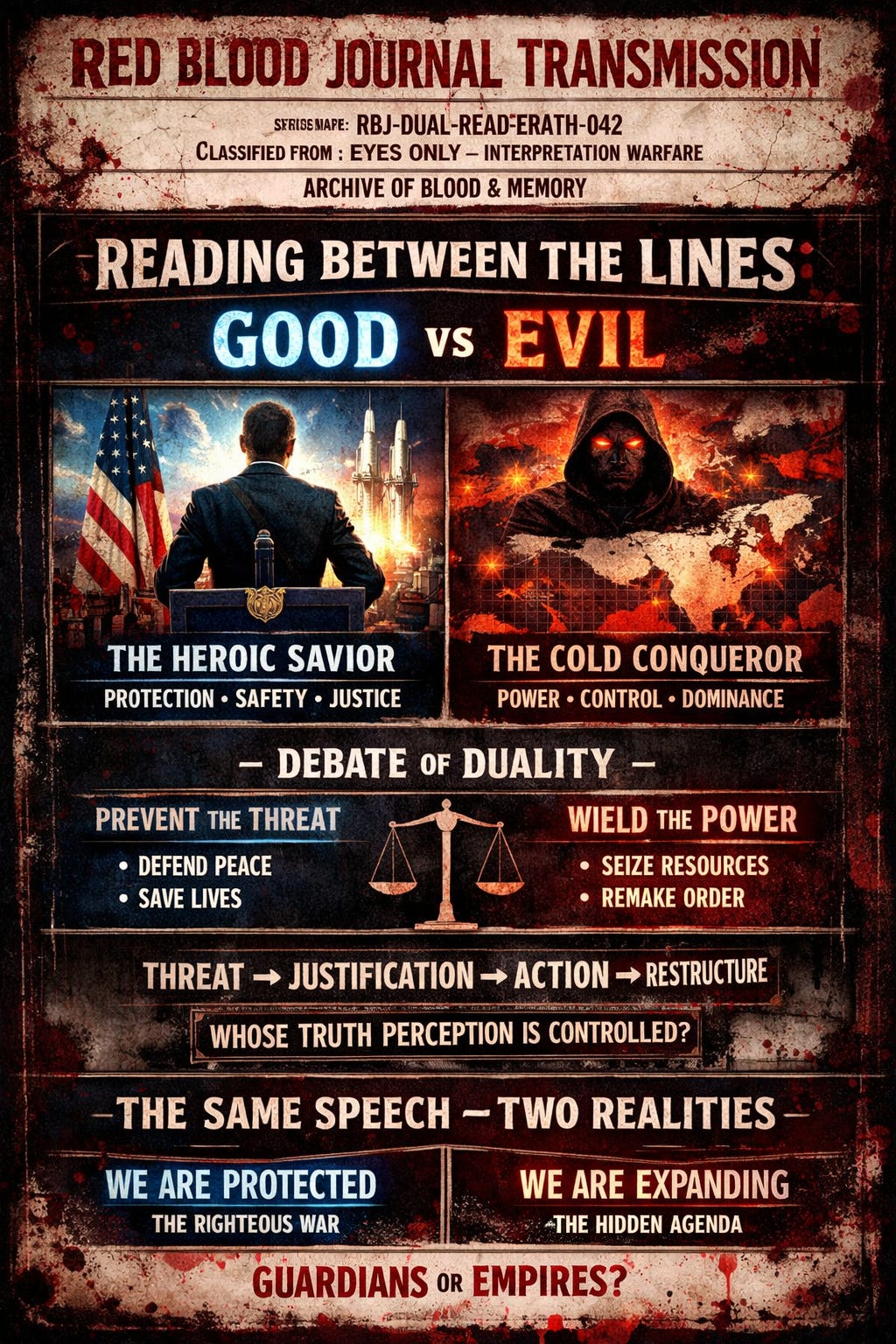
🩸 RED BLOOD JOURNAL TRANSMISSION
Transmission Code: RBJ-DUAL-READ-ERATH-042
Classification: EYES ONLY — INTERPRETATION WARFARE
Desk: Cognitive Battlefield & Narrative Analysis Unit
Archive: The Archive of Blood & Memory
How One Speech Creates Two Realities
A Study in Narrative Warfare
PROLOGUE — THE SAME WORDS, TWO WORLDS
There are moments on Planet Erath where a single speech becomes two entirely different realities.
Not because the words change…
—but because the lens does.
The document presented is one such artifact.
A declaration of power.
A justification of war.
A promise of safety.
Or…
A script.
A signal.
A narrative weapon.
This transmission does not ask what was said.
It asks:
What is being built in the mind of the listener?
I — THE OFFICIAL READ (THE “GOOD”)
Frame: Protection, Strength, Necessity
From the forward-facing lens, the speech constructs a clean moral architecture:
Enemy Defined Clearly:
Iran = “state sponsor of terror”Threat Elevated:
Nuclear weapons = existential dangerAction Justified:
Military force = defensive necessityOutcome Promised:
Safety, stability, future security
Key signals:
“Never allow Iran to have a nuclear weapon”
“Protecting our children and grandchildren”
“Free world security”
“Diplomacy was attempted first”
Interpretation (Good Lens):
This is a preventive war doctrine.
Strike before threat becomes irreversible
Remove capability, not just intention
Demonstrate overwhelming force to deter future conflict
Moral Positioning:
War is framed as reluctant but required
Civilian concern is acknowledged (gas prices, casualties)
Allies are emphasized → legitimacy signal
👉 In this lens, the speech reads as:
A leader acting decisively to eliminate a long-standing danger before it becomes catastrophic.
II — THE SHADOW READ (THE “EVIL”)
Frame: Control, Expansion, Narrative Management
Now reverse the lens.
Same words. Different structure.
Key observations:
1. Total Victory Language
“Their navy is gone”
“Their air force is gone”
“They are decimated”
👉 This is not containment — this is complete dismantling of a state
2. Economic Integration Signals
Venezuela described as:
“joint venture partners”
“production and sale of massive amounts of oil”
👉 Military → Economic pipeline
3. Energy Dominance Narrative
“Buy oil from the United States”
“We don’t need their oil”
“Take the Strait”
👉 Control of energy flow = control of global leverage
4. Regime Change Without Saying It
“Regime change was not our goal…”
“But regime change has occurred”
👉 Classic linguistic pivot:
Deny intention
Accept outcome
5. Escalation Leverage
Threat to destroy:
Electric grid
Oil infrastructure
👉 This is pressure doctrine, not just war
Interpretation (Shadow Lens):
This is not just a war speech.
It is a system restructuring announcement.
Remove adversary capability
Reshape regional power balance
Control energy supply chains
Demonstrate dominance globally
👉 In this lens, it reads as:
A controlled dismantling of a geopolitical competitor under the banner of security.
III — THE DEBATE (GOOD vs EVIL)
⚖️ Position A — Defender of the Speech
Iran posed a real and long-standing threat
Diplomacy failed repeatedly
Nuclear capability would destabilize the world
Swift action prevents larger wars later
Core Argument:
“If you wait, you lose control. Acting early saves lives long-term.”
⚖️ Position B — Challenger of the Speech
Threat narrative may be amplified or instrumentalized
Total destruction exceeds defensive necessity
Economic gains (oil, partnerships) follow military action
“Regime change” emerges despite denial
Core Argument:
“War is the tool; restructuring is the objective.”
IV — THE HIDDEN MECHANISM
Beyond good vs evil lies the mechanism itself.
The Pattern (Erath Model):
Threat → Justification → Action → Restructure → Narrative Reinforcement
From the text:
Threat = nuclear Iran
Justification = global safety
Action = overwhelming force
Restructure = energy + regional shifts
Reinforcement = “we are safer, stronger, greater”
👉 The cycle completes itself.
V — THE REAL BATTLEFIELD
The battlefield is not only Iran.
It is perception.
Two citizens can hear the same speech and walk away with:
One: “We were protected”
Another: “We expanded power”
Both are internally consistent.
Both are supported by the same text.
ANNEX A — LANGUAGE AS WEAPON
Words used repeatedly:
“Safety”
“Children”
“Threat”
“Victory”
“Strongest”
👉 These are emotional anchors, not just information.
They guide interpretation before analysis begins.
ANNEX B — STRATEGIC SIGNALS EXTRACTED
From the document :
Military dominance declared as absolute
Economic independence emphasized
Energy control positioned as leverage
Allies framed as dependent network
👉 This is multi-layer messaging:
Domestic reassurance
Global intimidation
Economic signaling
ANNEX C — THE ERATH DUALITY PRINCIPLE
On Planet Erath, every major event exists in two forms:
The Story Told
The Structure Built
Most people choose one.
Few examine both.
FINAL LINE — THE SPLIT REALITY
The speech is not inherently good or evil.
It is a mirror.
It reflects:
The fears you carry
The trust you hold
The system you believe in
And perhaps the most dangerous realization:
The same operation can be both protection and expansion—
depending on where you stand when the bombs fall.
🩸 END TRANSMISSION
🎭The Erath Duality:
A Study in Narrative Warfare
The provided text analyzes a specific military declaration regarding a conflict with Iran, viewing it through the dual lenses of moral justification and geopolitical restructuring.
One perspective frames the actions as a preventative defense necessary to ensure global security and eliminate nuclear threats for future generations.
Conversely, a more critical interpretation suggests the rhetoric serves as a cover for economic dominance and the forceful dismantling of a sovereign competitor to control global energy supplies.
The source argues that such speeches function as narrative weapons, using emotional anchors like “safety” and “victory” to shape public perception.
Ultimately, the analysis posits that the same event can be viewed as either protection or expansion, depending on the listener’s inherent trust in the system.
By breaking down the strategic signals within the speech, the text illustrates how language is used to consolidate power while simultaneously offering a narrative of peace.


