


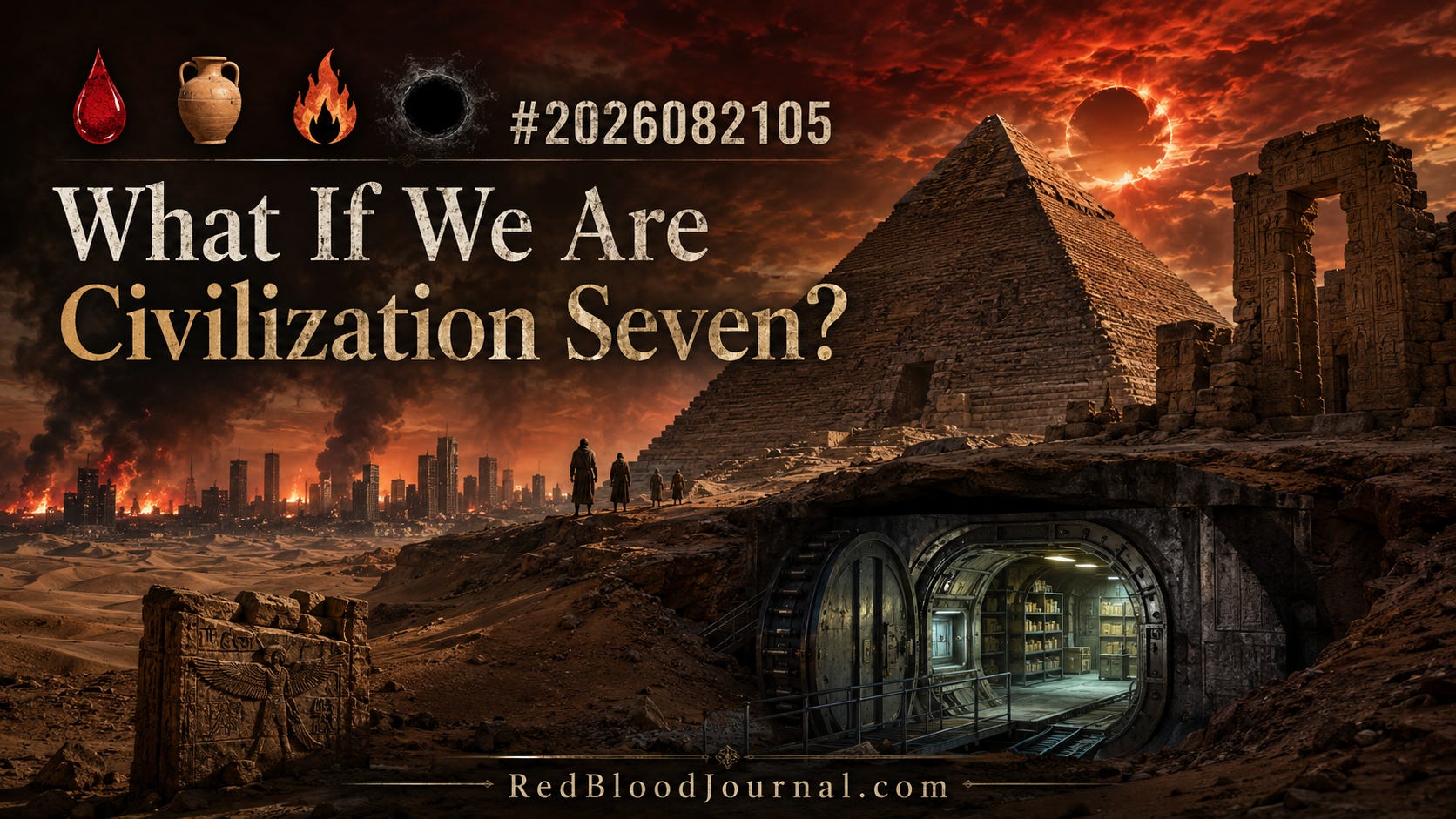
🩸 🏺 🔥 🕳️ 🔄 #2026082105 — What If We Are Civilization Seven?
The Pyramids, the Bunkers, the Survivors—and the Question Humanity Is Afraid to Ask
A Red Blood Journal Investigation
By Red Blood
Humanity keeps behaving as though technological advancement automatically means civilizational advancement.
It does not.
We have weapons capable of destroying cities in minutes.
We have biological laboratories manipulating organisms at microscopic levels.
We have artificial intelligence accumulating human knowledge at unprecedented speed.
We have governments capable of monitoring populations across continents.
And yet the animal inside the human vehicle remains remarkably familiar:
greed.
Power.
Territory.
Ego.
Fear.
Possession.
Control.
So here is the uncomfortable equation:
If technology keeps advancing while human greed remains unchecked, eventually destructive capability may exceed human wisdom.
And if that happens, what comes next?
Perhaps this is where one of humanity’s strangest questions begins.
🔻 1. WHAT IF THIS ISN’T THE FIRST TIME?
Imagine humanity reaches extraordinary technological sophistication.
Then war comes.
Nuclear exchange.
Biological catastrophe.
Environmental collapse.
Artificial intelligence gone wrong.
Or several disasters occurring simultaneously.
Billions perish.
Civilization disappears.
But not everyone dies.
Some survive.
And the survivors are unlikely to represent humanity randomly.
Because even today, some people are preparing far more seriously than others.
Governments maintain hardened facilities.
Ultra-wealthy individuals build private bunkers.
Seed banks preserve agriculture.
Data centers preserve information.
Military installations are hardened against attack.
Continuity-of-government systems are designed specifically around the possibility that ordinary society may cease functioning.
So ask the forbidden question:
If civilization collapses, who gets Civilization Two?
Not necessarily the strongest.
Not necessarily the wisest.
Perhaps simply:
those who prepared to survive Civilization One.
🔻 2. NOW RUN THE FILM BACKWARD
This becomes interesting when the same logic is applied to antiquity.
What if what humanity calls the beginning of civilization was actually a rebuilding?
Suppose an earlier human civilization reached tremendous sophistication and then suffered catastrophic destruction.
Most knowledge disappears.
Most infrastructure disappears.
Most people disappear.
But a small population survives.
Perhaps underground.
Perhaps in remote regions.
Perhaps aboard ships.
Perhaps in protected compounds built precisely for that purpose.
Then the catastrophe ends.
The doors open.
The survivors emerge.
What would they possess that everyone else did not?
Knowledge.
🔻 3. KNOWLEDGE WOULD BECOME THE GREATEST WEAPON ON EARTH
Imagine one group knows:
astronomy,
geometry,
agriculture,
medicine,
navigation,
metallurgy,
engineering,
irrigation,
calendars,
writing,
surveying,
mathematics.
Everyone else is struggling simply to survive.
Who becomes powerful?
The person carrying the biggest club?
Perhaps temporarily.
But eventually the people who know when the Nile will rise become indispensable.
The people who understand the stars become navigators.
The people who understand measurement become builders.
The people who preserve medicine become healers.
The people who preserve history become storytellers.
And the storytellers eventually become something even more powerful:
keepers of reality.
🔻 4. ENGINEERS COULD BECOME GODS
Consider what five thousand years does to a story.
Imagine someone emerges after catastrophe possessing knowledge others cannot understand.
He predicts an eclipse.
To him, it is astronomy.
To everyone else, perhaps:
He made the Sun disappear.
Someone understands sanitation.
People around him stop dying from disease.
To him, it is medicine.
To them:
He possesses healing powers.
Someone understands irrigation.
A desert produces crops.
To him, it is engineering.
To succeeding generations:
He brought life from the Earth.
Within several generations:
engineer becomes master.
Then:
master becomes prophet.
Then:
prophet becomes demigod.
Eventually:
the human disappears from the story entirely.
Only the god remains.
🔻 5. THEN COME THE PYRAMIDS
This does not mean aliens built the Egyptian pyramids.
It does not even mean an earlier advanced civilization built them.
The archaeological evidence overwhelmingly places their construction within ancient Egyptian civilization.
But another question remains legitimate:
Where did civilizations obtain and preserve their knowledge?
Egypt appears sophisticated because Egypt was sophisticated.
Its builders possessed remarkable abilities in organization, surveying, logistics, stoneworking and mathematics.
But what if some human knowledge is older than the civilizations to which archaeology currently attributes it?
Not machinery.
Not spaceships.
Not science-fiction technology.
Just:
knowledge.
Knowledge can survive when machines cannot.
🔻 6. THE MACHINE DISAPPEARS BEFORE THE IDEA
Imagine our civilization disappears tomorrow.
How long would smartphones survive?
Perhaps decades.
Cars?
A few centuries as fragments.
Skyscrapers?
Eventually ruins.
Digital servers?
Without electricity and maintenance, much of their information could disappear remarkably quickly.
But mathematics?
That can be copied.
Astronomy?
Copied.
Agriculture?
Taught.
Geometry?
Memorized.
Stories?
Repeated.
Therefore a future civilization might inherit our ideas without inheriting our machines.
That distinction changes everything.
Because archaeology five thousand years later might find relatively little evidence of the technical civilization that originally discovered the knowledge.
It would see only the civilization that inherited fragments of it.
🔻 7. THE BUNKER PROBLEM
Now return to 2026.
Why do powerful governments maintain hardened shelters?
Easy answer:
Because nuclear war is possible.
Why do wealthy individuals build elaborate survival compounds?
Easy answer:
Because they can afford to prepare.
Nothing mysterious is required.
But the philosophical implication is enormous.
Because bunkers accidentally reveal something about civilization:
Power already thinks beyond catastrophe.
Not everyone is merely asking:
How do we prevent the end?
Some are also asking:
How do we survive it?
Those are very different questions.
🔻 8. WHO GETS TO ENTER?
Suppose catastrophe actually comes.
A bunker cannot accommodate eight billion people.
Someone chooses who enters.
Political leadership.
Military leadership.
Engineers.
Doctors.
Scientists.
Communications specialists.
Security personnel.
Agricultural experts.
Perhaps families.
Perhaps wealthy sponsors.
Perhaps people never publicly identified.
Afterward, the surviving population would therefore contain a disproportionate amount of:
knowledge + authority + organization.
That population would have an enormous advantage when rebuilding begins.
🔻 9. CIVILIZATION SEVEN
Now consider the thought experiment.
Imagine this cycle happened before.
Civilization One develops.
Civilization One collapses.
Survivors become founders of Civilization Two.
Civilization Two eventually rises and collapses.
Survivors become founders of Civilization Three.
Repeat.
Eventually humanity arrives here.
What if we are Civilization Six?
Then the people preparing underground today may unknowingly be selecting the founding population of:
Civilization Seven.
And suddenly another question appears.
Who ruled Civilization Five?
Because if the mechanism works forward—
why couldn’t it have worked backward?
🔻 10. THE GREAT SECRET WOULD NOT NEED TO BE A MACHINE
People imagine that if ancient societies possessed hidden knowledge, somewhere there must be a fantastic machine hidden underneath a pyramid.
Perhaps that expectation is wrong.
The greatest secret might simply have been:
memory.
A historical record explaining:
who existed before,
what destroyed them,
what technologies became dangerous,
where survivors went,
how civilization was restarted,
and what knowledge must never again become widely available.
That would be more valuable than gold.
And infinitely more dangerous.
🔻 11. WHY WOULD KNOWLEDGE BECOME SECRET?
Suppose the survivors believed unrestricted knowledge caused the previous destruction.
What lesson might they teach their children?
Perhaps:
Knowledge must be controlled.
Then generations later:
information becomes restricted.
Restricted information becomes sacred knowledge.
Sacred knowledge belongs to initiates.
Initiates become priesthoods.
Priesthoods become institutions.
Institutions become political power.
Eventually nobody remembers why the knowledge was restricted.
They merely know:
the people inside the chamber may know what the people outside cannot.
Suddenly humanity’s ancient fascination with:
secret orders,
initiation ceremonies,
restricted temples,
forbidden rooms,
hidden archives,
sacred writings,
and priestly knowledge
takes on another possible interpretation.
Not proof.
But a question worth asking.
🔻 12. PERHAPS MYTH IS DAMAGED HISTORY
Human cultures contain extraordinary stories of catastrophic destruction.
Floods.
Fire.
Darkness.
Civilizations erased.
Small groups surviving.
Teachers arriving afterward.
Knowledge being given to humanity.
New civilizations beginning.
Academics understandably interpret many of these accounts as mythology, symbolism, religious tradition, memories of regional catastrophes, or combinations of these.
But perhaps mythology deserves another question:
Could some myths contain compressed historical memory?
A story passed orally for centuries changes.
Names change.
Technology becomes magic.
Humans become supernatural beings.
Events merge.
Timelines collapse.
And eventually:
history becomes religion.
🔻 13. QUESTION EVERYTHING—INCLUDING THIS REPORT
There is an enormous danger here.
Humans love patterns.
Once a theory appears capable of explaining everything, the mind begins forcing everything into that theory.
Pyramids become evidence.
Flood legends become evidence.
Bunkers become evidence.
Secret societies become evidence.
Missing artifacts become evidence.
Soon even the absence of evidence becomes evidence.
That is exactly when investigation turns into belief.
So Red Blood Journal applies the same rule to this hypothesis that it applies to official narratives:
Question it.
What evidence would prove it wrong?
What physical evidence should exist if an industrial civilization preceded ours?
Where are its mines?
Where are its manufactured materials?
Where are chemical signatures?
Where are unmistakable technological artifacts in securely dated ancient geological layers?
Where is the evidence that cannot reasonably be explained by known ancient civilizations?
Until those things appear, the previous-technological-civilization theory remains:
a hypothesis.
Not history.
🔻 14. BUT DON’T STOP ASKING BECAUSE THE ANSWER IS UNCOMFORTABLE
Skepticism should work in both directions.
Rejecting extraordinary claims without evidence is reasonable.
Declaring extraordinary possibilities impossible before investigating them is not.
The proper position is:
We don’t know.
And those may be the three most intelligent words available to humanity.
🔻 15. THE QUESTION UNDERNEATH THE QUESTION
Perhaps humanity has been asking the wrong question about the ancient world.
Instead of:
How did primitive people build extraordinary things?
Ask:
Were they actually primitive?
Instead of:
Who were their gods?
Ask:
What historical experiences produced the stories later called gods?
Instead of:
Where did their knowledge come from?
Ask:
How far backward does human knowledge really extend?
And instead of merely asking:
Why are people building bunkers today?
Ask:
What would humanity think those survivors were 5,000 years from now?
📦 RECEIPTS BOX
What is established
Ancient Egyptians built enormous monumental structures using sophisticated organization, mathematics, labor systems and engineering.
Human societies have repeatedly suffered catastrophic regional collapses.
Knowledge can disappear when institutions collapse.
Modern governments maintain continuity and hardened infrastructure.
Modern individuals and institutions maintain bunkers, archives, seed repositories and other systems intended to preserve life or knowledge through catastrophe.
What remains hypothetical
That technologically advanced global civilizations existed before recorded history.
That their elites survived previous catastrophes inside protected facilities.
That survivors became ancient priesthoods or ruling classes.
That ancient gods were memories of technologically knowledgeable humans.
That pyramids preserve knowledge inherited from a lost global civilization.
These possibilities require evidence beyond their ability to create an appealing explanation.
🩸 THE RED BLOOD PERSPECTIVE
The greatest intellectual mistake is not believing the wrong theory.
It is deciding beforehand which questions humanity is permitted to ask.
Power prefers certainty.
Religion prefers certainty.
Governments often prefer certainty.
Institutions prefer certainty.
Conspiracy theories prefer certainty too.
But discovery begins somewhere else:
uncertainty accompanied by curiosity.
Question the textbook.
Question the alternative historian.
Question the priest.
Question the billionaire.
Question the archaeologist.
Question the whistleblower.
Question the government.
Question Red Blood.
And above all:
question the explanation that feels so perfect that you no longer want to question it.
🌊 THE OCEAN OF LOVE AND POSITIVITY PERSPECTIVE
Perhaps the most important lesson has nothing to do with discovering Civilization Five.
Perhaps it concerns whether Civilization Seven ever needs to exist.
If greed repeatedly destroys civilizations, then building a better bunker is not humanity’s greatest achievement.
Removing the reason the bunker is necessary would be.
If the animal vehicle keeps obtaining increasingly powerful weapons while the spiritual driver remains asleep, technology eventually becomes a countdown clock.
But if consciousness develops alongside technology—
if compassion grows alongside power—
if wisdom grows alongside knowledge—
then perhaps humanity can finally break the cycle.
Maybe our responsibility isn’t to discover who survived the last destruction.
Maybe it is to ensure our children never have to survive the next one.
Because the greatest civilization would not be the civilization that builds the strongest pyramid.
Or the deepest bunker.
Or the deadliest weapon.
It would be the first civilization wise enough not to destroy itself.
And perhaps that is the examination Civilization Six has been given.
Will we become the ancestors of Civilization Seven?
Or will we finally become the civilization that never needs replacing?
In an Ocean of Love and Positivity.
🩸🌊✨ Fantastic!
🔄
Civilization Seven: The Cycle of Survival and Hidden Knowledge
Aug 21, 2026
This text explores the cyclical nature of human history by proposing that modern society might be one in a long line of technologically advanced civilizations that collapsed and restarted. The author suggests that knowledge is the ultimate survival tool, allowing small groups of prepared elites to emerge from catastrophes and appear as gods or miracle workers to less-informed survivors. By drawing parallels between modern bunkers and ancient structures, the source argues that mythology may actually be compressed history of previous eras. However, it maintains a skeptical stance, urging readers to demand physical evidence before accepting these ideas as fact. Ultimately, the narrative serves as a philosophical warning that humanity must develop wisdom and compassion to match its destructive power. It concludes that the true goal of our current age should be breaking the cycle of destruction rather than merely preparing for the next collapse.
#RedBloodJournal #CivilizationSeven #WhatIfWeAreCivilizationSeven #LostCivilizations #AncientCivilizations #AncientMysteries #Pyramids #EgyptianPyramids #CivilizationCollapse #CivilizationReset #HumanHistory #HiddenHistory #LostKnowledge #AncientKnowledge #SurvivalBunkers #EliteBunkers #ContinuityOfCivilization #KnowledgePreservation #Catastrophe #Humanity #Archaeology #Mythology #SecretKnowledge #QuestionEverything #OceanOfLoveAndPositivity #RedBlood #2026082105


