


🩸 Red Blood Journal
Report #1831
When Healing Threatens the Market
The Disappearance of Original Comtrex and the Medicine Cabinet That Replaced It
Executive Summary
There was once an over-the-counter cold medicine that many people remember not merely as helpful, but as remarkably effective.
Its name was Comtrex.
When symptoms began, a person could take the recommended capsules and receive broad relief from congestion, coughing, sneezing, fever, headache, runny nose and body aches.
One medicine addressed nearly everything.
Then the original formula disappeared.
The official explanation centered on phenylpropanolamine, or PPA—a powerful decongestant associated with a rare risk of hemorrhagic stroke. That risk cannot simply be ignored.
But neither should the unanswered questions.
The major study did not establish a statistically conclusive increase in hemorrhagic stroke from ordinary PPA-containing cough and cold remedies. Its strongest finding concerned women using PPA as an appetite suppressant, generally involving a different purpose and potentially greater exposure.
Nevertheless, PPA disappeared from human cold medicine entirely.
It was not placed behind the pharmacy counter.
It was not reserved for prescription use.
It was not retained at lower doses with stronger warnings.
It was not made available to informed patients under medical supervision.
It was removed.
The comprehensive medicine vanished, while a marketplace of divided, repeatedly purchased and frequently less-effective remedies expanded around the empty space it left behind.
This report asks whether that outcome represented public protection alone—or whether modern medicine is structured in a way that makes prolonged treatment more valuable than complete relief.
1. The Medicine People Remember
The original Comtrex experience is difficult to explain to someone familiar only with today’s cold-medicine aisle.
It did not require purchasing one medicine for daytime congestion, another for nighttime coughing, another for fever, another for allergies and another for sinus pressure.
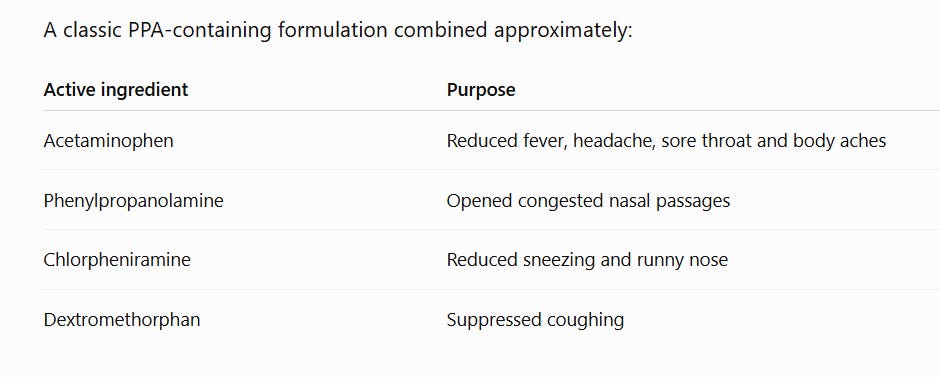
The formulation did not destroy the cold virus. The immune system still performed that work.
But from the patient’s perspective, the distinction sometimes appeared almost meaningless.
If the congestion opened, coughing stopped, fever declined, the body stopped aching and the patient could sleep, work and function normally, it felt as though the cold had disappeared.
That experience matters.
Medicine is not valuable only when it eliminates a pathogen. It is also valuable when it reduces suffering and restores normal life while the body heals.
2. Testimony from the Medicine Cabinet
This investigation began with firsthand memory:
“The original was so good that when a cold began, all that was necessary was to take the recommended capsules several times a day. The cold seemed to go away without making the person feel sick. Then, suddenly, Comtrex disappeared—and nothing else ever provided the same relief.”
Institutional records may list ingredients, regulatory dates and statistical findings.
They cannot fully record the experience of millions of people standing inside pharmacies, searching for a familiar medicine that was no longer there.
They do not preserve conversations with pharmacists.
They do not record how replacement formulas felt.
They do not document the moment consumers realized that the product carrying a familiar name was no longer the medicine they remembered.
This is where personal testimony becomes historically important.
Official records describe what institutions decided.
Living witnesses describe what those decisions did.
3. The Ingredient That Made the Difference
The defining ingredient in the older formula was phenylpropanolamine, commonly known as PPA.
PPA constricted swollen blood vessels in the nasal passages, reducing congestion and allowing easier breathing. It was widely used in cold medicines and appetite suppressants.
It was also a stimulant-like compound capable of raising blood pressure.
Reports emerged associating PPA with hemorrhagic stroke—a form of stroke caused by bleeding in or around the brain. The outcome could be catastrophic, including permanent disability or death.
That concern deserved investigation.
But investigation and elimination are not identical actions.
The important question is not whether PPA presented zero risk.
Nothing presents zero risk.
The question is whether the demonstrated risk from ordinary cold-medicine use justified removing every informed adult’s ability to obtain it.
4. What the Major Study Actually Found
The Yale Hemorrhagic Stroke Project examined 702 patients aged 18–49 who had suffered hemorrhagic strokes and compared them with 1,376 control subjects.
For men and women combined, the adjusted odds ratio associated with any recent PPA exposure was approximately 1.49.
For PPA-containing cough and cold remedies specifically, the adjusted odds ratio was approximately 1.23.
That cold-remedy result was not statistically conclusive.
The strongest association appeared among women using PPA-containing appetite suppressants. That adjusted odds ratio was approximately 15.92, although the estimate was based on relatively few exposed participants and had a very wide confidence interval.
Risk also appeared elevated among first-time users and at greater recent exposure.
These findings justified warnings, dose scrutiny and additional research.
But they did not establish that ordinary Comtrex users were becoming sick in substantial numbers.
The catastrophic event appears to have been extraordinarily rare. Estimates discussed around PPA suggested that well over 99.99% of users did not experience the hemorrhagic stroke that drove the regulatory decision.
The precise percentage for Comtrex users was never established.
Yet a statistically uncertain cold-remedy association was followed by a near-total removal of PPA from human access.
5. The Alternatives Regulators Did Not Preserve
Public discussion often presents only two choices:
Leave PPA completely unrestricted.
Remove it entirely.
That is a false choice.
Many intermediate protections were available:
Require a prescription.
Place it behind the pharmacy counter.
Screen for uncontrolled hypertension and cardiovascular risk.
Prohibit its use as an appetite suppressant.
Restrict total daily dosage.
Require prominent stroke warnings.
Limit package quantities.
Exclude first-time unsupervised use.
Require pharmacist counseling.
Establish an adverse-event registry.
Permit physicians and informed patients to decide together.
Society already uses these systems for countless medicines.
Pseudoephedrine remains available behind pharmacy counters.
Opioids remain available by prescription despite addiction and overdose risks.
Blood thinners remain available despite potentially fatal bleeding.
Chemotherapy remains available despite severe toxicity.
The presence of risk does not normally settle the matter. Medicine routinely balances danger against benefit.
With PPA, however, the balancing process ended with consumers receiving no choice at all.
6. The Risks Society Allows
An adult may legally:
Consume alcohol despite its association with cancer, liver failure, addiction, violence and fatal accidents.
Smoke cigarettes despite overwhelming evidence of disease and premature death.
Ride a motorcycle despite a measurable risk of catastrophic injury.
Operate an automobile despite tens of thousands of traffic deaths annually.
Purchase household and agricultural chemicals surrounded by continuing cancer litigation.
Use prescription drugs carrying black-box warnings for disability and death.
Society does not eliminate these activities merely because serious harm is possible.
Instead, it relies upon warnings, age restrictions, licenses, instructions, taxes, protective equipment and personal responsibility.
Why was informed choice unacceptable for Comtrex?
Regulators may answer that a cold normally resolves by itself and therefore does not justify even a tiny risk of stroke.
But that is a value judgment—not an unchallengeable scientific conclusion.
It assumes that regulators, rather than informed adults and physicians, should determine how much suffering a person must tolerate and which risks that person may voluntarily accept.
The same society that permits a person to purchase enough alcohol to cause fatal poisoning decided that the same adult could not obtain a controlled dose of PPA under any circumstances.
That contradiction requires more than the phrase “public safety.”
7. The Medicine Cabinet After Comtrex
After the original formula disappeared, the cold-medicine aisle did not become smaller.
It expanded.
Consumers encountered:
Daytime products
Nighttime products
Cough-only products
Sinus-only products
Mucus products
Allergy products
Severe-cold products
Pain-and-fever products
Nasal sprays
Throat treatments
Products combining several partially effective ingredients
One comprehensive experience became a collection of incomplete solutions.
Pseudoephedrine remained effective but moved behind pharmacy counters because it could be used in illegal methamphetamine production.
Manufacturers increasingly substituted oral phenylephrine because it could remain on open shelves.
Years later, an FDA advisory committee unanimously concluded that oral phenylephrine was ineffective as a nasal decongestant at the permitted dosage. The FDA subsequently proposed removing oral phenylephrine from the over-the-counter monograph.
The result is difficult to ignore.
An effective decongestant associated with a rare disputed cold-use risk disappeared.
Another effective decongestant became restricted for reasons unrelated to ordinary medical use.
A substantially weaker substitute occupied pharmacy shelves for years.
Consumers continued paying.
8. When One Effective Product Becomes Many Purchases
A capitalist market rewards revenue.
That statement does not require believing that every company is malicious or that every regulator is corrupt.
It describes the operating mechanism of the system.
A company is financially rewarded when customers:
Buy repeatedly
Purchase multiple products
Remain dependent upon continuing treatment
Choose branded formulations
Return whenever symptoms reappear
A medicine that provides broad relief with a few inexpensive doses may be excellent for the patient.
It may be less valuable to a market built around repeated consumption.
The original Comtrex satisfied several needs inside one product. The fragmented medicine cabinet satisfies those needs through multiple transactions.
That does not prove that pharmaceutical companies secretly arranged Comtrex’s removal.
But it establishes that the outcome aligned comfortably with commercial incentives.
An investigator must therefore ask:
When a regulatory decision produces both restricted medical choice and a larger replacement market, who examined whether commercial interests influenced the available alternatives?
9. Comtrex Was Also a Commercial Product
A serious investigation must confront the strongest counterargument.
Comtrex itself was manufactured and sold for profit.
If it worked exceptionally well, why would its manufacturer not fight to preserve such a successful product?
There are several possibilities:
Liability exposure became greater than anticipated future profits.
PPA could be replaced more cheaply than defended.
The manufacturer’s broader business strategy moved away from consumer medicines.
Regulators made continued human use commercially impractical.
Competing formulations could occupy the same market without the same legal exposure.
A fragmented market proved at least as profitable as one dominant comprehensive remedy.
These possibilities do not require a secret order to eliminate an effective medicine.
Large systems frequently produce coordinated-looking results because every institution follows its own financial and legal incentives.
The manufacturer avoids liability.
The regulator avoids blame.
The retailer continues selling replacements.
The media repeats the safety explanation.
The consumer purchases several new products.
No participant needs to admit responsibility for the final outcome.
The system moves in one direction because material incentives make every other direction more difficult.
10. Safety or Selective Safety?
The issue is not whether regulators should protect the public.
They should.
The issue is whether protection is applied consistently.
If an extremely rare and statistically uncertain risk from ordinary cold use justifies total removal, why are substantially more dangerous products handled through warnings and controlled access?
If informed adults cannot accept PPA’s risk, why may they accept much greater risks when alcohol, transportation, agriculture or another powerful industry depends upon that freedom?
The answer may be that risk is not evaluated in isolation.
It is evaluated alongside material importance.
A product supported by an enormous industry possesses defenders, lobbyists, lawyers, political relationships and economic leverage.
A replaceable cold-medicine ingredient possesses fewer protectors.
Safety may therefore become strictest where removal is economically easiest.
That is not neutral public health.
It is selective safety shaped by power.
11. The Difference Between Evidence and Permission
Science should determine:
What the medicine does
How often it causes harm
Which patients face greater risk
Which doses are safer
Which alternatives work
What remains uncertain
But science alone does not decide whether adults may obtain a medicine.
That decision belongs to institutions.
Institutions determine whether evidence leads to:
A warning
A dosage change
Restricted access
Prescription status
Additional trials
Or complete removal
The PPA evidence did not mechanically require one predetermined response.
Institutions chose elimination over controlled choice.
That distinction is essential.
The disappearance of Comtrex was not simply “what science decided.”
It was what authorities decided to do with incomplete scientific evidence.
12. The Larger Pattern
Comtrex is not merely a nostalgic story about an old cold medicine.
It introduces a broader pattern:
Patients and physicians report that a treatment works.
Authorities identify a risk, uncertainty or absence of approved evidence.
Access becomes restricted.
Less-effective or more profitable alternatives occupy the market.
Consumers are told that the original treatment was removed for their protection.
The practical loss experienced by patients disappears from the official history.
Anyone questioning proportionality is treated as opposing science.
But questioning a regulatory response is not opposition to science.
It is part of science.
A system that cannot tolerate questions about probability, proportionality, alternatives and financial incentives is no longer merely protecting evidence.
It is protecting authority.
13. The Material Question
The most important question is not whether every pharmaceutical company prefers illness over health.
That accusation would be too broad and too simple.
The deeper question is whether the material structure of healthcare rewards complete healing as strongly as it rewards continued treatment.
A healthy person may require no further product.
A patient whose symptoms are partially controlled continues returning.
A comprehensive medicine completes several transactions at once.
A fragmented treatment system creates many transactions.
When money becomes the measurement of success, the system may not need to consciously oppose healing.
It may simply invest more heavily in what remains profitable.
That is how material incentives can guide medicine without announcing themselves.
Conclusion
Original Comtrex appears to have been an unusually effective multi-symptom cold medicine for many users.
Its PPA ingredient carried a possible risk of hemorrhagic stroke that deserved serious attention.
But the evidence for ordinary cough and cold use was far less conclusive than the public was led to believe. The strongest association involved appetite-suppressant use, yet access to PPA cold medicine disappeared for everyone.
Controlled access was possible.
Prescription status was possible.
Pharmacist screening was possible.
Warnings and dose restrictions were possible.
Informed consent was possible.
Authorities selected removal.
The medicine cabinet that followed became larger, more fragmented and frequently less effective.
That does not yet prove a coordinated crime.
It establishes something more fundamental:
The system removed the patient’s right to weigh a tiny medical risk while preserving countless larger risks protected by stronger material interests.
The disappearance of Comtrex therefore deserves to be remembered not only as the loss of a medicine, but as an early warning.
When healing enters a material system, effectiveness is not the only force determining what survives.
Profit matters.
Liability matters.
Institutional power matters.
Political protection matters.
And sometimes the medicine that disappears tells more truth about the system than all the products remaining on the shelf.
🩸 RedBloodJournal.com 🩸
From the ocean of love and positivity—
where medicine exists to relieve human suffering, and material systems remain servants of life rather than masters over it.
🩸🌊✨ Fantastic!
💊 The Comtrex Legacy:
When Healing Threatens the Market
Jul 17, 2026
This report investigates the disappearance of the original Comtrex cold medicine, specifically focusing on the removal of its key ingredient, phenylpropanolamine (PPA). While regulators cited a risk of hemorrhagic stroke as the reason for the ban, the text argues that the scientific evidence regarding standard cold-remedy dosages was statistically inconclusive. The author suggests that instead of total elimination, authorities could have utilized prescriptions or warnings to preserve patient access to this highly effective treatment. The disappearance of a single comprehensive remedy led to a fragmented marketplace of multiple, less effective products, benefiting pharmaceutical companies through repeated consumer purchases. Ultimately, the source questions whether modern healthcare prioritizes corporate profit and liability avoidance over the genuine relief of human suffering. This narrative serves as a broader critique of how institutional power and material incentives dictate which medicines remain available to the public.


