


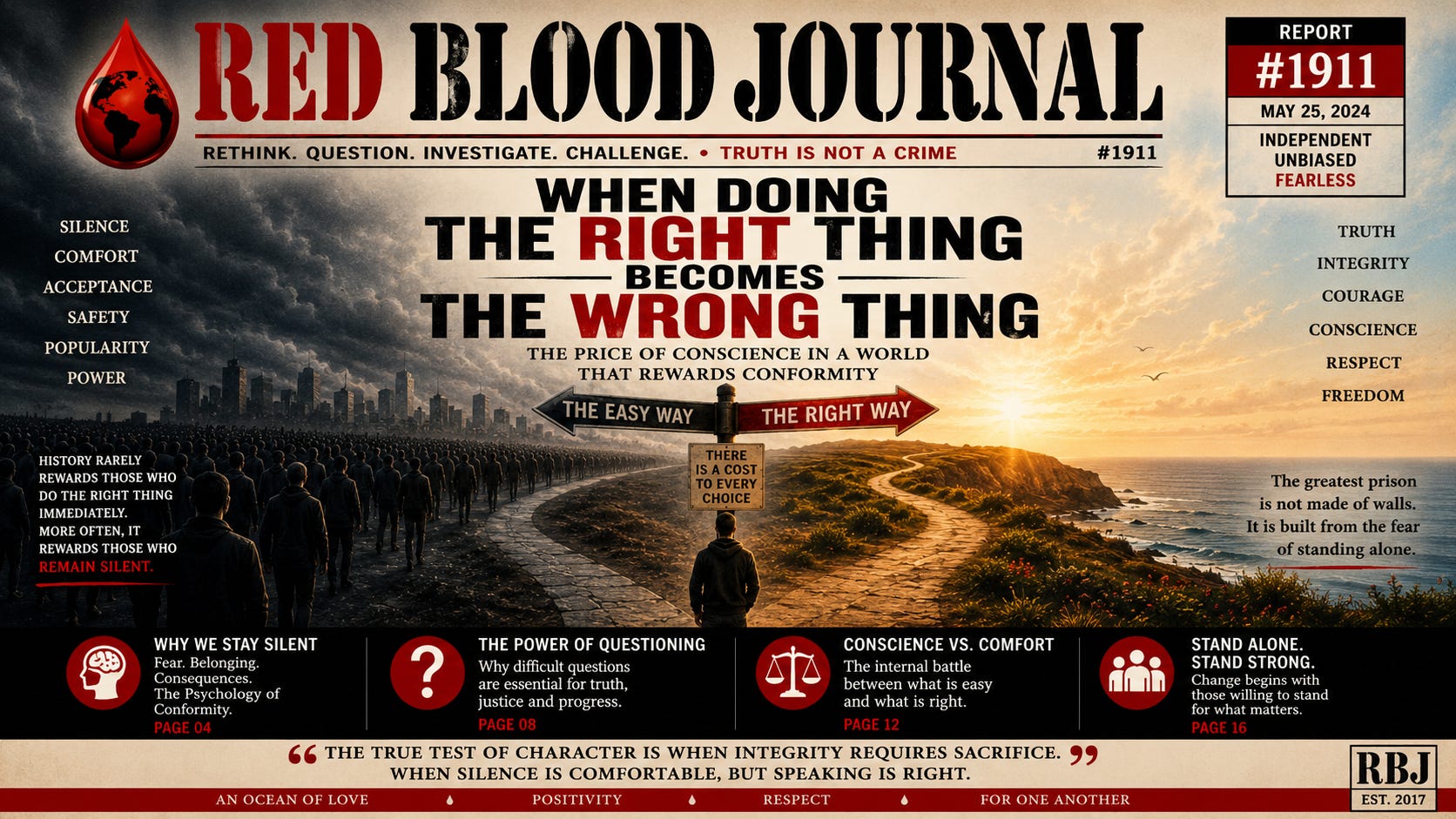
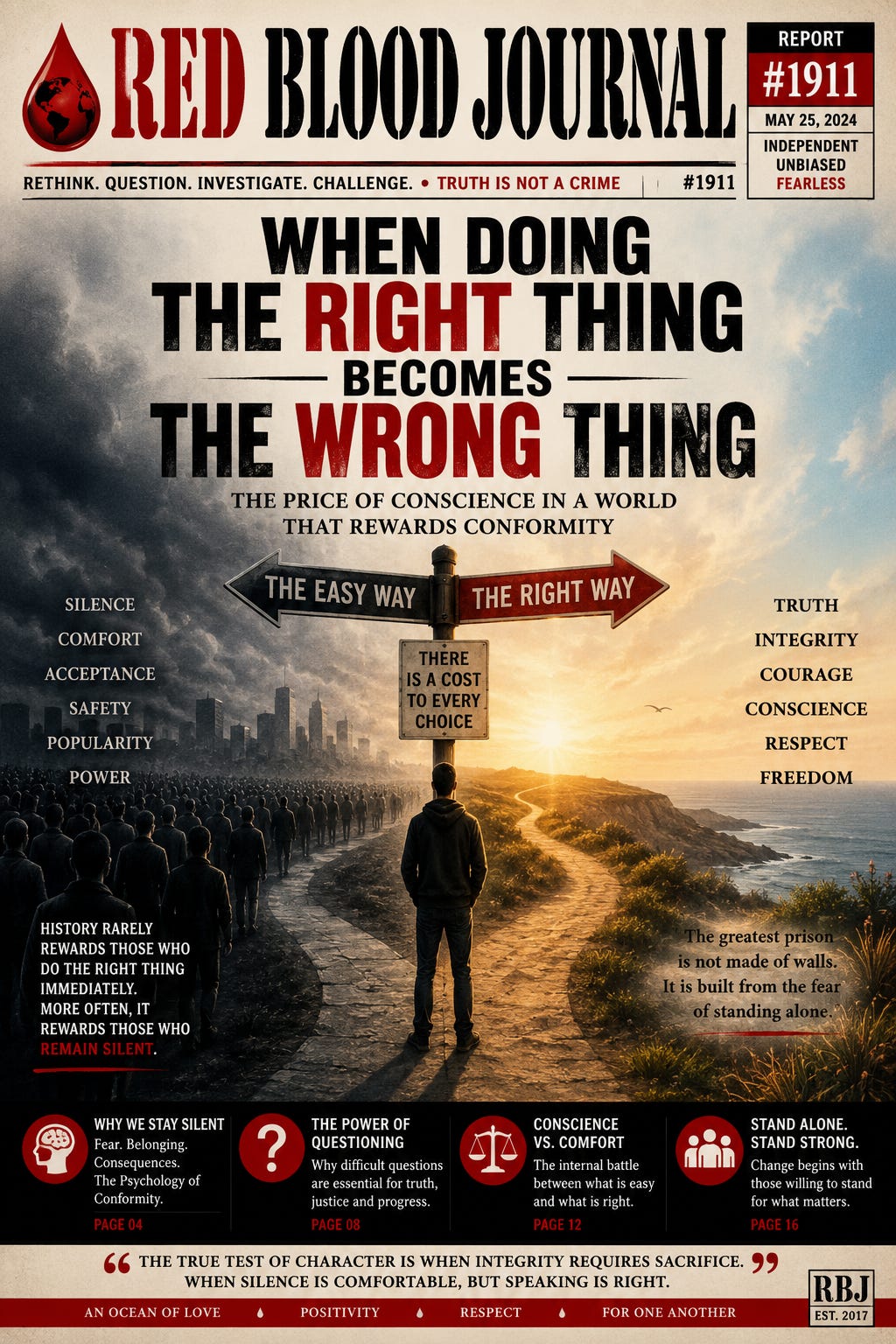
🩸 Red Blood Journal
Report #1911
When Doing the Right Thing Becomes the Wrong Thing
The Price of Conscience in a World That Rewards Conformity
Executive Summary
Throughout history, societies have celebrated courage in hindsight while often discouraging it in the present.
The paradox is simple:
Doing the right thing frequently feels like doing the wrong thing.
Not because morality has changed, but because standing by one’s conscience often comes with immediate consequences that make compromise appear attractive.
The individual who remains silent is often rewarded.
The individual who speaks is often questioned.
This report explores why conscience and comfort rarely travel together.
The Invisible Test
Most people imagine that they will recognize the moment when history asks them to make a moral decision.
In reality, those moments rarely announce themselves.
Instead, they arrive disguised as ordinary choices:
Should I remain silent?
Should I ask the uncomfortable question?
Should I defend someone who is unpopular?
Should I risk my position?
Should I follow my conscience or follow the crowd?
The difficulty is that the correct answer often carries the greatest personal cost.
Why Silence Is Rewarded
Every institution depends upon stability.
Businesses.
Governments.
Political parties.
Religious organizations.
Corporations.
Even families.
Stability often depends upon people accepting the existing narrative.
Questioning that narrative can create discomfort.
For this reason, silence frequently becomes the safest path.
Not because silence is right.
Because silence is convenient.
The Cost of Conscience
Following one’s conscience may cost:
Friends
Career opportunities
Financial security
Popularity
Social acceptance
Professional reputation
Meanwhile, conformity often offers:
Approval
Promotions
Comfort
Safety
Belonging
The temptation is understandable.
Human beings naturally seek acceptance.
Yet history repeatedly shows that meaningful change has rarely begun with the majority.
The Burden of Asking Questions
Every generation inherits accepted beliefs.
Some prove correct.
Others are revised.
Progress depends upon individuals willing to ask difficult questions without assuming they already know the answers.
Questioning should not be confused with certainty.
Nor should disagreement be confused with truth.
A healthy society allows ideas to be examined openly, tested against evidence, and debated respectfully.
Without that process, knowledge cannot advance.
Looking Back
History often transforms yesterday’s critic into tomorrow’s visionary.
Many individuals who challenged accepted ideas were criticized during their own lifetime.
Only later were their contributions reconsidered.
This does not mean every dissenter is correct.
It means societies benefit when people are free to question, investigate, and examine claims without fear alone determining the outcome.
The Real Examination
The true measure of character is rarely found when doing the right thing is easy.
It appears when integrity requires sacrifice.
When speaking carries consequences.
When silence offers comfort.
When conscience asks for courage.
The greatest moral tests seldom arrive with certainty.
They arrive with risk.
Final Reflection
Perhaps conscience exists for precisely these moments.
If doing the right thing never required sacrifice, integrity would have little meaning.
History remembers many who stood alone before they stood with the majority.
The challenge for every generation is not simply to ask what is popular.
It is to ask what is right.
Sometimes the greatest indication that we are following our conscience is that doing the right thing feels like doing the wrong thing.
Subjects
Conscience
Moral Courage
Integrity
Conformity
Social Pressure
Speaking Out
Truth and Responsibility
Freedom of Thought
Ethical Decision-Making
Character
Philosophy
Human Nature
Independent Thinking
Personal Responsibility
🩸 Closing Note
The purpose of Red Blood Journal is not to tell readers what to believe, but to encourage them to think independently, examine ideas honestly, and follow their own conscience with humility, compassion, and courage.
May we continue to navigate life with an ocean of love, positivity, and respect for one another.
🩸🌊✨ Fantastic!
🩸 The High Cost of Conscience
Jul 17, 2026
The provided text explores the paradox of moral courage, suggesting that following one’s conscience often feels like a mistake because it triggers immediate social and professional consequences. While societies eventually honor historical figures who challenged the status quo, the report argues that conformity is frequently rewarded in the present to maintain institutional stability. True integrity is defined not by easy choices, but by the willingness to endure personal sacrifice for the sake of truth and independent thought. The source ultimately serves as a philosophical reflection on the tension between social acceptance and ethical duty, urging readers to prioritize their values over the comfort of silence. By examining the risks of dissent, it highlights how a healthy society depends on those brave enough to ask uncomfortable questions.


