


🩸 RedBloodJournal.com
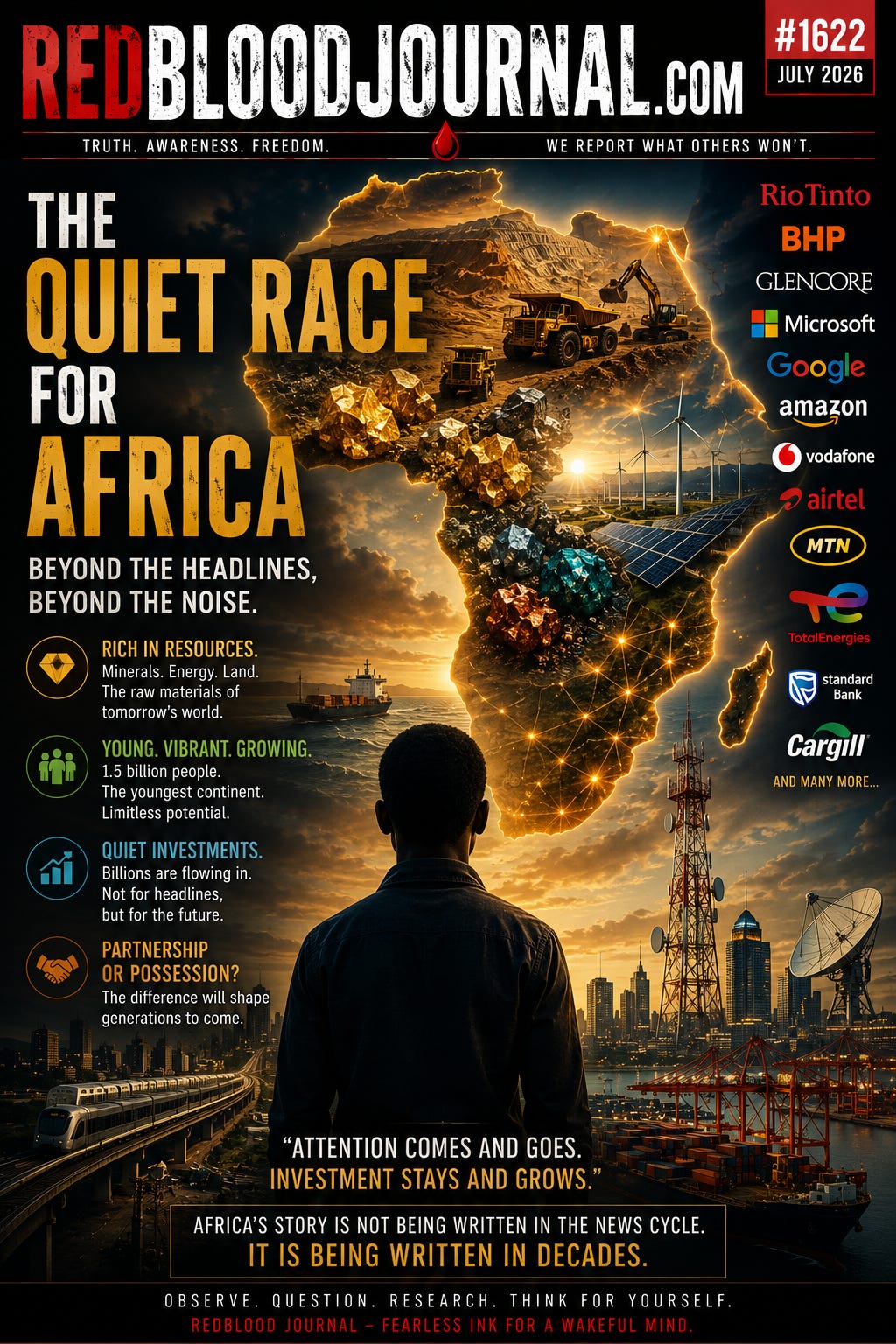
#1622 – The Quiet Race for Africa
An Opinion
By Red Blood
July 2026
Introduction
When most people think about Africa, the headlines they remember are often wars, coups, disease outbreaks, famine, migration, or humanitarian crises.
Yet away from the daily news cycle, another story is unfolding.
It is measured not in television ratings, but in billions of dollars of investment.
While public attention frequently moves elsewhere, corporations, governments, investment funds, and infrastructure developers continue expanding their presence across the continent.
This raises a question worth asking:
If Africa receives relatively little sustained attention from international media, why are so many of the world’s largest organizations investing there?
A Continent Rich in Opportunity
Africa is home to more than 1.5 billion people.
It possesses vast reserves of critical minerals, agricultural land, energy resources, and one of the world’s youngest populations.
Copper.
Cobalt.
Lithium.
Gold.
Diamonds.
Rare earth elements.
Oil.
Natural gas.
Freshwater.
Sunlight.
Agricultural potential.
These resources increasingly support industries ranging from electronics and electric vehicles to artificial intelligence infrastructure and renewable energy.
It is therefore unsurprising that long-term investors view Africa as strategically important. (AFSIC 2026 - Investing in Africa)
The Quiet Presence
Many globally recognized companies already operate extensively across Africa.
Mining companies.
Energy producers.
Telecommunications providers.
Banks.
Technology firms.
Agricultural companies.
Port operators.
Infrastructure developers.
Their projects rarely dominate evening television broadcasts, yet they often involve commitments worth hundreds of millions or even billions of dollars.
Recent announcements continue this trend, including major investments in digital infrastructure and cloud computing, energy, logistics, and finance. (Reuters)
Investment Is Not the Same as Development
Investment alone does not guarantee improved living standards.
The long-term outcome depends on many factors:
Governance.
Transparency.
Education.
Healthcare.
Infrastructure.
Rule of law.
Local participation.
Environmental stewardship.
History shows examples where investment created jobs, infrastructure, and economic growth.
It also shows examples where wealth was unevenly distributed or natural-resource development became a source of conflict.
Different countries have experienced different outcomes.
Looking Beyond Headlines
Television news often focuses on events that are immediate and dramatic.
Long-term commercial investment usually receives far less attention.
As a result, many people may be unaware of the scale of economic activity taking place across the continent.
Understanding Africa requires looking beyond the day’s headlines and examining demographic trends, investment patterns, technological development, and regional cooperation.
A Red Blood Journal Perspective
From the perspective of this publication, one observation stands out:
Attention and investment do not always move together.
A region can receive relatively little day-to-day media coverage while simultaneously becoming increasingly important to governments, corporations, and investors planning decades into the future.
Whether this reflects ordinary economic strategy, geopolitical competition, or a combination of many different motivations is a question readers should investigate for themselves.
The strongest conclusions are reached not by accepting a single narrative, but by comparing evidence from multiple sources and remaining willing to revise one’s understanding as new information emerges.
Final Reflection
History often remembers the moments when armies arrived.
It sometimes overlooks the decades when contracts, investments, infrastructure, education, and technology quietly reshaped entire societies.
Africa’s future will not be determined solely by outside investors or foreign governments.
It will ultimately be shaped by the choices of African nations and their people.
The question is not whether the world has discovered Africa.
The question is whether the world is prepared to become a genuine partner in its long-term prosperity—or whether the competition for influence will become one more chapter in a much longer story.
Only time will answer.
🌍 The Quiet Race for Africa
Jul 8, 2026
The provided text explores a discrepancy between media portrayals of Africa and the massive global investments flowing into the continent. While news cycles typically focus on instability and humanitarian crises, international corporations and governments are quietly securing strategic resources like lithium, cobalt, and energy. This economic movement is driven by Africa’s vast mineral wealth and its status as home to the world’s youngest population. The author emphasizes that while these infrastructure and technology projects hold potential for growth, their success depends heavily on governance and transparency. Ultimately, the source suggests that the long-term economic reshaping of the continent is a significant story often missed by those who only follow mainstream headlines. The narrative concludes that Africa’s ultimate trajectory will be determined by whether global powers act as genuine partners or merely competitors for influence.


