


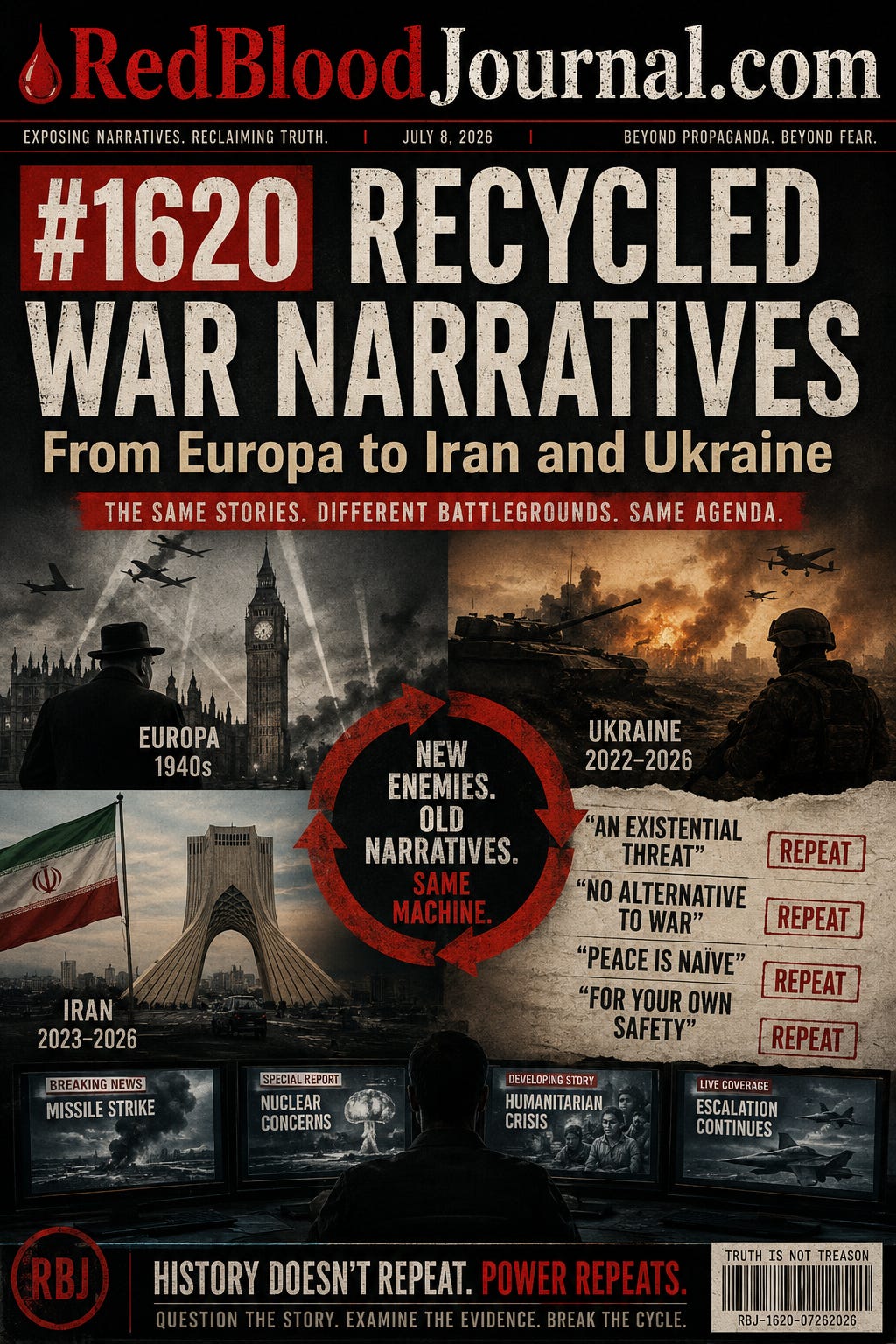
🩸 RedBloodJournal.com
#1620 – Recycled War Narratives: From Europa to Iran and Ukraine
An Opinion
By Red Blood
July 8, 2026
Introduction
History rarely repeats itself in exactly the same form.
Instead, it often appears to recycle familiar stories, familiar fears, and familiar methods of persuasion.
Whether one studies the official histories of the Second World War, revisionist interpretations such as Europa: The Last Battle, or today’s conflicts involving Iran and Ukraine, one recurring pattern stands out:
Every generation is presented with a narrative explaining why the current war is unavoidable.
The names change.
The countries change.
The technology changes.
The emotional structure of the story often does not.
This report is not an attempt to prove that any historical interpretation is correct. Rather, it is an observation about how governments, media organizations, military institutions, and political movements frequently communicate during periods of international conflict.
The Narrative of Inevitability
One recurring feature of wartime communication is the idea that events have reached a point where no alternative remains.
Negotiation becomes portrayed as weakness.
Diplomacy becomes portrayed as delay.
Compromise becomes portrayed as surrender.
Military action becomes portrayed as the only responsible path.
This pattern appears repeatedly throughout modern history.
Whether discussing World War II, the Cold War, Iraq, Afghanistan, Ukraine, or current tensions surrounding Iran, populations often hear that “this time is different” and that extraordinary measures are unavoidable.
The Disappearance of Off-Ramps
One of the recurring themes discussed in revisionist histories is the claim that opportunities for peace existed but failed or were rejected.
Mainstream historians often dispute many of those specific claims, and substantial historical debate remains over particular events.
Regardless of those disagreements, an interesting question persists:
How are possible diplomatic solutions presented to the public during major conflicts?
Modern wars frequently produce headlines describing negotiations, ceasefires, indirect talks, or mediation efforts.
Sometimes these efforts succeed.
Sometimes they fail.
Sometimes the public never learns why.
Whether involving Ukraine or Iran, negotiations often appear briefly before disappearing behind renewed military escalation.
The observer may reasonably ask whether every diplomatic possibility has truly been exhausted before conflict intensifies.
Fear as a Strategic Resource
Fear has always been one of war’s most effective resources.
Every conflict produces warnings of catastrophic consequences if immediate action is not taken.
Possible invasions.
Economic collapse.
Weapons of mass destruction.
Regional instability.
Humanitarian disaster.
Some warnings later prove accurate.
Others are exaggerated.
Some never materialize.
The important observation is not whether every warning is true or false, but that fear can rapidly reshape public opinion and narrow the range of acceptable debate.
The Language Rarely Changes
Although each conflict has unique causes and circumstances, the vocabulary often sounds familiar.
Protect democracy.
Defend civilization.
Prevent aggression.
Maintain international order.
Protect national security.
Support allies.
Deter future attacks.
These phrases may represent sincere policy goals.
They also function as powerful messaging tools because they simplify complex geopolitical situations into moral narratives that are easier for the public to understand.
Information Becomes Another Battlefield
Modern wars are fought not only with missiles and soldiers, but also with information.
Governments publish intelligence.
Opponents deny it.
Journalists investigate.
Analysts interpret.
Social media accelerates every claim.
Within hours, millions of people may become convinced of competing versions of the same event.
The result is that information itself becomes contested territory.
The battle for public perception often begins before military operations and continues long after the fighting ends.
Ukraine and Iran Through This Lens
The wars involving Ukraine and the tensions surrounding Iran differ greatly in history, geography, alliances, and political context.
Yet observers may notice recurring communication patterns.
Both conflicts have generated intense messaging about existential threats.
Both have involved economic sanctions alongside military strategy.
Both have featured ongoing discussions of negotiations alternating with renewed escalation.
Both have become subjects of global information campaigns in which competing narratives seek to influence domestic and international audiences.
Recognizing these similarities does not mean the conflicts are identical or that the underlying political claims are equally valid.
It simply highlights that governments and institutions often rely on familiar methods of persuasion during periods of crisis.
Why Familiar Narratives Return
Communication strategies survive because they have worked before.
Every generation inherits institutions, political incentives, and media systems shaped by previous conflicts.
Messages that once mobilized public support are often adapted for new circumstances.
This does not necessarily imply coordination across history.
It may simply reflect that leaders, governments, and societies repeatedly reach for communication methods that have proven effective in the past.
The Responsibility of the Observer
The challenge for the observer is not to reject every official statement.
Nor is it to automatically embrace every alternative explanation.
Both certainty and cynicism can become forms of intellectual blindness.
A healthier approach is to ask consistent questions.
What evidence supports this claim?
What evidence challenges it?
What remains unknown?
Who benefits from public acceptance of a particular narrative?
What peaceful alternatives have been explored?
Those questions remain valuable regardless of the conflict under discussion.
Conclusion
The enduring lesson is not that history repeats with mechanical precision.
Rather, it is that human societies often recycle familiar narratives when confronted with fear, uncertainty, and war.
Whether examining revisionist interpretations of the past or contemporary conflicts involving Ukraine and Iran, one pattern deserves continued attention:
War requires stories.
Those stories shape public perception long before history records its verdict.
The responsibility of every citizen is neither blind acceptance nor automatic rejection.
It is careful observation, disciplined skepticism, and a willingness to distinguish evidence from assumption.
Only then can history become something more than another cycle of recycled narratives.
🩸 Red Blood Journal Position
Every major conflict deserves rigorous examination.
Official accounts should be questioned with evidence.
Alternative accounts should be questioned with equal rigor.
The goal is not to replace one certainty with another, but to understand how narratives influence the decisions of nations and the beliefs of ordinary people.
End of Report
📖 The Architecture of Conflict Persuasion
Jul 8, 2026
The provided text examines how governments and media utilize consistent storytelling patterns to justify and sustain international conflicts across different eras. By analyzing historical events alongside modern tensions in Ukraine and Iran, the author argues that narratives of inevitability are recycled to make military action seem like the only viable option. These strategies often rely on strategic fear and the dismissal of diplomatic alternatives to consolidate public support and narrow the scope of political debate. The source emphasizes that modern warfare is fought on an informational battlefield, where moral language simplifies complex geopolitical realities into digestible stories. Ultimately, the text encourages readers to maintain disciplined skepticism by questioning both official and alternative accounts of global crises. This overview serves as a reminder that while technologies and locations change, the fundamental methods of persuasion used to mobilize societies for war remain remarkably similar.


