


🩸 🛶 RedBloodJournal.com
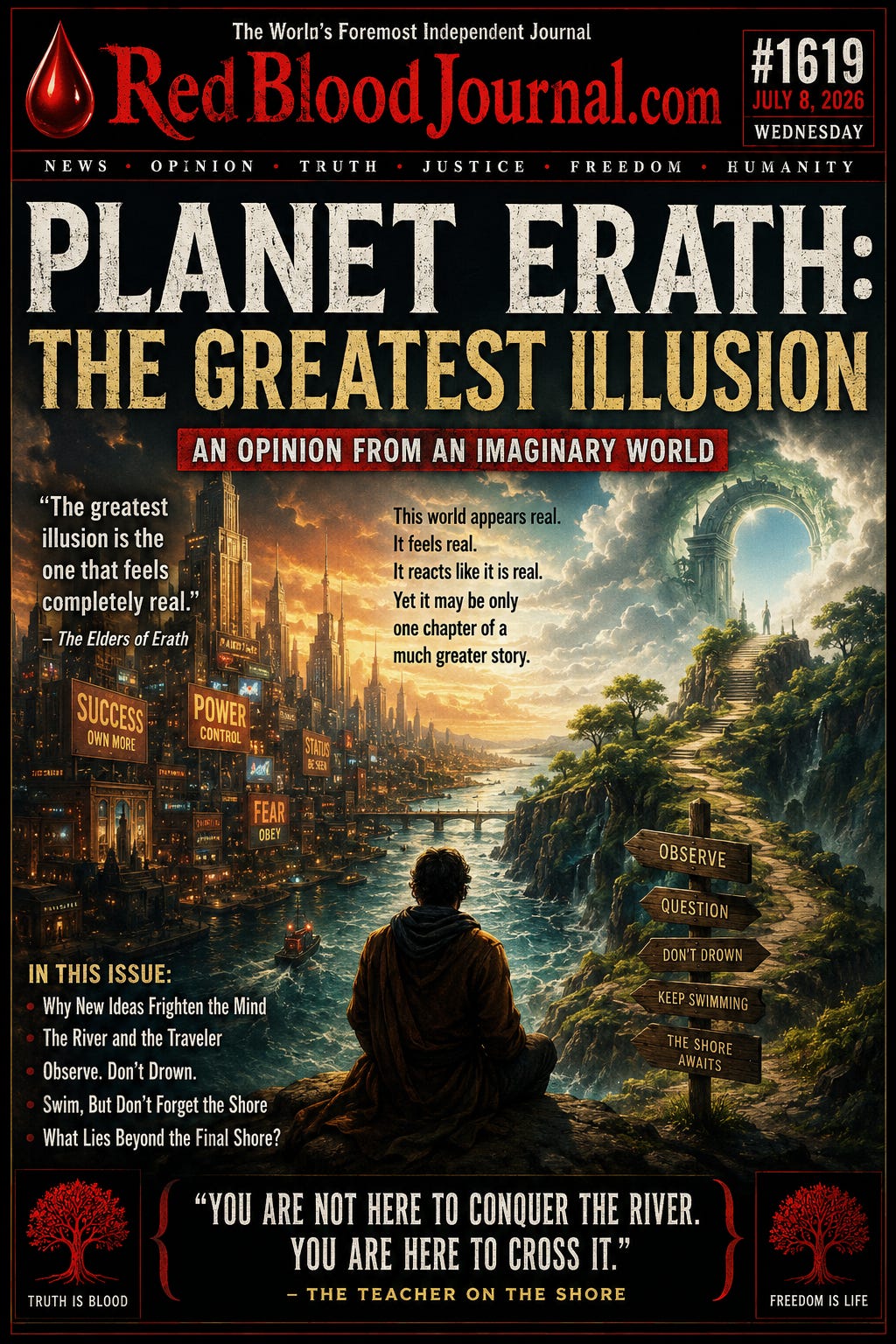
#1619 – Planet Erath: The Greatest Illusion
An Opinion from an Imaginary World
By Red Blood
July 8, 2026
Introduction
On the imaginary planet of Erath, the oldest philosophers agreed on one lesson above all others.
The greatest illusion is the one that feels completely real.
Every generation was born into the same world, touched the same mountains, sailed the same oceans, built the same cities, fought the same wars, accumulated the same wealth, and eventually left it all behind.
Yet almost no one stopped to ask the simplest question:
What if this world is not the destination, but the classroom?
The elders never demanded that anyone believe them.
Instead, they encouraged observation.
“If our words are false,” they would say, “careful observation will expose them.”
“If our words are true, careful observation will reveal them.”
That was the Erathian way.
The Perfect Illusion
The philosophers believed that reality did not have to be fake in order to be temporary.
A dream can feel real while it lasts.
A play can move the audience to tears even though everyone knows the actors will remove their costumes afterward.
A virtual reality simulation can cause genuine excitement, fear, and emotion while the headset remains on.
Perhaps, they suggested, life itself shares something with each of these.
Not because life lacks meaning, but because its meaning may extend beyond what can be touched with the hands.
Most citizens dismissed the idea.
The material world appeared too convincing.
Money solved problems.
Power commanded respect.
Status attracted admiration.
Possessions created identity.
Everything encouraged the belief that success inside the game was the highest achievement.
The philosophers quietly wondered whether winning the game and understanding the purpose of the game were two entirely different accomplishments.
Why New Ideas Frighten People
One elder asked his students a question.
“If a person owns everything inside a game, what happens when someone suggests that the game will eventually end?”
The students answered together.
“They become afraid.”
The elder nodded.
“Not because the idea has been proven.”
“But because attachment resists uncertainty.”
On Erath, fear often came not from evidence but from the possibility that deeply held assumptions might be incomplete.
Whenever someone questioned wealth, power, political systems, social status, or any institution that people relied upon for identity, resistance quickly appeared.
The philosophers did not see this as proof that the questions were correct.
Neither did they see resistance as proof that the questions were false.
They simply recognized attachment as one of the strongest forces in human thinking.
The more tightly someone clung to temporary things, the more threatening any alternative perspective could seem.
The River
Every child on Erath learned the story of the river.
A traveler entered a powerful current.
Some became so fascinated with the water that they spent their lives trying to own it.
Others fought endlessly over which side of the river belonged to whom.
Some tried to stop the current itself.
Few remembered why they had entered the river in the first place.
One old teacher stood on the shore and smiled.
“You are not here to conquer the river.”
“You are here to cross it.”
The water was never meant to become anyone’s permanent home.
Observe Before You Conclude
Unlike many teachers, the philosophers of Erath discouraged blind belief.
They also discouraged blind disbelief.
Both, they believed, ended curiosity.
Instead, they encouraged careful observation.
Observe how quickly fear spreads.
Observe how easily comfort becomes attachment.
Observe how often people defend ideas before examining them.
Observe how frequently temporary victories become permanent disappointments.
Most importantly, observe yourself.
Notice which ideas make you uncomfortable.
Ask why.
Perhaps the discomfort reveals weakness.
Perhaps it reveals truth.
Perhaps it reveals neither.
Only continued observation can tell.
Swimming Without Drowning
The philosophers never encouraged people to abandon society.
They worked.
Raised families.
Created art.
Studied science.
Built businesses.
Helped neighbors.
Participated fully in life.
Their difference lay elsewhere.
They refused to mistake temporary conditions for eternal ones.
One elder explained it this way:
“Swim.”
“Do not drown.”
“The river is real enough to carry you.”
“But it is not where you are meant to build your forever.”
The Final Shore
Every journey eventually reaches its shoreline.
Every conversation ends.
Every empire fades.
Every fortune changes hands.
Every body grows old.
Whatever lies beyond that final shore remains unknown while we are still crossing the river.
Perhaps the elders were right.
Perhaps they were mistaken.
No living traveler can prove either conclusion with certainty.
For that reason, they taught humility instead of certainty.
Curiosity instead of arrogance.
Observation instead of blind acceptance.
Compassion instead of domination.
If this world is the final destination, then living with wisdom has lost nothing.
If this world is only one stage of a greater journey, then wisdom becomes even more valuable.
Either way, kindness, honesty, humility, and thoughtful observation remain worthwhile companions.
Closing Thoughts
Perhaps the greatest illusion is not the world itself.
Perhaps the greatest illusion is believing that whatever surrounds us today is all that can ever exist.
The citizens of Erath were never asked to reject the world.
They were simply encouraged not to become imprisoned by it.
So they lived.
They learned.
They loved.
They questioned.
And they continued swimming, knowing that one day every traveler reaches the opposite shore.
Only then, they believed, would the true nature of the journey finally become clear.
The greatest prison is not made of stone.
It is the certainty that there is nothing beyond the walls.
Whether that certainty is true or false is a question each traveler must answer through observation, humility, and the life they choose to live.
🛶 The Crossing of Erath: Observations on the Great Illusion
Jul 8, 2026
The provided text explores the Erathian Perspective, a philosophical framework from an imaginary world that views physical reality as a temporary classroom rather than a final destination. These teachings suggest that life is a metaphorical river intended for crossing, warning that an excessive attachment to material success and status can blind individuals to the journey’s true purpose. Rather than demanding blind faith, the Erathian elders encourage diligent observation and humility to distinguish between fleeting illusions and enduring truths. They argue that fear and resistance to new ideas often stem from the discomfort of acknowledging that our current surroundings are not permanent. Ultimately, the source advocates for a life of kindness and curiosity, suggesting that whether or not a world exists beyond our own, living with wisdom and detachment remains the most fulfilling path. This perspective encourages people to participate fully in society without becoming imprisoned by the certainty that the material world is all that exists.


