


🩸 RedBloodJournal.com
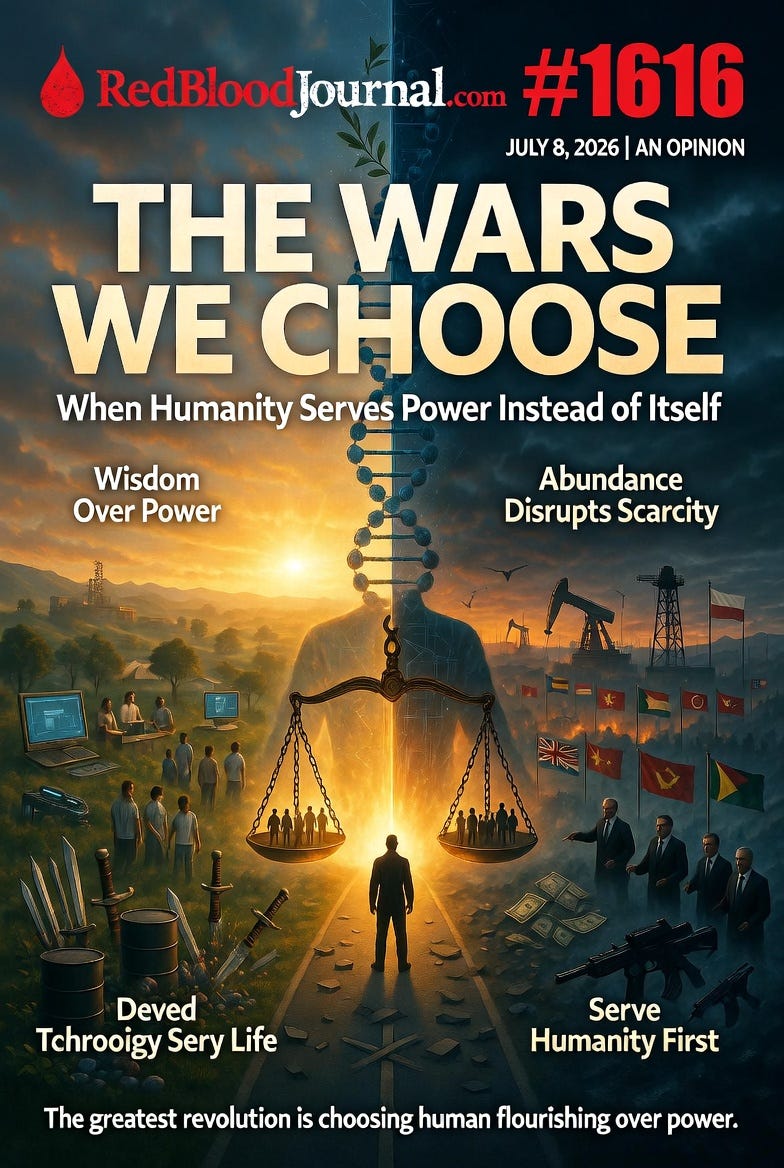
#1616 – The Wars We Choose
When Humanity Serves Power Instead of Itself
An Opinion
There is a question I return to often.
Not because I know the answer, but because I believe civilization depends on asking it.
What if humanity’s highest goal were not wealth or power, but humanity itself?
Imagine a world where every scientific discovery was first measured by one standard:
Does this reduce suffering?
Not:
Will it increase profit?
Not:
Will it strengthen our geopolitical advantage?
Not:
Will it preserve an existing industry?
Simply:
Will it make life better for humanity?
History teaches us that every transformative technology changes the balance of power.
The printing press challenged authority.
Electricity reshaped civilization.
The internet transformed communication.
Artificial intelligence is already changing the nature of work and knowledge.
Every breakthrough creates new opportunities—but it also creates new fears.
Those who benefit from the existing system naturally have incentives to protect it. Governments seek national security. Corporations seek market share. Institutions seek stability. These motivations are understandable, but they can also slow or shape the adoption of disruptive ideas.
This is not unique to one nation or one era.
It is a recurring pattern throughout history.
The question is whether humanity should remain trapped in that pattern forever.
Consider how much of modern geopolitics revolves around strategic resources.
Oil.
Natural gas.
Critical minerals.
Energy infrastructure.
Entire economies, alliances, and foreign policies have been built around them.
If future technologies significantly reduce dependence on scarce resources, they could reshape not only markets but also international relationships. Whether particular technologies succeed or fail depends on scientific, engineering, economic, and political realities. But the larger principle remains:
When power depends on scarcity, abundance can become disruptive.
Perhaps that is why the most important revolution is not technological.
It is philosophical.
Imagine if every government, every corporation, every university, and every laboratory operated under a single guiding principle:
Advance humanity before advancing power.
Would we invest differently?
Would we educate differently?
Would we negotiate differently?
Would we still accept endless cycles of fear, competition, and conflict as inevitable?
No one can know with certainty.
But history suggests that many wars have been driven, at least in part, by competition over resources, territory, influence, and economic interests.
If humanity eventually learns to place human flourishing above material advantage, perhaps many future conflicts could be prevented before they begin.
This is not a call to abandon science.
It is a call to examine the intentions behind it.
Technology is neither good nor evil.
It reflects the values of those who create it and those who decide how it will be used.
The greatest breakthrough of the future may not be a new engine, a new battery, or a new source of energy.
It may be a civilization mature enough to ask one question before every major decision:
Does this serve humanity—or merely those who already hold power?
The answer to that question may determine whether the next century is remembered for its wars…
or for its wisdom.
🌍 The Human Mandate:
Wisdom Over Power
Jul 8, 2026
The provided text explores a philosophical shift that prioritizes human flourishing over the traditional pursuit of wealth and geopolitical power. It argues that throughout history, transformative breakthroughs have often been suppressed or shaped to maintain existing power structures and resource scarcity. By examining the intentions behind scientific advancement, the author suggests that society can break the cycle of global conflict driven by competition. The narrative challenges institutions to adopt a human-centric mandate where progress is measured by its ability to reduce suffering rather than its capacity for profit. Ultimately, the source posits that the most vital future innovation is a mature civilization capable of choosing collective wisdom over the preservation of authority.


