


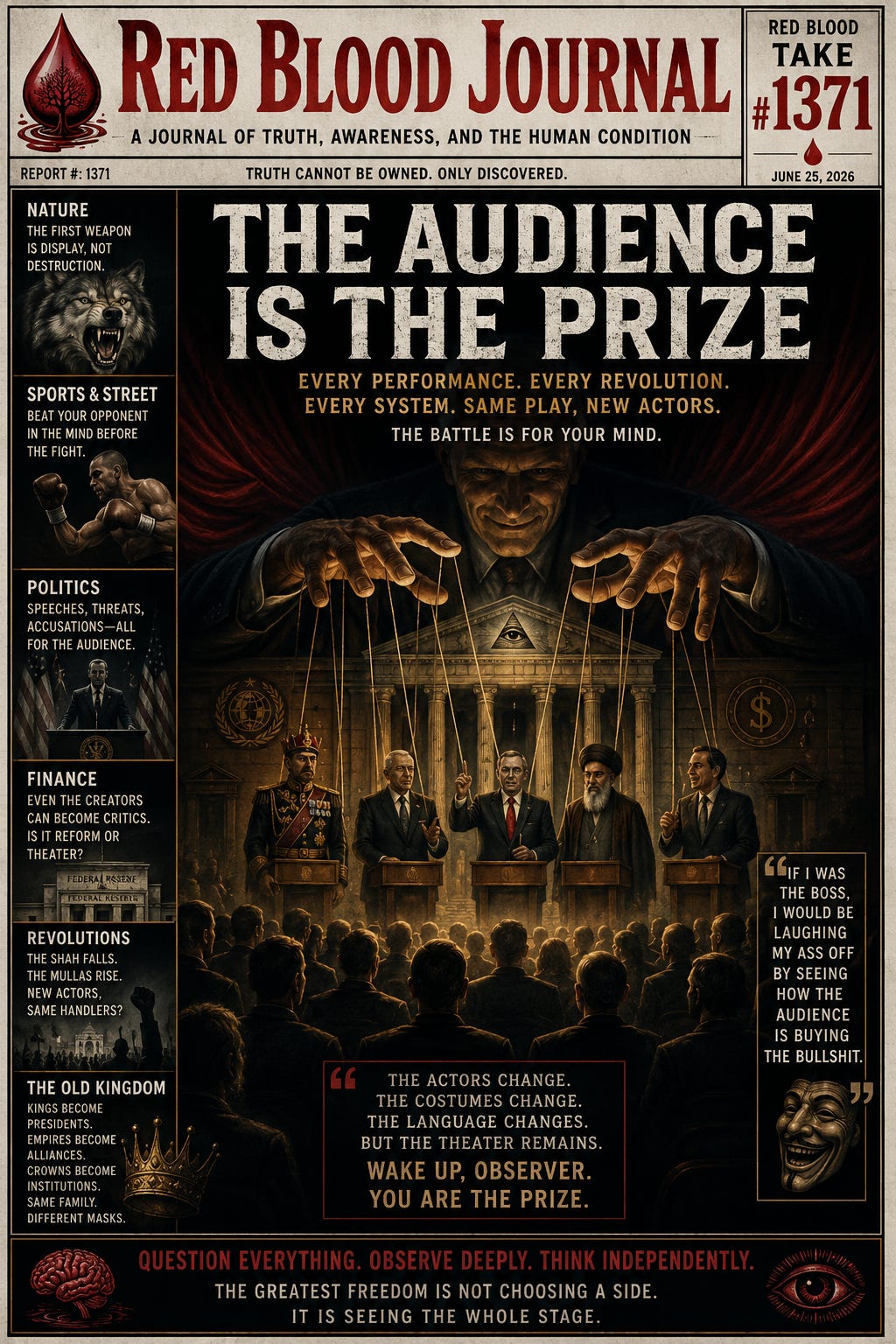
🩸 Red Blood Journal
Red Blood Take #1371
The Audience Is the Prize
Every stage has actors. Every conflict has a script. But the real battle is for the mind of the observer.
Report #: 1371
Date: June 25, 2026
Introduction
In a play, the actors perform as though the audience does not exist.
They argue.
They cry.
They threaten.
They fight.
They behave as if the story on stage is the only reality that matters.
But the truth is simple: the play does not exist for the actors.
It exists for the audience.
Without an audience, there is no performance. There is no applause, no outrage, no hero, no villain, and no reason for the curtain to rise.
The actors may appear to be the center of the story, but they are only the visible instruments of the performance.
The real target is the audience.
The same pattern can be seen in nature, in sports, in street confrontations, in politics, and throughout history.
The visible fight is rarely the whole fight.
The first battlefield is the mind.
The First Battle Is Psychological
Before a boxer throws a punch, he often begins with words.
He talks tough.
He insults the opponent.
He projects confidence.
He attempts to weaken the other fighter mentally before the physical contest even begins.
The purpose is not only to impress the crowd. It is to plant doubt inside the opponent.
Road rage follows the same pattern.
Before fists are ever thrown, if they are thrown at all, both sides often attempt to display power through the face, the voice, the body, and the threat.
The message is simple:
Power stands behind me.
Nature uses the same language.
A dog exposes its teeth.
A cat arches its back.
A bird spreads its wings.
Many animals make themselves appear larger, louder, and more dangerous than they actually are.
The goal is often to win the confrontation before it becomes physical.
In other words, the display is the first weapon.
Politics Uses the Same Weapon
Politics follows the same pattern on a larger stage.
Governments threaten one another.
Leaders deliver speeches of strength.
Parties accuse one another of destroying the nation.
Nations present themselves as fearless, righteous, and prepared.
The visible opponent appears to be another leader, another party, another nation, or another ideology.
But the larger target is often the audience watching the performance.
The citizen.
The voter.
The investor.
The believer.
The frightened.
The hopeful.
Politics is not only a fight between actors.
It is a psychological contest for the mind of the public.
The audience is encouraged to react, fear, cheer, hate, defend, and choose sides before asking who wrote the script.
The Federal Reserve Example
This same lens can be applied to financial history.
When studying the creation of the Federal Reserve system, one notices a pattern that deserves attention. Some of the people connected to the early design, defense, or explanation of the system later became public critics of how the system developed, how it was used, or what it had become.
To the surface observer, this appears to be honest disagreement, regret, correction, or political evolution.
And it may be exactly that.
But through the Red Blood lens, another question appears:
Can public criticism by insiders also become part of the performance?
If a system is created, defended, criticized, adjusted, and then preserved, the audience may believe it has witnessed accountability. Yet the deeper structure may remain untouched.
The critic becomes another actor.
The defender becomes another actor.
The reformer becomes another actor.
The audience watches the argument and assumes the argument itself proves independence.
But does it?
Or does the argument help preserve the stage by giving the audience the appearance of conflict?
The purpose of this question is not to declare a final answer.
The purpose is to train the observer to look beyond the visible disagreement and ask what remains unchanged after the argument is over.
The Shah of Iran and the Revolutionary Stage
The same lens can be applied to Iran.
The official public story of the 1979 Iranian Revolution is that one regime collapsed and another replaced it.
The Shah exited the stage.
The mullahs entered the stage.
The audience was presented with a dramatic reversal: a monarchy aligned with the old order was replaced by a revolutionary religious government claiming independence from that order.
To many observers, the story was simple.
The old boss lost.
The new regime rose.
But my interpretation asks a different question.
What if the audience focused on the change of actors and assumed the ownership of the theater had changed?
The Shah and the Islamic Republic appear to be enemies on the public stage.
One wore the costume of monarchy.
The other wore the costume of religion.
One spoke the language of modernization.
The other spoke the language of revolution.
One represented the palace.
The other represented the mosque.
But the Red Blood question is this:
Did the theater change, or did only the cast change?
In this interpretation, the people who overthrew the Shah and installed the mullahs may have presented the audience with the appearance of a clean break from the old handlers. The public was shown an enemy of the previous order and was encouraged to believe that the new regime was no longer under the thumb of the old boss.
But behind the curtain, the possibility remains that the same deeper structure continued to influence the new stage.
The actors changed.
The slogans changed.
The costumes changed.
The public enemy changed.
But did the hidden power truly change?
That is the question.
And today, if the same system is now preparing to reverse the script again, then the audience may once more be watching another change of actors while believing it is witnessing the end of the old play.
The Old Kingdom in Modern Clothing
In my vision, it is still the same old kingdom laughing at the illusion of freedom and democracy.
Not because freedom and democracy are meaningless ideals.
They are powerful ideals.
They have inspired people, protected rights, and given societies language for justice.
But ideals can be used as costumes.
The old kingdom does not need to wear a crown anymore.
Kings become presidents.
Empires become alliances.
Crowns become institutions.
Royal courts become agencies, councils, foundations, banks, parties, and international organizations.
But in this interpretation, they are all still actors.
The audience is told that monarchy ended.
The audience is told that empire ended.
The audience is told that power now belongs to the people.
Yet the structure of influence may have simply learned to speak modern language.
The palace became the institution.
The crown became the constitution.
The empire became the alliance.
The kingdom became the system.
The audience celebrates the costume change while rarely asking whether the same family still owns the theater.
The Comedy Behind the Curtain
If there is a hidden director, the director does not need to appear on stage.
The director only needs the audience to believe the actors are independent.
The actors can argue.
The actors can denounce one another.
The actors can overthrow one another.
The actors can condemn the old system while preserving the structure beneath it.
The audience then believes it has witnessed change.
If I were the boss behind such a performance, I would be laughing at how easily the audience buys the script.
The strongest prison is not made of walls.
It is made of perception.
A person who believes he is free will rarely look for the cage.
A population that believes it rules itself will rarely ask who shaped the choices placed before it.
That is the genius of the performance.
The Forgotten Audience
The audience believes it is watching history.
But perhaps history is also watching the audience.
Every reaction is measured.
Every fear is useful.
Every division can be harvested.
Every belief can be directed.
The actors on stage may pretend the audience does not exist, but the entire performance exists because of the audience.
The audience is the prize.
The audience is the energy.
The audience is the emotional fuel.
The audience is the battlefield.
Without the audience, the actors have no power.
Without belief, the script collapses.
Without fear, the performance weakens.
Without division, the old kingdom loses its favorite tool.
Final Reflection
This report is not asking the reader to accept every interpretation as fact.
It is asking the reader to observe the pattern.
Before every fight, there is a display.
Before every war, there is a story.
Before every revolution, there is a script.
Before every system is accepted, there is a performance.
The boxer talks tough before the punch.
The dog bares its teeth before the bite.
The politician speaks before the policy.
The revolutionary shouts before the new order.
The institution criticizes itself before preserving itself.
The actor performs as though the audience does not matter, while the audience was the reason for the performance all along.
The highest form of awareness is not choosing the loudest actor.
It is asking who owns the theater.
🩸 Ocean of Love and Positivity
The Ocean of Love and Positivity teaches that the peaceful observer is harder to manipulate than the angry participant. The old kingdom survives by keeping the audience emotional, divided, fearful, and loyal to actors on the stage. True freedom begins when the observer steps back, studies the script, questions the theater, and refuses to surrender the mind to any performance that feeds on division.
🎭 The Theater of Power:
Who Owns the Stage?
Jun 25, 2026
This text explores the concept of political and social power as a form of theater, where public conflicts are carefully staged performances designed to manipulate the observer. The author argues that the audience is the true target of every display, from nature and sports to international revolutions and financial institutions. By focusing on the psychological impact of the spectacle, the narrative suggests that visible actors often serve a hidden structure that remains unchanged despite apparent shifts in leadership. This perspective challenges readers to look past the surface-level drama of slogans and costumes to identify the permanent forces that own the theater. Ultimately, the source promotes emotional detachment and critical observation as the only ways to escape the influence of these orchestrated scripts. Under this lens, true awareness involves questioning the continuity of power rather than simply choosing a side in a public argument.


