


🩸 Red Blood Journal 🩸
Title:
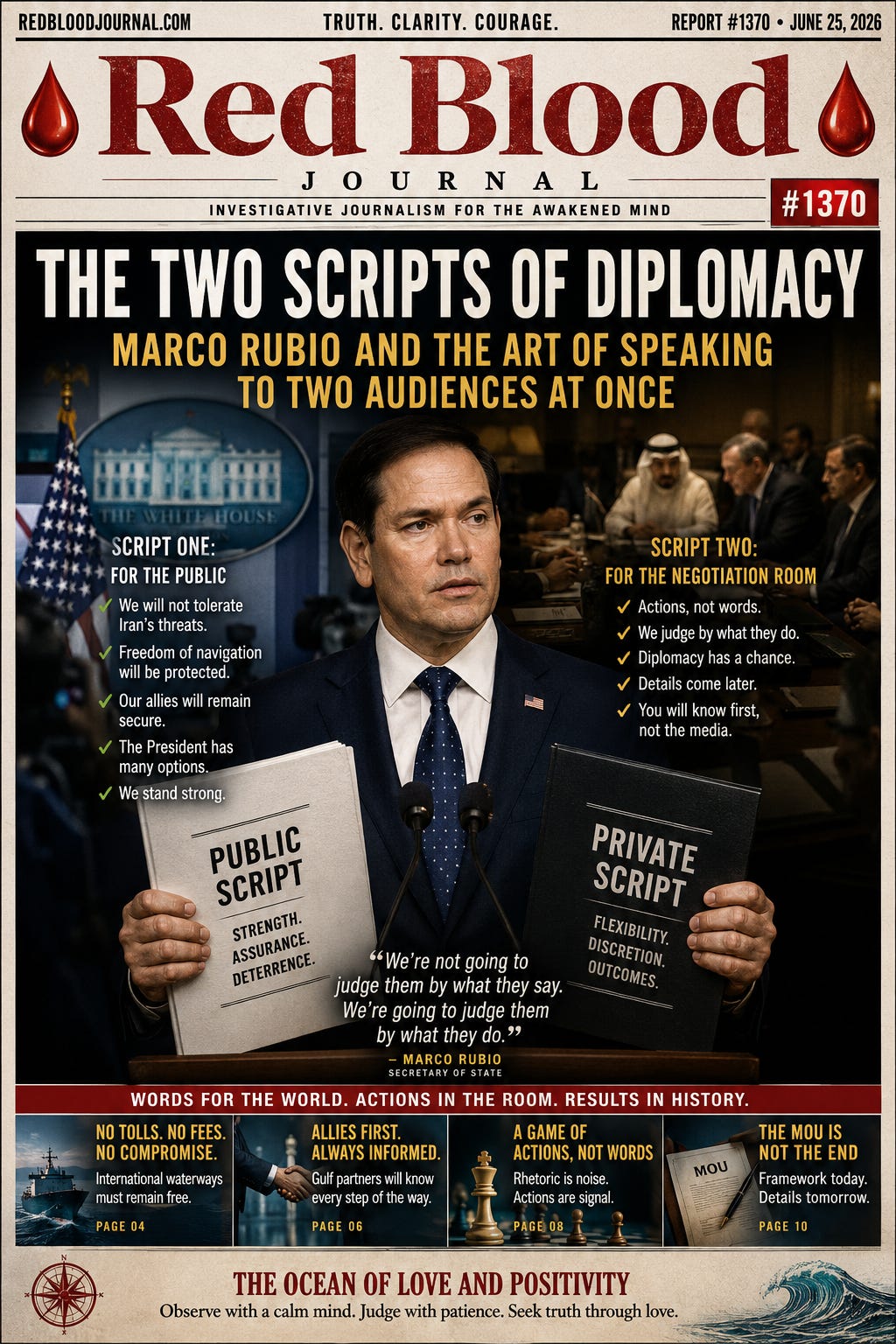
#1370 — The Two Scripts of Diplomacy
Marco Rubio and the Art of Speaking to Two Audiences at Once
By: Red Blood | Investigative Journal
Date: June 25, 2026
Report #: 1370
Introduction
Politics has always been as much about communication as it is about policy. Throughout history, leaders have often found themselves speaking to multiple audiences simultaneously. One audience consists of the public watching through television cameras and social media. The other consists of allies, adversaries, negotiators, intelligence services, and decision-makers operating behind closed doors.
When examining recent remarks by U.S. Secretary of State Marco Rubio regarding negotiations with Iran and regional security, a recurring pattern emerges. His language repeatedly separates public rhetoric from observable actions.
Whether intentional or simply the reality of diplomacy, the transcript provides an opportunity to examine how modern international negotiations often involve what appear to be two parallel conversations.
Script One: The Public Stage
Every government must reassure its own population.
The public script serves several purposes:
Demonstrate strength.
Maintain confidence among allies.
Apply political pressure.
Avoid appearing weak.
Preserve negotiating leverage.
This is the language carried by headlines.
Examples include:
“We will not tolerate...”
“The President has many options.”
“Iran continues to threaten...”
“Our allies will remain secure.”
These statements are designed to project certainty.
Script Two: The Negotiation Room
The transcript repeatedly shifts away from rhetoric toward practical realities.
Several comments stand out.
Rubio explains:
“We’re not interested in their press conferences... We’re going to judge them by their actions.”
That statement alone distinguishes between what governments say publicly and what they actually do.
Later he adds that Iran will likely continue producing strong public rhetoric regardless of what may be occurring inside negotiations.
Again, the focus returns to actions rather than speeches.
Speaking to Multiple Audiences
Throughout the press conference Rubio appears to be addressing several audiences simultaneously.
Audience One
American voters.
They hear:
“We remain strong.”
Audience Two
Regional allies.
They hear:
“You will be informed before anything is agreed.”
Rubio repeatedly assures Gulf partners they will not learn developments through the media but directly from Washington.
Audience Three
Iranian negotiators.
The message appears to be:
“We are willing to negotiate, but actions—not words—will determine the outcome.”
Audience Four
International markets.
Repeated emphasis is placed on maintaining freedom of navigation through international waterways and rejecting any toll or fee system.
The Memorandum of Understanding
One of the more revealing exchanges concerns the Memorandum of Understanding (MOU).
When asked why important details were absent, Rubio answers that an MOU is not intended to be the final agreement.
Instead, it establishes the framework for negotiations.
Verification.
Timelines.
Enforcement.
Technical details.
All come later.
This distinction suggests that public announcements may represent only the opening chapter rather than the complete agreement.
Reading Between the Lines
For observers attempting to understand diplomacy, one sentence may summarize the entire press conference.
“We’re not going to judge them by what they say. We’re going to judge them by what they do.”
That principle applies not only to Iran.
It can also serve as a framework for evaluating governments, politicians, corporations, media organizations, and even ourselves.
Words influence emotions.
Actions reveal intentions.
The Observer’s Lesson
Diplomacy often resembles a stage performance.
Public speeches are visible.
Private negotiations are not.
The public generally hears the headlines.
Negotiators focus on measurable outcomes.
This does not necessarily imply deception.
Rather, it reflects the reality that governments frequently communicate differently depending on the audience they are addressing.
Recognizing this distinction encourages observers to place greater weight on actions than on rhetoric.
Final Reflection
The experienced observer gradually learns to watch political events much like a chess match rather than a theatrical performance.
The pieces move quietly.
The headlines move loudly.
Sometimes both describe the same game.
Sometimes they do not.
Perhaps the most valuable habit any citizen can develop is to listen carefully—but judge patiently.
Not by promises.
Not by speeches.
Not by slogans.
But by results.
🌊 The Ocean of Love and Positivity
Looking beyond politics does not require ignoring it. It requires observing it with a calm mind. The quieter the mind becomes, the easier it is to distinguish performance from reality, emotion from evidence, and words from actions. In that stillness, understanding grows—not through taking sides, but through seeing more clearly. The Ocean of Love and Positivity begins where observation replaces reaction, and where truth is sought through patience, humility, and compassion rather than division.
🎭 The Two Scripts of Diplomacy:
Actions Over Rhetoric
Jun 25, 2026
This investigative report explores the dual nature of modern diplomacy through an analysis of Secretary of State Marco Rubio’s communications regarding Iran.
The text posits that political leaders often utilize two distinct scripts: a loud, public-facing rhetoric meant to project strength to voters and a private, practical strategy focused on measurable actions.
By examining various audiences like regional allies and international markets, the source illustrates how official statements serve as a theatrical performance while real progress happens behind the scenes.
Ultimately, the author encourages observers to prioritize tangible results over political slogans to better distinguish diplomatic reality from public posturing.
This perspective suggests that true understanding of global affairs requires looking past emotional headlines to find the quiet movements of actual policy.


