


🩸 Red Blood Journal
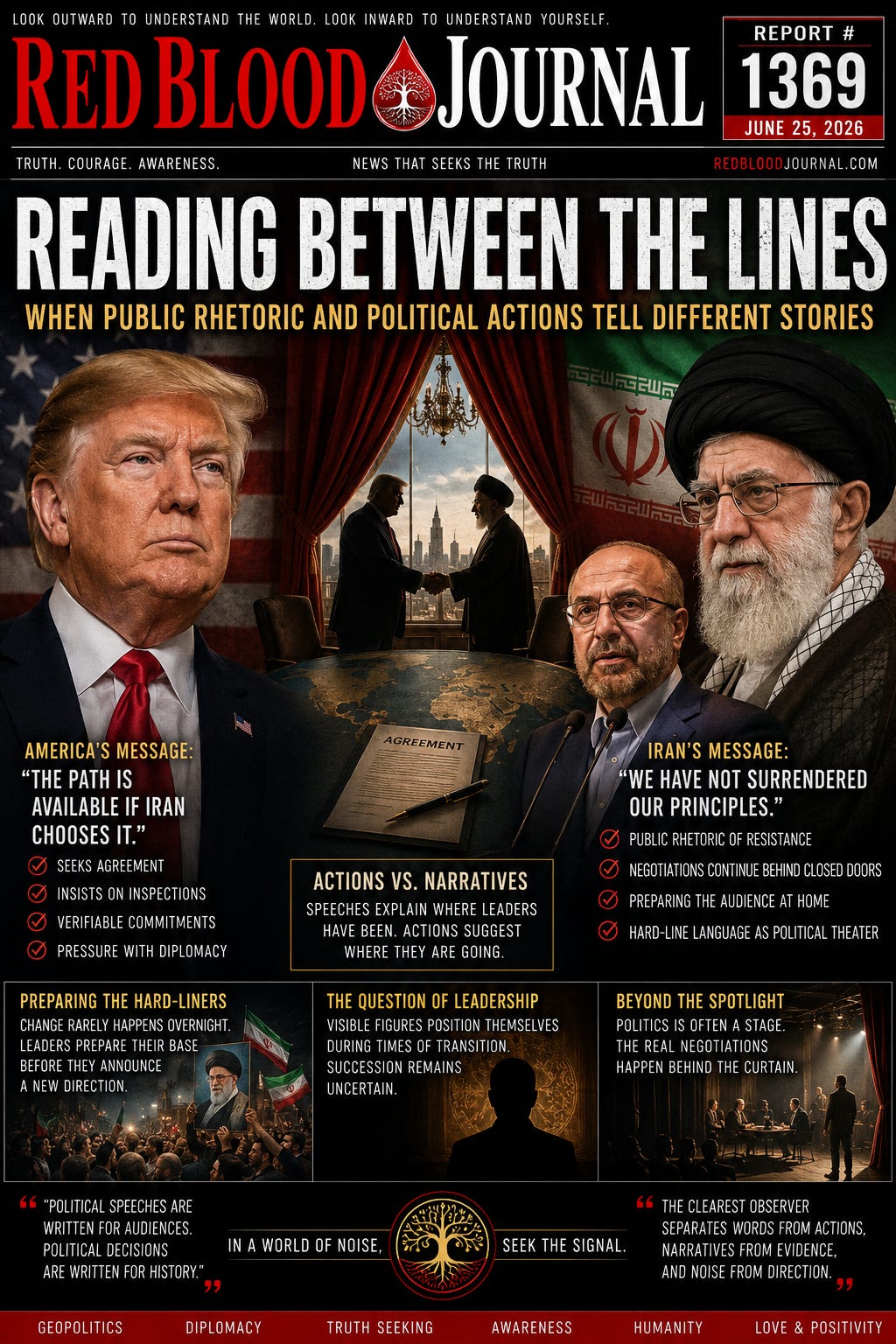
Reading Between the Lines: Preparing the Audience for Change
Subtitle: When public rhetoric and political actions begin telling different stories.
Report #: 1369
Date: June 25, 2026
Executive Summary
One of the oldest rules of politics is simple:
When words and actions disagree, watch the actions.
As negotiations between the United States and the Islamic Republic continue, an interesting pattern has emerged. Public statements from both sides often contradict one another, yet many of the practical steps taken behind closed doors appear to move in the same general direction.
Whether this represents genuine diplomacy or carefully managed political theater remains uncertain. However, to an outside observer, the actions may reveal more than the speeches.
Two Different Audiences
President Donald Trump has repeatedly stated that his objective is an agreement that includes inspections, restrictions, and verifiable commitments. His administration has also publicly discussed sanctions relief tied to compliance while maintaining that any agreement must be enforceable. (Reuters)
Meanwhile, Iranian officials continue presenting a public image of resistance, insisting that the Islamic Republic has not surrendered its principles or accepted Washington’s version of events. Iranian officials have publicly disputed several American claims regarding inspections and other reported understandings. (Reuters)
These differing narratives raise an important question.
Are both governments speaking to different audiences?
Preparing the Hard-Liners
Political systems rarely reverse decades of policy overnight.
When significant change becomes necessary, leaders often introduce it gradually while maintaining familiar language for their core supporters.
To many observers, this appears to be what may be unfolding inside Iran.
The public message remains uncompromising.
The practical negotiations continue.
If that interpretation is correct, then the strongest rhetoric may not be intended for Washington at all.
It may instead be directed toward preserving support among those inside the system who have built their political identity around opposition to the United States.
Actions Versus Narratives
History repeatedly demonstrates that governments frequently negotiate privately while speaking differently in public.
The current negotiations have likewise produced conflicting accounts over issues such as nuclear inspections, sanctions relief, humanitarian funds, and navigation through the Strait of Hormuz. Public statements from Washington and Tehran have often differed even while talks have continued. (Reuters)
For an observer, this reinforces a familiar lesson:
Political speeches often explain where leaders have been.
Political actions suggest where they are going.
The Question of Future Leadership
Periods of political transition naturally produce speculation about future leadership.
Some observers point to increasingly visible political figures—including Mohammad Bagher Ghalibaf—as individuals who could play a larger role in Iran’s future political landscape. However, there is no publicly confirmed evidence that any particular individual has been selected in advance to lead the country or that succession decisions have already been finalized. Any such conclusion remains speculative. (Wikipedia)
Visibility alone does not establish succession.
Nevertheless, during periods of change, ambitious political figures often position themselves to appear as experienced, capable, and indispensable should an opportunity arise.
Reading the Theater
Politics often resembles a stage production.
Some actors perform for foreign audiences.
Others perform for domestic supporters.
Behind the curtain, negotiations may proceed very differently from the dialogue delivered under the spotlight.
For observers attempting to understand unfolding events, the challenge is not deciding which speech sounds more convincing.
The challenge is identifying which actions continue after the cameras are turned off.
Final Observation
Whether current negotiations ultimately produce lasting change remains unknown.
What can be observed is that public rhetoric and practical diplomacy are not always identical. Distinguishing between verified events, official narratives, and personal interpretations is essential for understanding complex political developments.
As always, history is written less by speeches than by decisions—and those decisions become visible over time.
🩸 RedBloodJournal.com 🩸
Look outward to understand the world. Look inward to understand yourself. The clearest observer learns to separate words from actions, narratives from evidence, and noise from direction. In that balance lies the first step toward the Ocean of Love and Positivity.
🎭 The Theatre of Diplomacy:
Actions Behind the Rhetoric
Jun 25, 2026
This report analyzes the discrepancy between public political rhetoric and private diplomatic actions during negotiations between the United States and Iran.
While leaders from both nations often project conflicting narratives to satisfy domestic hard-liners, their practical steps behind the scenes frequently suggest a different trajectory.
The text highlights how governments use political theater to manage public perception while simultaneously pursuing pragmatic policy shifts.
Furthermore, it addresses speculation regarding future Iranian leadership, noting that increased visibility for certain figures does not necessarily confirm a planned succession.
Ultimately, the source argues that verifiable actions are more reliable indicators of political direction than official speeches or carefully crafted propaganda.
By distinguishing between theatrical performance and actual diplomacy, observers can better understand the complexities of international relations.


