


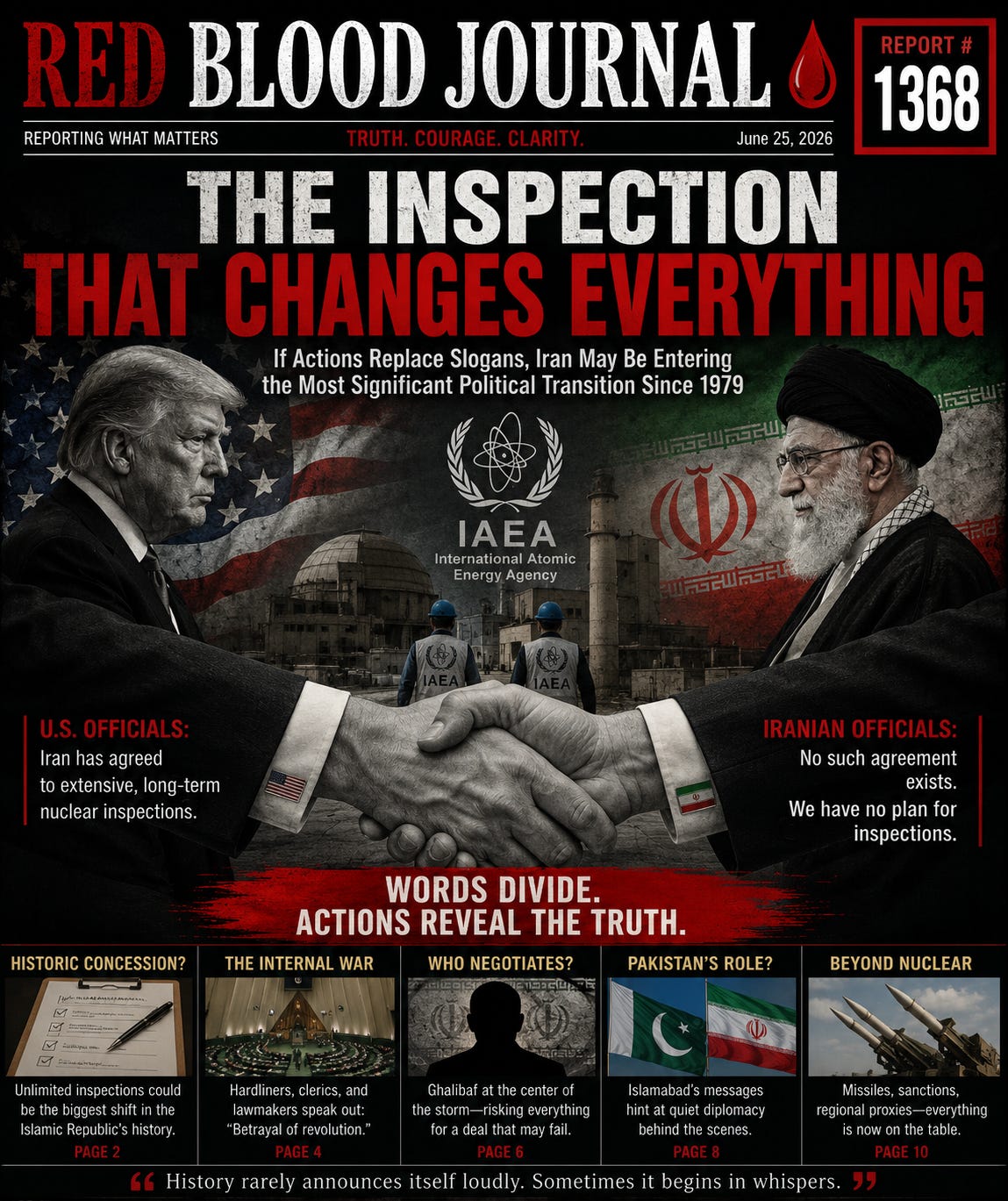
🩸 Red Blood Journal 🩸
Title:
The Inspection That Changes Everything
Subtitle:
If Actions Replace Slogans, Iran May Be Entering the Most Significant Political Transition Since 1979
Report #: 1368
Date: June 25, 2026
Introduction
For more than four decades, one principle stood above nearly every other policy of the Islamic Republic: resistance to foreign influence, particularly American influence. Entire generations were taught that negotiations with the United States represented surrender, while foreign inspections of military or nuclear facilities were portrayed as violations of national sovereignty.
Today, a growing number of statements, diplomatic developments, and conflicting public messages have led many observers to ask a simple question:
Has something fundamentally changed?
The answer remains uncertain. Yet the gap between official rhetoric and reported diplomatic activity appears wider than at any previous point in the history of the Islamic Republic.
The Public Narrative vs. The Diplomatic Narrative
Official Iranian representatives continue to deny that broad agreements have been reached regarding inspections or major concessions.
At the same time, American officials—including President Donald Trump and members of his administration—have publicly described negotiations progressing toward extensive verification measures and long-term oversight.
Whether every statement proves accurate is less important than the growing contradiction itself.
When two governments tell completely different stories, careful observers often focus less on the words and more on the actions that eventually follow.
The Inspection Question
Perhaps the most consequential issue is not sanctions.
It is not frozen assets.
It is not oil exports.
It is inspections.
Historically, verification has always represented the most difficult component of any nuclear agreement because inspections determine whether promises become observable reality.
If expanded inspections—including access beyond previously accepted limits—were eventually implemented, they would represent one of the most significant strategic changes in the history of the Islamic Republic.
Conversely, if such inspections never materialize, today’s announcements may become another chapter in diplomatic signaling rather than political transformation.
The difference can only be measured by future events.
Reading the Reactions
Equally important is the reaction inside Iran.
The transcript highlights criticism coming not from reformists or opposition groups, but from voices traditionally associated with the revolutionary establishment itself.
Whether those criticisms represent isolated disagreements or evidence of deeper fractures remains uncertain.
However, whenever political systems begin producing conflicting narratives from within, analysts naturally begin examining internal cohesion rather than external confrontation.
A Shift From External Conflict to Internal Competition
One recurring observation throughout the discussion is that the primary struggle may no longer be between Iran and the United States.
Instead, attention increasingly turns inward.
Questions emerge regarding:
succession,
institutional authority,
competing political factions,
and who will shape Iran’s next chapter.
If correct, history may eventually remember this period less as a confrontation with foreign governments and more as the beginning of an internal political realignment.
Actions Speak Louder Than Speeches
Throughout history, governments have often spoken one language while negotiating another.
Public speeches energize supporters.
Private diplomacy attempts to solve problems.
Neither automatically invalidates the other.
For observers, the most reliable guide is rarely rhetoric.
It is implementation.
If inspections occur...
If agreements are signed...
If policies change...
Then those actions become history regardless of previous speeches.
Reading Between the Lines
This moment illustrates an important lesson for every observer.
Political analysis should not begin with choosing sides.
It should begin by comparing words with observable outcomes.
The more consistent the outcomes become, the clearer the underlying direction becomes.
Predictions should always remain secondary to evidence.
Final Observation
Whether the reported negotiations ultimately succeed or fail, one reality appears increasingly visible:
The conversation inside Iran is changing.
Questions that once could not be openly discussed are now being debated among political insiders themselves.
That alone signals that something beneath the surface is moving.
History often announces its arrival quietly—long before official declarations acknowledge it.
The Ocean of Love and Positivity
Perhaps the greatest lesson extends beyond governments.
Nations, like individuals, eventually face moments when old certainties begin to crack. During those moments, fear encourages people to cling more tightly to familiar narratives. Wisdom encourages something different: observe patiently, remain open-minded, and let actions reveal the truth. Looking inward before choosing sides creates a steadier foundation than reacting to every headline. Like the calm ocean beneath the surface of the waves, clarity often exists beneath the noise for those willing to wait, observe, and seek understanding with love and positivity. 🩸🌊
🔎 The Inspection That Changes Everything
Jun 25, 2026
This report examines a potential historical turning point for the Islamic Republic of Iran as it navigates unprecedented negotiations with the United States.
While official rhetoric maintains a stance of resistance, the text highlights a significant disconnect between public slogans and private diplomacy, specifically regarding the possibility of intrusive foreign inspections.
These verification measures represent a massive shift in national policy that could signal the most substantial political transition since the 1979 revolution.
The source suggests that the primary struggle is no longer an external conflict, but rather an internal competition involving succession and institutional authority.
Ultimately, the document advises observers to prioritize observable actions and implementation over political speeches to understand Iran’s future direction.
This period of uncertainty reflects a changing internal conversation where long-held certainties are finally being questioned by political insiders.


