


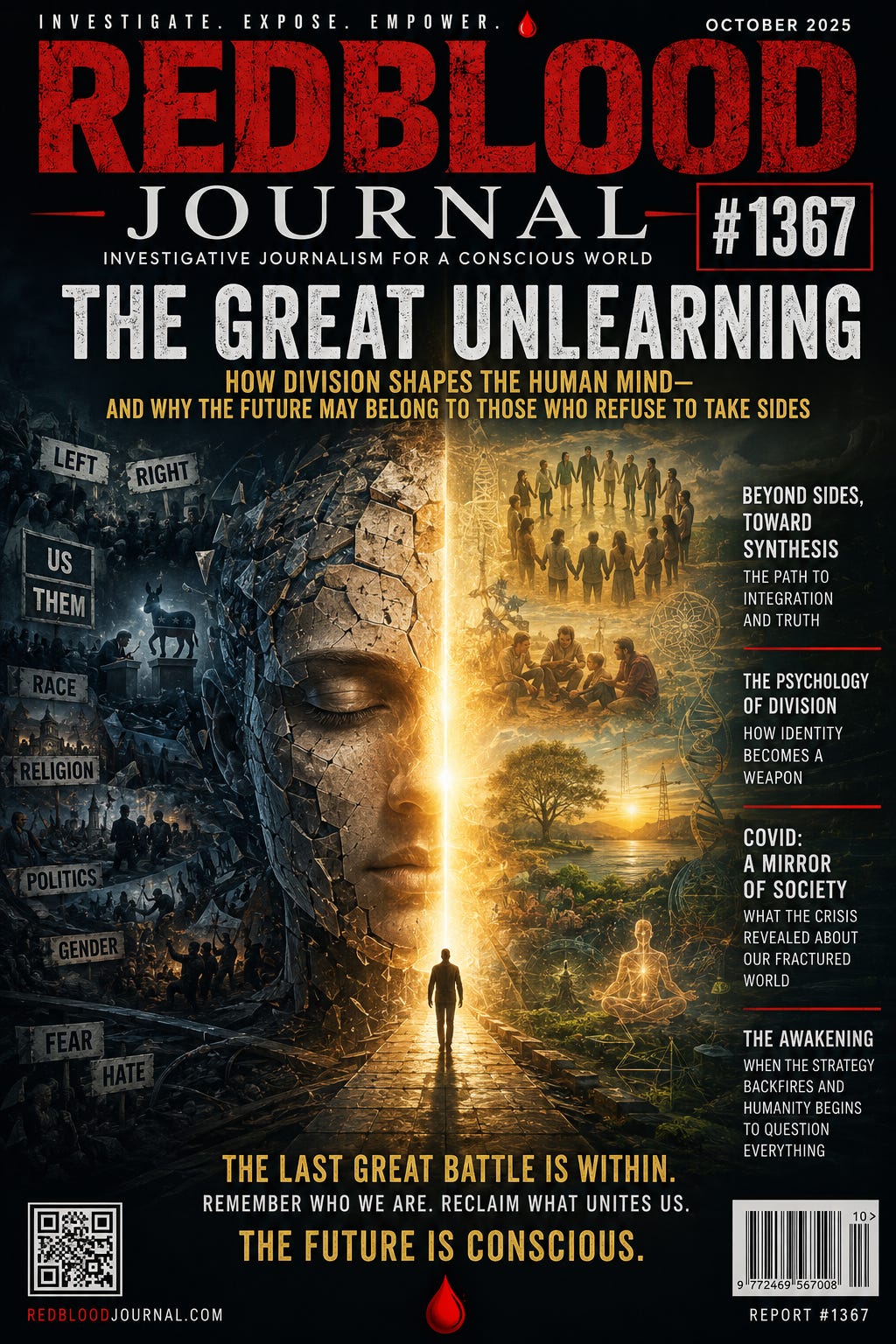
🩸 RedBloodJournal.com 🩸
The Great Unlearning
How Division Shapes the Human Mind—and Why the Future May Belong to Those Who Refuse to Take Sides
Report #1367
October 2025
Introduction: The Invisible Classroom
Most people believe they choose their beliefs.
But what if, long before those choices were ever made, the framework for choosing had already been designed?
From childhood onward, humanity is introduced to teams, flags, parties, denominations, ideologies, schools of thought, and countless labels. We inherit identities before we are old enough to question them. By adulthood, many people are no longer searching for truth—they are defending the identity they have inherited.
History shows that divided populations are easier to influence than united ones.
Whether those divisions emerged naturally or were later exploited by those seeking power, the effect is remarkably consistent: people become more invested in defeating one another than in understanding one another.
Perhaps the greatest lesson humanity has yet to learn is not how to choose the right side—but how to step outside the battlefield altogether.
The Mind Was Trained to Choose
Human beings naturally organize information into categories.
This ability helps us survive, but it also creates an unexpected vulnerability.
Once we identify ourselves as belonging to one group, our minds begin protecting that identity. Evidence supporting our group is welcomed. Evidence challenging it is resisted.
Psychologists describe this as confirmation bias, identity protection, and in-group loyalty.
The result is subtle but powerful.
Instead of asking,
“What is true?”
we begin asking,
“Which side is this helping?”
Without realizing it, truth becomes secondary to belonging.
The First Great Division
Long before modern politics, humanity organized itself through belief.
Different civilizations developed different names, rituals, traditions, and sacred texts.
For countless individuals these traditions became profound sources of morality, purpose, and community.
Yet history also shows that religious identities have often become boundaries separating one people from another.
The paradox is striking.
Many faiths teach compassion.
Many speak of one Creator.
Many encourage love, forgiveness, justice, humility, and mercy.
Yet throughout history, followers have frequently viewed one another as opponents rather than fellow seekers.
The question worth asking is not whether religion is good or bad.
The question is whether identity itself can become stronger than the principles it was meant to protect.
Division Evolves
As societies became more complex, new identities emerged.
Political parties.
Nationalism.
Economic systems.
Race.
Gender.
Class.
Sports.
Technology.
Even entertainment.
Each category offers belonging.
Each also creates an opposing category.
Modern technology accelerates this process.
Algorithms reward outrage.
Conflict generates attention.
Attention generates profit.
The more emotionally invested people become, the longer they remain engaged.
Division becomes economically valuable.
COVID: A Mirror of Modern Society
The COVID-19 pandemic revealed something larger than a public health crisis.
Communities disagreed over lockdowns.
Families argued over vaccines.
Friendships ended over political differences.
Institutions gained supporters and critics alike.
Regardless of where one stood on specific policies, one reality became difficult to ignore:
People increasingly judged one another not as individuals, but as representatives of opposing camps.
The crisis became a mirror reflecting how quickly identity can overshadow dialogue.
When Division Reaches Its Limit
Every system eventually encounters diminishing returns.
When enough people become exhausted by conflict, a different question begins to emerge.
Instead of asking,
“Who is my enemy?”
they begin asking,
“Why does everything require choosing sides?”
This shift represents something profound.
Not a political awakening.
Not a religious awakening.
A psychological awakening.
It is the realization that every side may contain both insight and error.
The Art of Integration
Perhaps wisdom does not belong to any single ideology.
Perhaps it is collected.
A free mind can admire scientific discovery without worshipping institutions.
It can appreciate religious wisdom without abandoning critical thought.
It can value tradition while remaining open to new understanding.
It can disagree without hatred.
It can question without fear.
Integration does not eliminate differences.
It allows differences to become teachers instead of enemies.
The University of Life
Imagine life not as a battlefield but as a university.
Every disagreement becomes a lesson.
Every challenge becomes an examination.
Every opposing viewpoint becomes another classroom.
The highest grade is not awarded to the loudest defender of a tribe.
It belongs to the individual who can observe every side without becoming imprisoned by any side.
Perhaps that has always been the hidden curriculum.
The Great Unlearning
Humanity has spent thousands of years learning how to separate.
Perhaps the next chapter requires learning how to reconnect.
Not by eliminating religion.
Not by abolishing politics.
Not by destroying culture.
But by refusing to allow any identity to become greater than our shared humanity.
The moment people stop asking,
“Which side should I join?”
and begin asking,
“What can I learn from every side?”
the architecture of division begins to weaken.
Conclusion: The Final Frontier
The greatest revolution may never occur in governments.
It may never occur in financial markets.
It may never occur through technology.
The greatest revolution begins when an individual discovers that the mind no longer needs an enemy in order to understand itself.
History has repeatedly demonstrated the power of division.
Perhaps the next era will reveal the power of integration.
If humanity learns to recognize wisdom wherever it appears—and rejects hatred regardless of its source—the oldest strategy of control loses its greatest advantage.
The future may belong not to those who win the argument...
...but to those who no longer need one.
The Inner Ocean
Beyond every label, beyond every ideology, beyond every flag and every doctrine lies something quieter—the observer within.
The Inner Ocean asks for neither victory nor surrender. It asks only for awareness.
Those who learn to look inward may discover that the strongest mind is not the one that defeats every opponent, but the one that no longer depends on opponents to know itself.
Perhaps that is where genuine freedom begins.
🔓 The Great Unlearning:
The Architecture of Human Division
Jun 25, 2026
This text examines how pre-programmed social identities and systemic categorization shape human behavior and fuel persistent conflict.
It argues that people often prioritize group loyalty over objective truth, a tendency reinforced by historical belief systems, modern political structures, and digital algorithms.
The author suggests that society has reached a state of psychological exhaustion, where individuals are beginning to value human connection and integrated wisdom over binary tribalism.
By treating differing viewpoints as educational opportunities rather than threats, humanity can potentially move past manipulative strategies of control.
Ultimately, the passage advocates for a radical mental shift where self-awareness replaces the need for an enemy. This process of “unlearning” seeks to establish a future defined by shared humanity and independent thought.


