


🩸 RedBloodJournal.com 🩸
Report #1366
Title
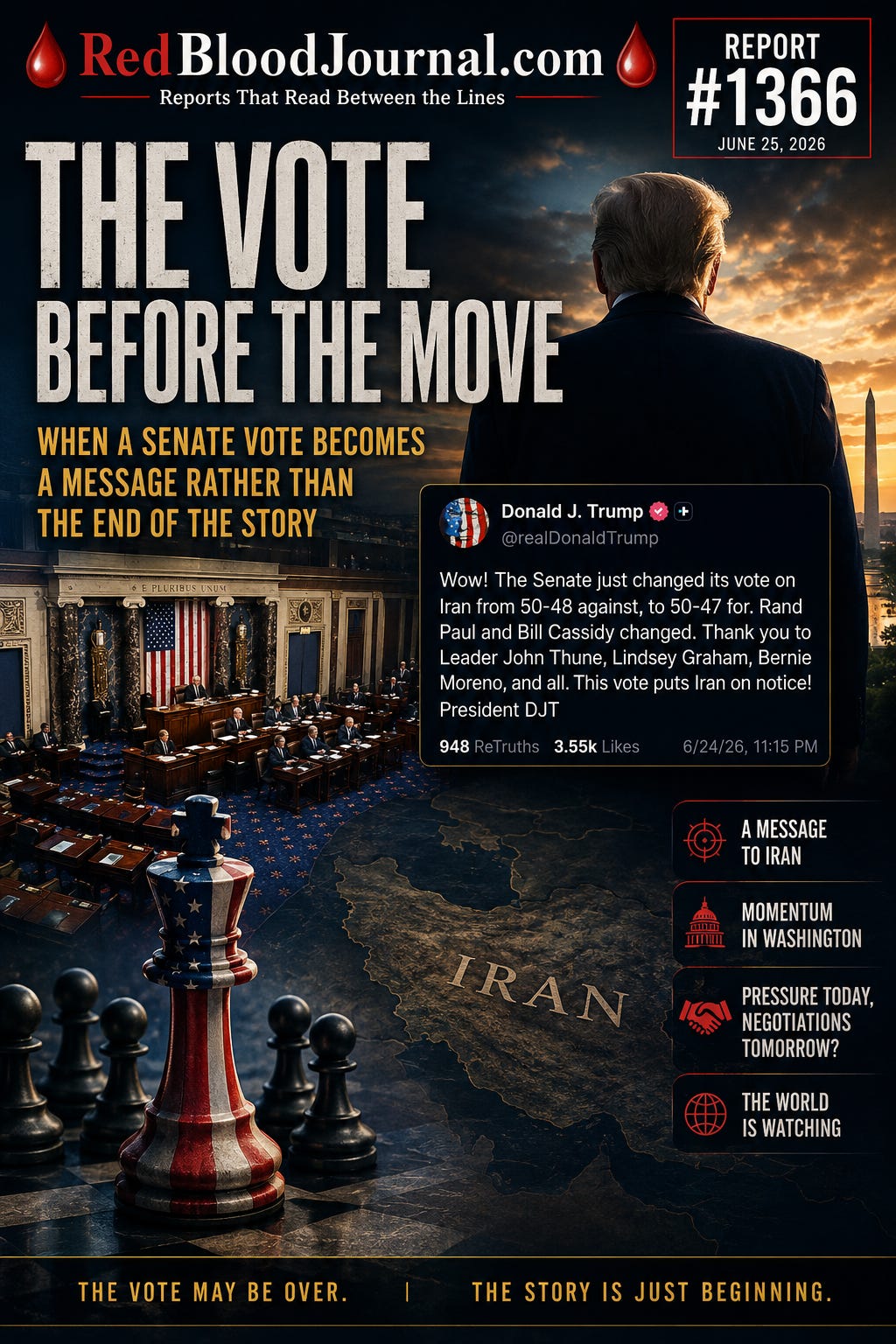
The Vote Before the Move
Subtitle
When a Senate Vote Becomes a Message Rather Than the End of the Story
Date: June 25, 2026
Executive Summary
Political events often serve two purposes: they produce a legal outcome and they send a message. Sometimes the message is more important than the vote itself.
President Donald Trump’s statement following the Senate vote regarding Iran emphasizes not only the final result, but that the outcome changed during the process. Whether intentionally or not, the post frames the vote as evidence that political momentum shifted.
If history is any guide, public political messages are frequently designed to influence multiple audiences at once: domestic supporters, allies, adversaries, financial markets, and negotiators.
The real significance may not be the vote itself, but what follows.
Reading Between the Lines
Several observations stand out.
1. The focus is on movement.
The post repeatedly highlights that the vote changed.
Not simply:
“We won.”
Instead:
“The Senate changed its vote.”
That wording suggests a story of momentum rather than merely counting votes.
2. Iran is the audience.
The closing sentence is direct.
“This vote puts Iran on notice.”
This transforms what could have been a domestic political announcement into an international signal.
Whether symbolic or practical, the intended audience extends beyond Washington.
3. Individual senators are publicly acknowledged.
Listing senators who changed their votes accomplishes several things.
It rewards political allies.
It encourages party unity.
It signals that leadership notices loyalty.
It reminds undecided lawmakers that votes carry public visibility.
Historical Pattern
Major geopolitical negotiations often follow a recognizable sequence.
Public pressure increases.
Political institutions demonstrate unity.
Media expectations rise.
Negotiations continue behind closed doors.
A compromise eventually appears stronger because pressure came first.
History contains many examples where public confrontation preceded private diplomacy.
That does not prove the same pattern is occurring here, but it is a pattern worth recognizing.
Predictions
The following are observations and possibilities, not certainties.
Prediction 1
Public rhetoric toward Iran is likely to remain firm even if private diplomatic discussions continue.
Strong public language and private negotiations are not mutually exclusive.
Prediction 2
Additional political or economic pressure may follow before any major agreement is announced.
Pressure often increases negotiating leverage.
Prediction 3
Both supporters and opponents will interpret the same events as confirmation of their existing views.
Political polarization ensures that identical facts often produce opposite conclusions.
Prediction 4
Financial markets will continue reacting more to expectations than to completed policy.
Often the anticipation of action has greater immediate impact than the action itself.
Prediction 5
Future developments should be judged more by actions than by headlines.
Votes, speeches, and social media posts communicate intent, but long-term consequences are determined by legislation, diplomacy, military decisions, and implementation.
Looking Through the Theater
Politics frequently operates on two stages simultaneously.
One stage is visible:
speeches
votes
headlines
interviews
social media
The other stage is largely unseen:
negotiations
strategic planning
intelligence assessments
diplomatic conversations
economic calculations
Observers who focus exclusively on either stage risk missing part of the picture.
The challenge is not to assume hidden intentions, but to remain aware that public events can serve multiple purposes at once.
Final Thought
Every major political event creates two stories.
The first is the event everyone watches.
The second is the chain of events the first one quietly begins.
Wisdom comes from resisting the urge to draw immediate conclusions. Instead, watch patiently as actions unfold over time. Headlines may change by the hour, but patterns reveal themselves only with distance.
🌊 Ocean of Love and Positivity
Whether governments compete, negotiate, or confront one another, individuals still face the same personal choice: to become consumed by fear and division or to cultivate clarity, compassion, and self-awareness. Looking inward does not require ignoring world events; it means observing them without surrendering one’s inner peace. The calmest mind often sees the broadest horizon. In the end, wisdom grows not from reacting to every headline, but from developing an inner foundation that remains steady while the world continues its constant motion. 🩸🌊✨ Fantastic!
📜 The Senate Vote:
Geopolitical Strategy and Political Theater
Jun 25, 2026
The provided report analyzes a 2026 Senate vote regarding Iran, framing the legislative event as a calculated piece of geopolitical theater rather than a simple legal outcome.
By highlighting how lawmakers changed their positions, the text suggests that President Trump utilized the momentum of the vote to signal American strength to international adversaries and domestic audiences alike.
The author argues that such public political displays often serve as a precursor to private diplomacy, using overt pressure to gain leverage in future negotiations.
Furthermore, the source encourages readers to look beyond sensationalist headlines to recognize the deeper strategic patterns hidden within government actions.
Ultimately, the narrative contrasts the chaotic nature of global politics with the necessity of maintaining personal clarity and inner peace amidst societal division.


