


🩸 RedBloodJournal.com 🩸
#1359
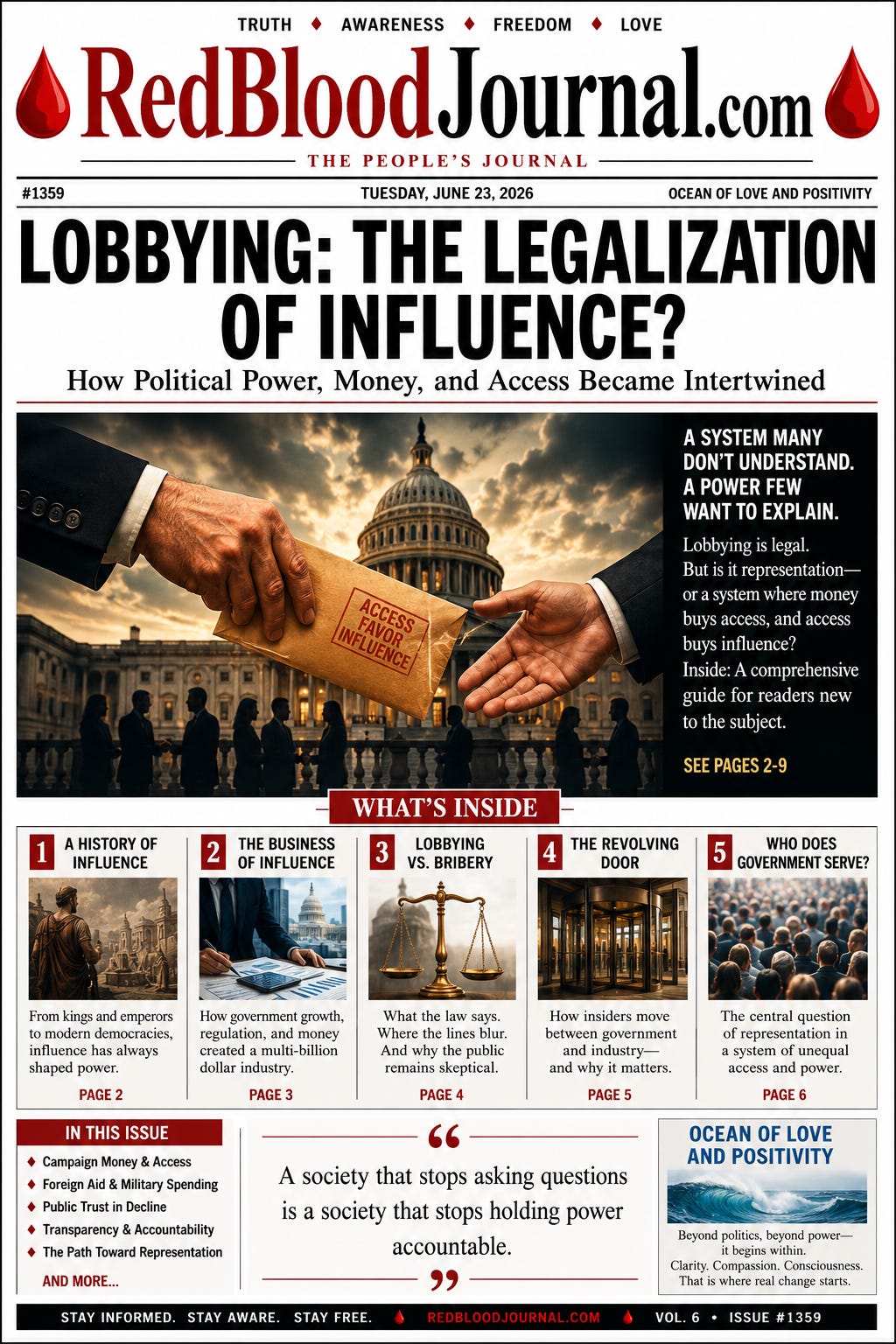
Lobbying: The Legalization of Influence?
How Political Power, Money, and Access Became Intertwined
Date: June 23, 2026
Introduction
Most citizens grow up believing that government exists to represent the people.
The idea is simple: citizens elect representatives, representatives write laws, and government serves the public interest.
Yet as individuals become more familiar with politics, many begin asking uncomfortable questions.
Why do policies supported by large portions of the public sometimes fail to pass?
Why do certain industries repeatedly receive favorable treatment?
Why do politicians spend enormous amounts of time fundraising?
Why do lobbyists have direct access to lawmakers while ordinary citizens often struggle to have their voices heard?
To understand these questions, one must understand lobbying.
Whether viewed as a legitimate part of democracy or as a sophisticated system of legalized influence, lobbying has become one of the most powerful forces operating behind modern government.
Part I: Influence Existed Before Democracy
Lobbying did not begin in Washington.
It did not begin in Congress.
It did not begin in modern politics.
The practice of influencing power is as old as civilization itself.
Throughout history:
Merchants sought favorable trade agreements.
Wealthy families sought tax privileges.
Military leaders sought funding.
Religious institutions sought influence.
Noble families sought access to rulers.
Every government, regardless of its form, has attracted those who wished to influence decisions for their own benefit.
Kings had advisers.
Emperors had courts.
Modern governments have lobbyists.
The names have changed.
The pursuit of influence has not.
Part II: The Rise of Modern Lobbying
As representative governments developed, influence adapted.
Rather than convincing a king, interested groups now sought to influence elected lawmakers.
The principle sounded reasonable.
Citizens should be allowed to petition government.
Organizations should be allowed to present information.
Experts should be allowed to advise lawmakers.
This became one of the foundations of modern democratic systems.
But over time another question emerged.
What happens when some voices possess vastly greater resources than others?
The answer would shape modern politics.
Part III: Government Became Big Business
As governments expanded, so did the value of influencing them.
Modern governments regulate:
Healthcare
Banking
Energy
Transportation
Defense
Agriculture
Technology
Education
Each regulation creates winners and losers.
Each budget allocates resources.
Each law creates opportunities.
When a single legislative decision can affect billions of dollars, influencing that decision becomes extremely valuable.
A company may spend millions attempting to shape regulations if favorable legislation could generate hundreds of millions in future profits.
From a business perspective, influence becomes an investment.
As government power grows, the market value of political influence grows alongside it.
Part IV: Lobbying Versus Bribery
Supporters of lobbying insist there is a clear distinction between lobbying and bribery.
Legally, they are correct.
Bribery generally involves:
A direct exchange.
Something of value.
A specific official action.
This is illegal.
Lobbying generally involves:
Advocacy.
Meetings.
Research.
Public campaigns.
Policy recommendations.
This is legal.
Yet critics argue that the distinction becomes less clear when vast sums of money enter the political process.
A question frequently raised by skeptics is:
If influence can be purchased indirectly, does the public experience a meaningful difference?
The answer depends largely upon one’s view of the political system.
Part V: The Revolving Door
One of the most controversial aspects of modern lobbying is what critics call the revolving door.
The process is simple.
A government official gains experience, relationships, and insider knowledge.
The official leaves government.
The official becomes a lobbyist.
The former official then uses those relationships to influence former colleagues.
Sometimes the process operates in reverse.
Lobbyists enter government positions.
Government officials return to lobbying firms.
Supporters argue this creates expertise.
Critics argue it creates conflicts of interest.
The debate continues because both arguments contain elements of truth.
Part VI: Campaigns Require Money
Modern elections are expensive.
Advertising, travel, staff, consultants, polling, and media outreach require substantial funding.
As campaign costs rise, fundraising becomes increasingly important.
This creates another question.
If political survival depends heavily upon financial support, who ultimately gains influence over political priorities?
Supporters argue that campaign contributions do not automatically purchase votes.
Critics argue that access itself has value.
Even when no laws are broken, unequal access can shape outcomes.
This is where much of the public’s distrust originates.
Part VII: The Public Trust Problem
Many citizens experience a growing disconnect between official narratives and everyday reality.
They hear:
The economy is strong.
Inflation is under control.
Employment is healthy.
Yet many simultaneously experience:
Rising housing costs.
Increasing insurance premiums.
Expensive healthcare.
Growing personal debt.
Reduced purchasing power.
Whether these perceptions are accurate or not is less important than the consequences.
Trust begins to erode whenever lived experience appears inconsistent with official messaging.
As trust declines, citizens increasingly question not only policies but the institutions themselves.
Part VIII: Foreign Aid, Military Spending, and Public Skepticism
Another source of controversy involves government spending priorities.
Many citizens ask:
Why are vast sums available for foreign assistance?
Why does military spending continue expanding?
Why do domestic problems remain unresolved?
Supporters of these expenditures argue that alliances, defense capabilities, and international commitments serve long-term national interests.
Critics often respond that struggling populations naturally question overseas spending when local needs appear unmet.
The debate is not merely financial.
It is philosophical.
Who should government serve first?
What obligations exist beyond national borders?
How should limited resources be allocated?
These questions remain unresolved.
Part IX: The Central Question
The lobbying debate ultimately comes down to one issue.
Representation.
Does government primarily represent citizens?
Does it primarily represent organized interests?
Does it represent economic power?
Or does it represent some combination of all three?
The answer differs depending upon whom one asks.
Yet the persistence of the question itself reveals something important.
A healthy society continuously examines the relationship between power and influence.
The moment citizens stop asking questions, accountability begins to disappear.
Conclusion
Lobbying is neither a new phenomenon nor a uniquely modern one.
Influence has accompanied power throughout human history.
The modern debate centers not on whether influence exists, but on how much influence should be allowed, who possesses it, and whether ordinary citizens retain meaningful representation within increasingly complex political systems.
The challenge facing every generation is the same:
How can a society allow participation without allowing influence to become domination?
There is no universally accepted answer.
Only an ongoing discussion.
And perhaps that discussion is one of the most important responsibilities of a free people.
Ocean of Love and Positivity
Political systems rise and fall.
Parties change.
Leaders come and go.
Institutions evolve.
Yet one responsibility remains beyond politics itself.
The responsibility to seek truth honestly.
To question respectfully.
To think independently.
To avoid becoming consumed by anger while pursuing understanding.
The Ocean of Love and Positivity reminds us that wisdom is not found merely in exposing flaws within the world, but also in cultivating clarity within ourselves.
For a society to become healthier, individuals must first become more conscious observers of the forces that shape both the outer world and the inner mind.
Only then can genuine understanding begin.
⚖️ The Legalization of Influence:
Lobbying and the Power of Access
Jun 23, 2026
This article explores the historical evolution and modern implications of lobbying as a mechanism of political influence.
It suggests that while the practice of seeking government favor is ancient, it has transformed into a sophisticated multi-billion dollar industry where access is often treated as a business investment.
The text examines controversial elements such as the revolving door between public office and private advocacy, alongside the growing tension between corporate interests and the needs of ordinary citizens.
By highlighting the high costs of political campaigns, the source argues that financial resources significantly dictate who has a seat at the decision-making table.
Ultimately, the piece prompts readers to question whether modern representative systems truly serve the public or primarily respond to organized economic power.
It concludes by stressing that maintaining a healthy society requires constant vigilance and an independent mindset regarding how power is exercised.


