


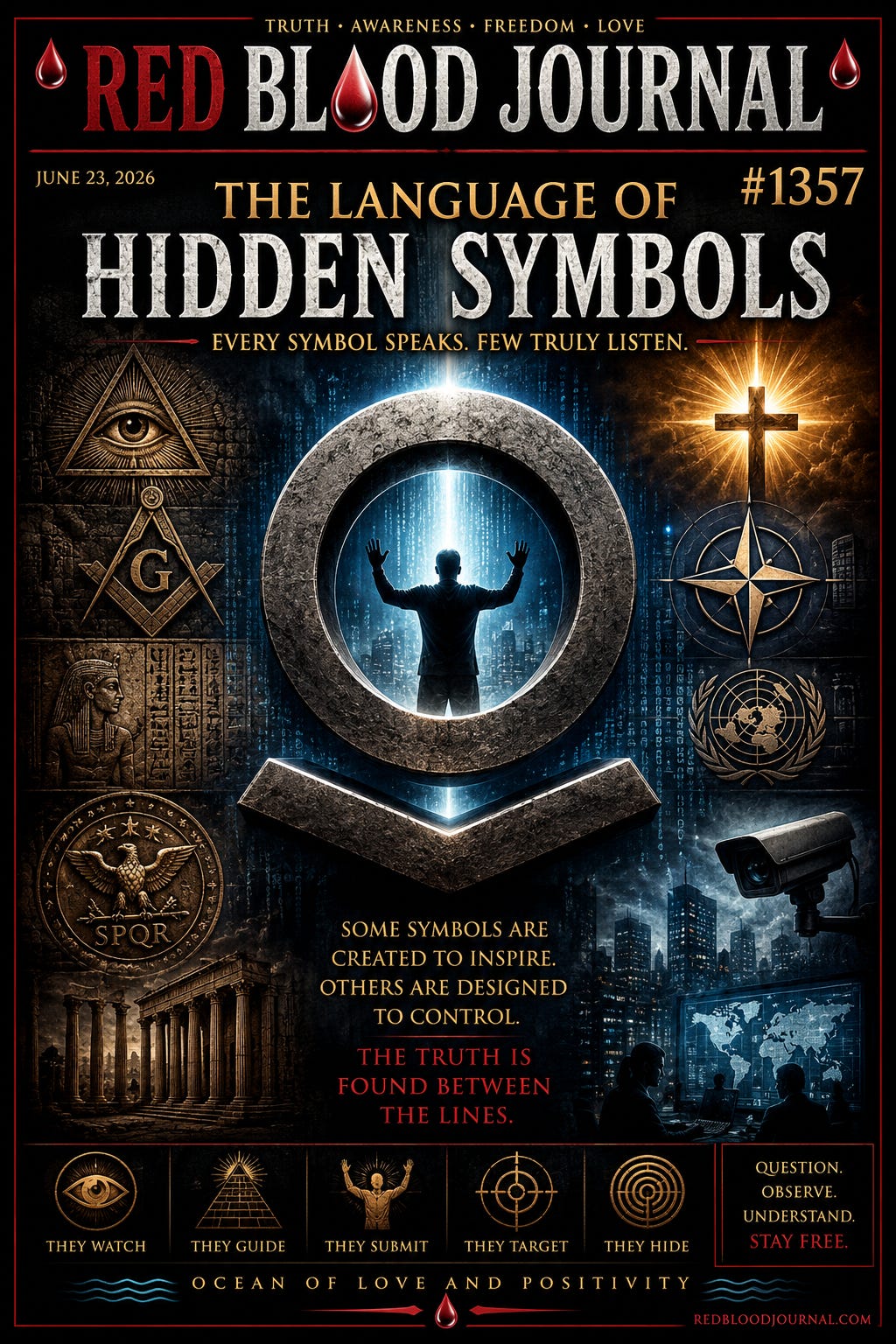
🩸 Red Blood Journal #1357
The Language of Hidden Symbols
June 23, 2026
Introduction
Throughout history, power has rarely communicated through words alone.
Kings, empires, religions, corporations, political movements, and governments have all relied on symbols to communicate ideas, establish authority, and shape perception. Long before most people could read, symbols served as a universal language capable of transmitting messages instantly.
A flag, a seal, a crest, or a logo can often communicate more emotion in a second than a thousand words can communicate in a speech.
Whether intentional or not, symbols influence the way people think, feel, and interpret the world around them.
The Oldest Language of Power
Symbols have accompanied power throughout human history.
Ancient rulers stamped their images onto coins. Religious institutions decorated temples with sacred imagery. Military forces marched beneath banners designed to inspire allies and intimidate enemies.
The symbol often became more recognizable than the ruler who created it.
Empires rose and fell, yet their symbols remained embedded in collective memory long after their leaders disappeared.
The reason is simple:
Symbols bypass lengthy explanations and communicate directly to the imagination.
Hidden Meaning or Human Interpretation?
The debate surrounding symbols has existed for centuries.
When one person looks at a symbol, they may see one meaning. Another person may see something entirely different.
One observer sees freedom.
Another sees control.
One sees protection.
Another sees surveillance.
One sees hope.
Another sees submission.
The symbol itself remains unchanged, yet the interpretation changes from observer to observer.
This raises an important question:
Are hidden meanings intentionally placed within symbols, or do human beings naturally create meanings where none were originally intended?
The answer may be both.
Why Simple Symbols Are Powerful
Modern organizations increasingly favor simple logos and minimalist designs.
A circle.
A line.
A triangle.
A single shape can carry multiple meanings simultaneously.
A circle may represent:
Unity
Completion
Infinity
The sun
An eye
Observation
Wholeness
A horizontal line may represent:
Stability
Foundation
Horizon
Separation
Limitation
When combined together, a simple image may produce countless interpretations.
This flexibility is often what makes a symbol memorable.
Each observer contributes part of the meaning.
The Symbol as a Mirror
An overlooked aspect of symbolism is that symbols often reveal as much about the observer as they do about the creator.
A hopeful mind may see opportunity.
A fearful mind may see danger.
A spiritual thinker may see transcendence.
A political critic may see structures of power.
A technologist may see innovation.
The same image can trigger entirely different conclusions.
In this sense, every symbol functions as a mirror.
People often discover their own beliefs reflected back at them through the images they examine.
The Theater Behind the Curtain
Power structures throughout history have understood the value of symbolism.
Symbols create identity.
Symbols create loyalty.
Symbols create emotional attachment.
The most effective symbols are often the ones that remain partially unexplained.
Their ambiguity allows different audiences to project different meanings onto them while still feeling connected to the same image.
This is why a symbol can survive even when the institution behind it changes.
The image becomes larger than its creator.
The symbol takes on a life of its own.
Looking Beyond the Surface
The search for hidden meanings can be valuable when approached carefully.
Blind acceptance can lead to fantasy.
Blind dismissal can lead to ignorance.
The wiser path is observation.
To ask questions.
To examine evidence.
To compare intention with outcome.
To recognize that every symbol may contain multiple layers of meaning—some intentional, some accidental, and some created entirely by the observer.
The goal is not to force conclusions.
The goal is to understand.
Conclusion
Perhaps the most powerful hidden symbol is not found on a flag, a government seal, a corporate logo, or a monument.
Perhaps the most powerful symbol is the human mind itself.
Every day, people observe the world and assign meaning to what they see.
Some meanings are accurate.
Some are mistaken.
Some are intentional.
Some are imagined.
The challenge is learning how to distinguish between them.
True understanding begins when observation is combined with curiosity, skepticism, and self-awareness.
Only then can symbols become tools for insight rather than instruments of confusion.
🌊 Ocean of Love and Positivity
The Ocean of Love and Positivity does not ask anyone to accept or reject a symbol simply because others have assigned meaning to it. Instead, it encourages thoughtful observation and honest inquiry. Symbols may point in many directions, but wisdom comes from understanding why a particular meaning resonates within the observer. The journey inward remains more important than any symbol found in the outer world, for it is within that inner ocean that clarity, understanding, love, and positivity are ultimately discovered.
🩸 RedBloodJournal.com 🩸
🩸🌊✨ Fantastic! ✨🌊🩸
👁️ The Silent Lexicon:
Deciphering the Visual Language of Power
Jun 23, 2026
This text explores the profound influence of symbols as a universal language used by power structures to communicate authority and shape public perception.
Historically, imagery such as seals, flags, and logos has functioned as a more immediate tool for emotional connection than spoken words, often outlasting the empires that created them.
The author emphasizes that a symbol’s power lies in its inherent ambiguity, allowing it to act as a mirror that reflects the observer’s own beliefs and fears.
While some meanings are intentionally embedded by organizations to foster loyalty, others are created through personal interpretation or collective memory.
Ultimately, the source encourages a balanced approach of observation and self-awareness to distinguish between manufactured messages and personal projections.
By understanding this silent lexicon, individuals can transform these visual tools into instruments of insight rather than objects of confusion.


