


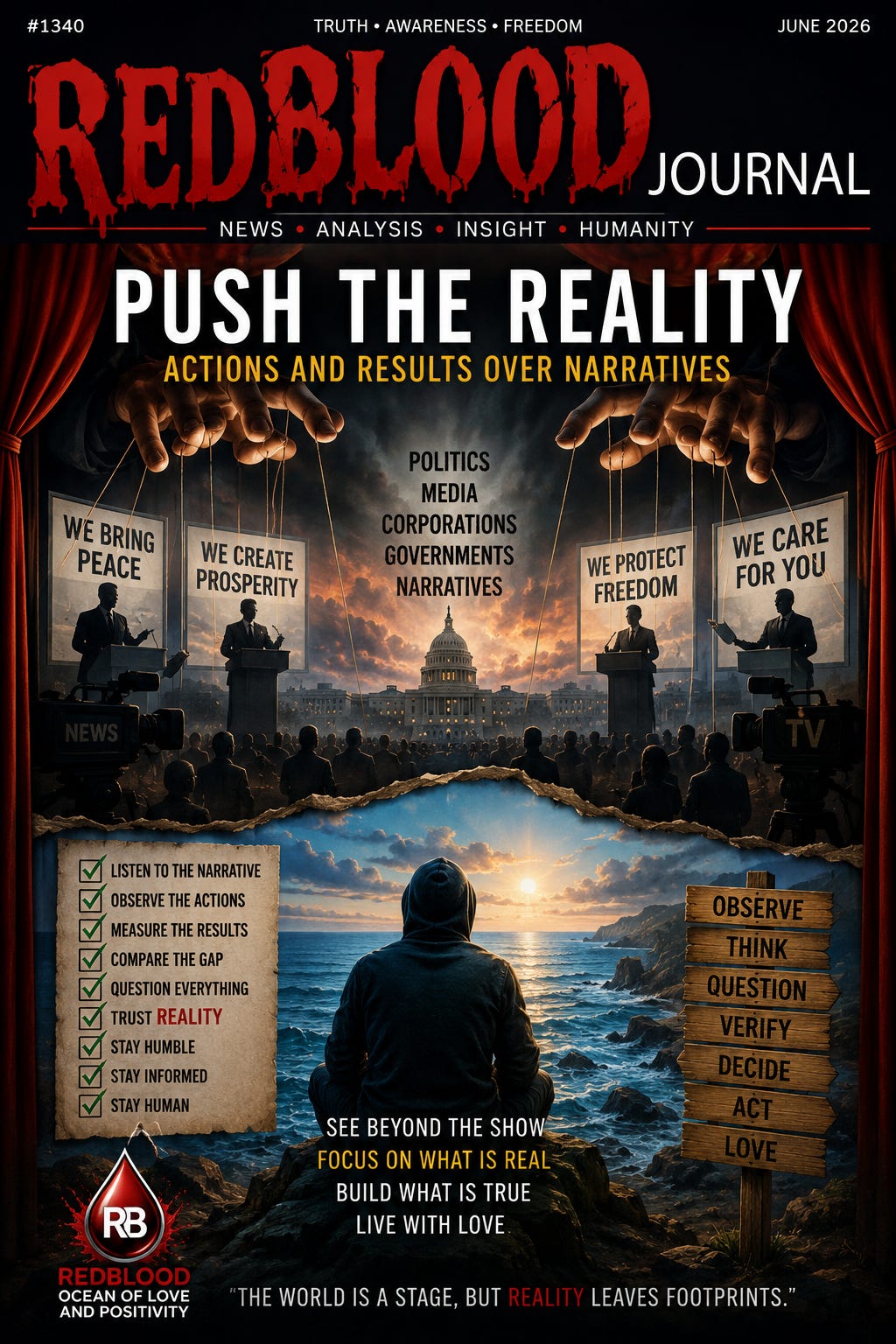
🩸 RedBloodJournal.com #1340 🩸
Push the Reality
When Actions and Results Matter More Than Narratives
By Red Blood
Human beings are storytellers.
Long before governments existed, before newspapers, television, radio, and social media, people gathered around fires and exchanged stories to explain the world around them.
Stories are powerful.
Stories inspire courage.
Stories inspire fear.
Stories inspire hope.
Stories inspire obedience.
Stories inspire rebellion.
Every government uses stories.
Every religion uses stories.
Every corporation uses stories.
Every movement uses stories.
The question is not whether stories exist.
The question is whether the story matches reality.
The Age of Narratives
Modern civilization is flooded with narratives.
Political narratives.
Economic narratives.
Military narratives.
Scientific narratives.
Corporate narratives.
Social narratives.
Every day billions of people are exposed to explanations about what is happening, why it is happening, and who should be praised or blamed.
The volume is so overwhelming that many people no longer have time to examine the events themselves.
The narrative arrives before the evidence.
The explanation arrives before the observation.
The conclusion arrives before the investigation.
And so the story becomes reality.
Or at least the appearance of reality.
Watching the Actions
There is another approach.
A much simpler approach.
Listen carefully.
Then watch carefully.
If a government speaks about peace, observe whether peace follows.
If a government speaks about prosperity, observe whether prosperity follows.
If a corporation speaks about serving customers, observe whether customers benefit.
If leaders speak about freedom, observe whether freedom expands or contracts.
If institutions speak about transparency, observe how much transparency actually appears.
The observer is not interested in speeches alone.
The observer is interested in results.
Because reality eventually leaves footprints.
Reality can hide temporarily.
Reality can wear costumes.
Reality can change actors.
Reality can even change entire political parties.
But reality eventually leaves evidence.
The Gap
The most interesting place to observe is the gap.
The gap between words and actions.
The gap between promises and outcomes.
The gap between intentions and consequences.
The larger the gap becomes, the more questions naturally arise.
People begin asking:
Why is housing becoming less affordable?
Why is debt increasing?
Why does technology continue advancing while stress continues rising?
Why do promises repeat while outcomes remain unchanged?
These questions do not require conspiracy theories.
They do not require blind trust.
They require observation.
Nothing more.
Nothing less.
The Theater and the Audience
Politics often resembles a theater.
Actors enter.
Actors leave.
New costumes appear.
New slogans appear.
New villains appear.
New heroes appear.
The audience is encouraged to cheer.
The audience is encouraged to fear.
The audience is encouraged to choose sides.
But the observer asks a different question:
What changed after the performance ended?
Was life improved?
Was independence increased?
Was truth expanded?
Were ordinary people stronger, freer, wiser, and more secure?
Or did only the script change?
Push the Reality
To push reality does not mean rejecting every narrative.
It means testing every narrative.
It means refusing to surrender observation to authority.
It means allowing facts, actions, and outcomes to outweigh emotional persuasion.
Reality does not need advertising.
Reality does not require a public relations department.
Reality simply exists.
The challenge is finding it beneath the noise.
And perhaps that is why so many people eventually become exhausted with politics, media, and endless conflict.
Not because they stop caring.
But because they begin searching for something more stable than the daily script.
Something that remains unchanged regardless of who occupies the stage.
Something deeper than the performance.
Something closer to truth.
And perhaps that search eventually leads inward.
Beyond the headlines.
Beyond the actors.
Beyond the fear.
Toward the quiet recognition that while the stage may never stop changing, the observer can still learn to see clearly.
And in that clarity, perhaps there remains an Ocean of Love and Positivity waiting beneath the waves of the world’s endless theater.
The stage may rise and fall.
The actors may come and go.
But the Ocean remains.
And that is 🩸🌊✨ Fantastic!
👁️ Beyond the Theater of Narratives
Jun 21, 2026
The provided text explores the disconnect between curated narratives and the actual reality of human experience.
It argues that while governments, corporations, and movements use storytelling to influence public perception, true understanding requires observing tangible results rather than listening to speeches.
By identifying the gap between promises and outcomes, individuals can move past the theatrical nature of modern politics and media.
The author encourages a shift toward personal observation and critical thinking to avoid being manipulated by emotional scripts.
Ultimately, the piece suggests that seeking internal clarity and truth allows one to find stability beneath the chaotic surface of societal conflict.
This process leads to a deeper, more constant state of peace that exists independently of external performances.


