


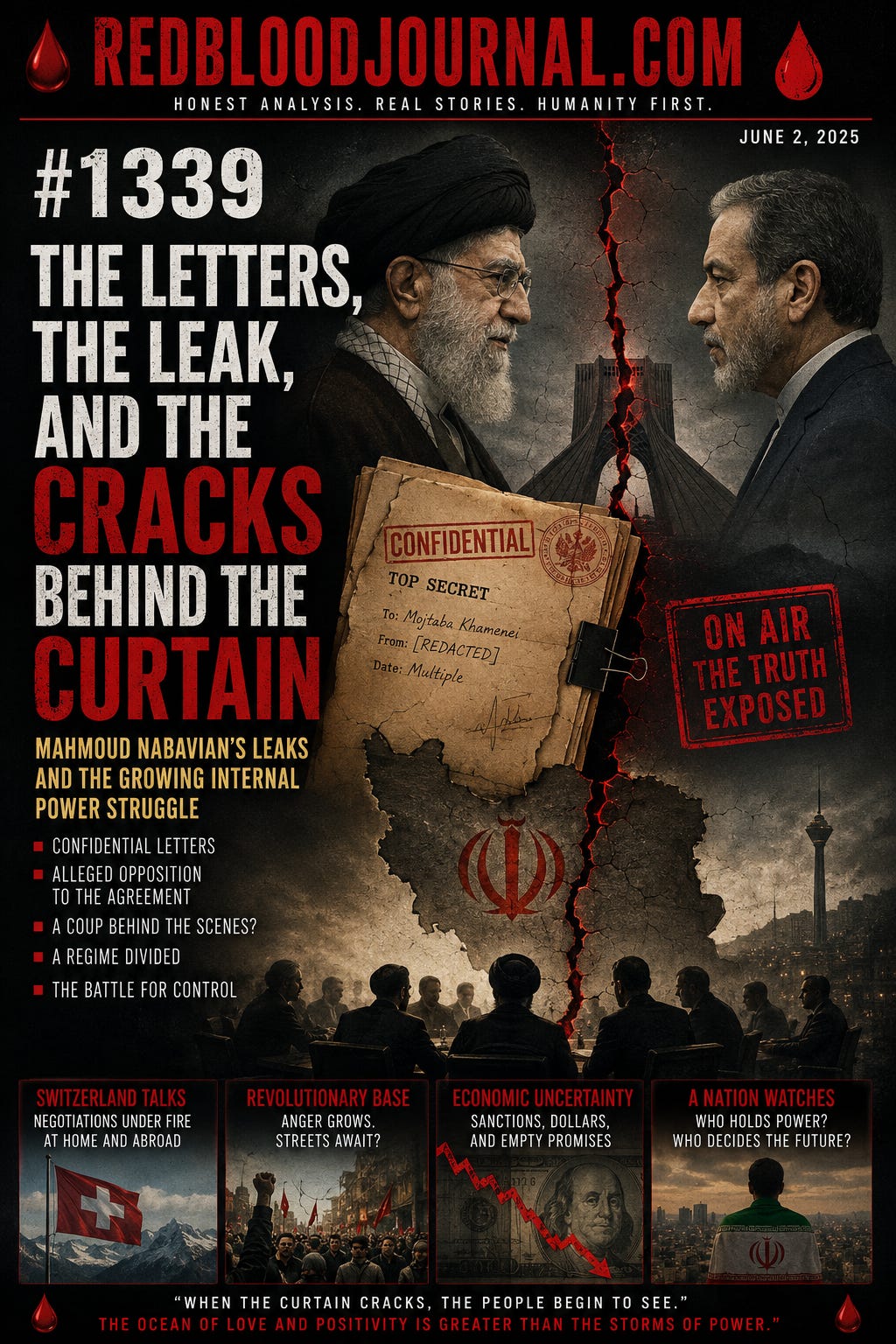
🩸 RedBloodJournal.com #1339🩸
The Letters, The Leak, and the Cracks Behind the Curtain
Mahmoud Nabavian’s Revelations and the Growing Internal Power Struggle
By Red Blood
For years, many observers assumed that the Islamic Republic operated as a unified machine.
Different factions argued.
Different politicians competed.
Different personalities emerged and disappeared.
But when critical decisions arrived, the public image remained one of unity.
Recent events suggest that image may be far less solid than many believed.
When a Letter Changes the Story
The controversy began when Mahmoud Nabavian appeared on state television and publicly discussed what he claimed were confidential communications attributed to Mojtaba Khamenei.
Whether every document was authentic or not is ultimately less important than what happened next.
The reaction itself revealed something significant.
Instead of producing clarity, the disclosures created confusion.
Instead of demonstrating unity, they exposed division.
Instead of strengthening confidence, they raised questions.
Questions that had previously been whispered suddenly entered public discussion.
Who is actually making decisions?
Who supports the negotiations?
Who opposes them?
And perhaps most importantly:
Who truly holds authority?
The Appearance of Two Governments
Political systems often project a single image to the public.
Behind that image, however, power may be distributed among multiple competing centers.
One group may control security.
Another may control finances.
Another may influence foreign policy.
Another may shape public messaging.
Most of the time these differences remain hidden.
The public sees the final product rather than the internal debate.
The recent controversy gave observers a rare glimpse behind the curtain.
The dispute was not simply about negotiations.
It was about legitimacy.
If one faction claims to represent the true wishes of leadership while another faction moves policy in a different direction, the argument quickly becomes larger than the policy itself.
It becomes a struggle over who speaks for the system.
The Negotiation Fault Line
Every government contains individuals who believe compromise is necessary.
Every government also contains individuals who believe compromise is surrender.
The reported Swiss negotiations appear to have become the latest battlefield between these two visions.
One side appears to view negotiations as a practical necessity.
The other sees them as a dangerous step toward transformation.
Neither side is merely debating technical details.
They are debating the future identity of the state itself.
This is why emotions have become so intense.
The argument is no longer about a document.
It is about direction.
Why Leaks Are Dangerous
Leaks are powerful because they bypass official narratives.
A carefully crafted public message can take months to construct.
A single leaked document can challenge that message in minutes.
Whether accurate, incomplete, or misunderstood, leaked information forces institutions into defensive positions.
People begin asking questions.
Rumors spread.
Loyalties become visible.
The organization is suddenly forced to explain itself.
History shows that major institutions often fear internal leaks more than external criticism.
External criticism is expected.
Internal disclosures are not.
The Real Story Behind the Story
The most important observation may not be what the letters allegedly contained.
The most important observation is that a conflict serious enough to produce such disclosures appears to exist at all.
Strong systems usually keep disagreements private.
When disagreements begin appearing in public view, it often indicates that internal mechanisms for resolving disputes are weakening.
Whether this situation grows larger or fades away remains unknown.
But once people witness cracks in a wall, they begin looking for other cracks.
And once questions begin, they rarely stop with the first answer.
The Human Side
While political factions argue, ordinary people continue living their lives.
They go to work.
They raise families.
They worry about prices.
They worry about the future.
For many citizens, the battle between competing power centers matters less than whether life improves.
Political struggles are often measured in headlines.
People measure them in daily reality.
The distance between those two measurements can be enormous.
The Larger Lesson
Throughout history, institutions have often appeared strongest immediately before revealing their deepest divisions.
The public usually sees the finished stage performance.
Rarely do they witness the actors arguing behind the scenery.
The recent controversy may ultimately prove insignificant.
Or it may be remembered as one of those moments when the curtain briefly opened and revealed that the theater was far more complicated than it appeared.
Time will decide.
Until then, observers continue watching the stage while wondering what conversations are taking place behind it.
And perhaps the wisest observer remembers that while governments, factions, leaders, and agreements rise and fall like waves, there remains something deeper beneath them all.
An ocean that is untouched by political storms.
An ocean that does not choose sides.
An ocean of love, understanding, and positivity waiting quietly beneath the noise.
The Ocean of Love and Positivity remains open to all who choose to look beyond the stage and into the deeper waters of existence.
🩸 RedBloodJournal.com 🩸
🎭 Cracks Behind the Curtain:
Power Struggles in the Islamic Republic
Jun 21, 2026
This article examines the internal fracturing of the Iranian political establishment following the public disclosure of confidential communications by Mahmoud Nabavian.
These leaks have exposed a clandestine power struggle between rival factions, challenging the long-standing illusion of a unified government.
The tension centers on a fundamental disagreement regarding international negotiations, pitting those who favor pragmatic compromise against those who view it as a betrayal of state identity.
Such high-profile disputes suggest that the traditional mechanisms for resolving conflict privately are beginning to fail.
Ultimately, these divisions reveal a deepening crisis of legitimacy and authority within the leadership as various groups vie for control over the nation’s future direction.
This public display of friction serves as a rare glimpse into the complex instability hidden behind the regime’s official narrative.


