


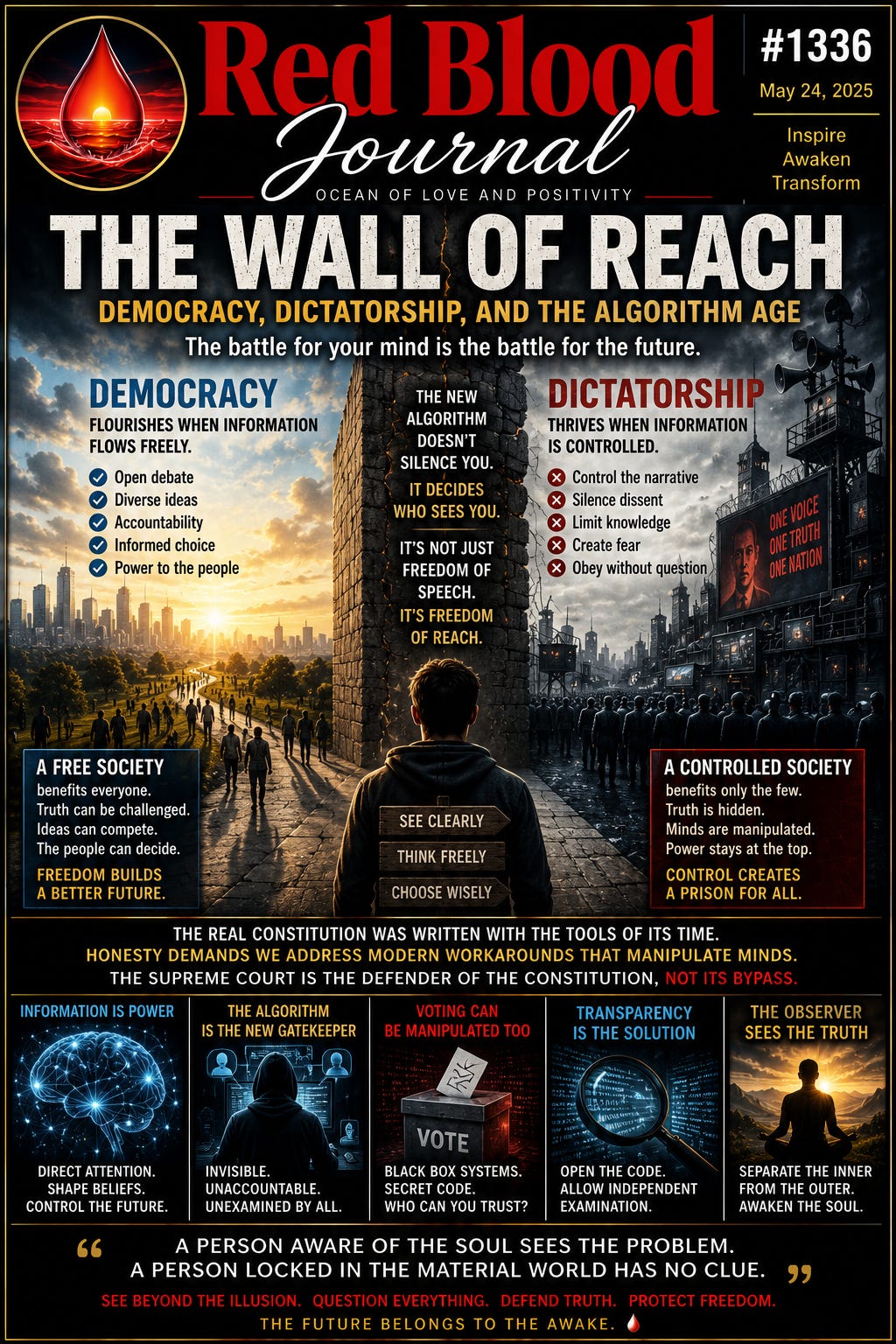
🩸 RedBloodJournal.com #1336
The Wall of Reach, Democracy, and the Algorithm Age
Information, Visibility, and Public Trust in the Digital Era
By Red Blood
Modern societies often define themselves through the language of freedom.
Freedom of speech.
Freedom of the press.
Freedom of association.
Freedom of political participation.
These principles form the foundation of many democratic systems and are intended to ensure that citizens can exchange ideas, challenge authority, and participate meaningfully in public life.
Yet technological change has introduced a new question that previous generations never faced on a global scale:
What happens when information is no longer limited by publication, but by visibility?
From Information Scarcity to Information Abundance
For most of human history, access to information was limited.
Books were scarce.
News traveled slowly.
Communication was constrained by geography and technology.
The challenge was obtaining information.
Today, the challenge is different.
Information is abundant.
Billions of pieces of content are created every day.
The question is no longer whether information exists.
The question is which information people actually see.
This shift has transformed visibility into one of the most influential forces in modern society.
The Difference Between Speech and Reach
In democratic societies, freedom of speech traditionally protects an individual’s ability to express ideas.
However, modern digital platforms introduce another factor: distribution.
A message may exist online and remain technically uncensored.
Yet its visibility may be influenced by recommendation systems, ranking mechanisms, engagement models, advertising structures, and algorithmic prioritization.
As a result, a distinction has emerged between freedom of speech and freedom of reach.
One concerns the ability to speak.
The other concerns the ability to be heard.
This distinction raises important questions about how public discourse functions in an increasingly digital world.
Democracy and the Flow of Information
A healthy democracy depends upon informed citizens.
For citizens to make meaningful decisions, they must have access to diverse viewpoints, competing arguments, and reliable information.
Historically, democratic systems have relied upon open debate and public scrutiny as safeguards against concentrated power.
When information flows freely, ideas compete on their merits.
When information becomes concentrated, controlled, or heavily filtered, concerns naturally arise regarding public understanding and decision-making.
The challenge is not unique to any political system.
Throughout history, governments, institutions, corporations, media organizations, and other centers of influence have sought to shape public perception.
Technology has simply changed the methods through which this influence may occur.
The Rise of the Algorithmic Gatekeeper
In previous eras, gatekeepers were visible.
Editors selected headlines.
Publishers selected books.
Broadcasters selected programming.
Today, much of that selection process is performed by software.
Algorithms determine recommendations.
Algorithms influence discovery.
Algorithms affect visibility.
Algorithms shape attention.
While these systems are often designed to improve user experience and manage vast quantities of information, they also possess significant influence over what populations encounter on a daily basis.
This reality has led to increasing debate regarding transparency, accountability, and public oversight.
Public Trust and Transparent Systems
Trust is one of the most valuable assets within any society.
Whether discussing elections, media organizations, financial institutions, or digital platforms, public confidence generally increases when systems are transparent and open to independent review.
Conversely, confidence often declines when critical processes become opaque and difficult to examine.
This principle extends beyond politics.
People tend to trust systems they can inspect, question, audit, and verify.
They tend to be more skeptical of systems that require unquestioning acceptance.
The issue is not necessarily whether a system is fair or unfair.
The issue is whether citizens possess sufficient visibility into the process to evaluate it for themselves.
The Observer’s Perspective
Beyond questions of governance and technology lies a more personal challenge.
Every individual lives within a constant stream of information.
News.
Politics.
Advertising.
Entertainment.
Social media.
Commentary.
Opinions.
The modern citizen is exposed to more information in a single day than previous generations may have encountered in months.
Under such conditions, self-awareness becomes increasingly important.
The ability to pause, reflect, and observe one’s own reactions provides a measure of independence from external influences.
The individual who develops this capacity is better positioned to distinguish between information and persuasion, between reaction and reflection, between attention and intention.
The Continuing Challenge
The debate surrounding democracy, information, algorithms, and public trust is unlikely to disappear.
As technology evolves, societies will continue confronting difficult questions regarding transparency, visibility, accountability, and influence.
The answers may vary across nations and generations.
Yet one principle remains consistent.
A free society depends not only upon the ability to speak, but also upon citizens who are willing to think critically, question assumptions, and examine the systems that shape public perception.
The future of freedom may depend as much upon informed observation as it does upon political institutions.
And while technologies, governments, and platforms will continue to change, the responsibility to observe, question, and understand ultimately remains with the individual.
🌊 Ocean of Love and Positivity 🌊
👁️ The Wall of Reach:
Visibility in the Algorithm Age
Jun 21, 2026
This article examines the critical evolution from information scarcity to algorithmic abundance, highlighting how digital platforms now control public discourse through visibility rather than censorship.
The author argues that while freedom of speech remains a legal standard, the true power lies in freedom of reach, where software determines which ideas are actually heard.
Because algorithmic gatekeepers have replaced traditional editors, the text emphasizes the urgent need for systemic transparency to maintain public trust in democratic institutions.
Ultimately, the source suggests that informed citizenship requires individuals to practice self-awareness and critical thinking to navigate an environment designed to shape their perceptions.
By distinguishing between expression and distribution, the writing calls for a deeper investigation into how automated systems influence the modern flow of information.


