


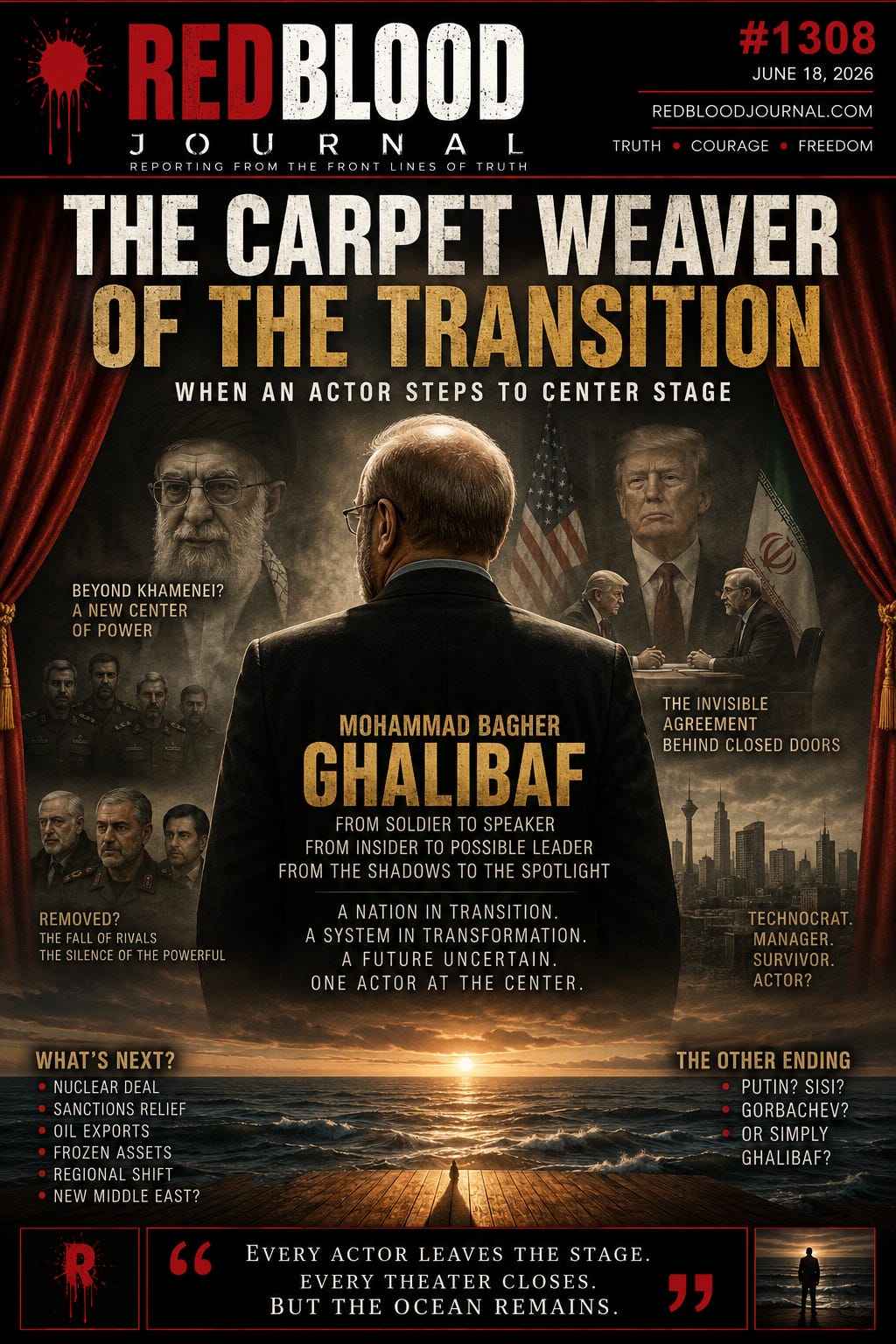
🩸 RedBloodJournal.com #1308
The Carpet Weaver of the Transition
When an Actor Steps to Center Stage
By Red Blood
There are moments in every theater production when a supporting actor slowly walks toward the center of the stage.
The audience does not always notice it at first.
The lights remain focused elsewhere.
The script continues.
The familiar characters keep speaking their lines.
Yet quietly, almost unnoticed, another actor moves into position.
Many observers of Iranian politics now see Mohammad Bagher Ghalibaf in exactly this role.
Whether one admires him, distrusts him, fears him, or dismisses him, one fact has become difficult to ignore:
His name keeps appearing at the center of conversations about Iran’s future.
For years he played many roles.
Military commander.
Mayor.
Parliament speaker.
Political insider.
Manager.
Technocrat.
Revolutionary.
Pragmatist.
Each role appeared when needed.
Each costume fit the scene.
And like every actor in a long-running production, he learned how to survive while others disappeared from the script.
The Predictions
Years before recent events, some commentators suggested that Ghalibaf was positioning himself for a moment of transition.
Among them was Shahin Najafi, who warned people not to underestimate him.
The prediction was simple:
If the system ever changed form, Ghalibaf might emerge from within it rather than against it.
Not as a revolutionary destroying the stage.
But as an actor inheriting it.
Whether that prediction was accurate remains unknown.
But many now point back to those statements and wonder.
The Theater of Power
Political systems often resemble theaters more than battlefields.
The audience sees speeches.
The audience sees elections.
The audience sees arguments.
The audience sees enemies.
The audience sees heroes.
Yet the audience rarely sees the rehearsals.
Rarely sees the script revisions.
Rarely sees the backstage negotiations.
Rarely sees who decides which actor receives more stage time.
In recent months, many observers noticed that Ghalibaf increasingly spoke as though he were already making decisions beyond the traditional limits of his role.
The language shifted.
The posture shifted.
The confidence shifted.
For some, this signaled nothing.
For others, it signaled everything.
The Invisible Handshake
One of the recurring themes surrounding Ghalibaf is the belief that major agreements happen far away from cameras.
Public documents may be shown.
Public speeches may be delivered.
Public disputes may be performed.
But many suspect the real negotiations occur where no audience is present.
Whether true or false, this belief fuels the perception that Ghalibaf is less concerned with ideological theater and more concerned with managing outcomes.
In this view, the actor is not trying to win applause.
He is trying to keep the production running.
The Technocrat
Unlike many ideological figures, Ghalibaf is frequently described by supporters and critics alike as a manager.
A technocrat.
Someone focused on systems, infrastructure, administration, and practical control.
To his supporters, this is a strength.
To his critics, it is dangerous.
Because a skilled manager can guide a system through transformation while appearing to change very little.
The stage remains.
The curtains remain.
The audience remains.
But the script quietly changes.
Putin, Sisi, or Gorbachev?
Commentators have compared him to many figures.
Some see shades of Vladimir Putin.
Others see similarities to Abdel Fattah el-Sisi.
Still others compare him to Mikhail Gorbachev.
Each comparison reflects a different possible ending to the story.
A consolidator.
A stabilizer.
A reformer.
Or perhaps none of the above.
Perhaps he is simply Ghalibaf.
An actor playing a role that no previous actor has played before.
The Question Behind the Question
The most important question may not be whether Ghalibaf becomes powerful.
History is full of powerful men.
The deeper question is:
Who writes the script?
Every audience becomes fascinated with actors.
Some love them.
Some hate them.
Some cheer.
Some boo.
Some buy tickets for every performance.
But very few ask who wrote the play.
And fewer still ask why the play was written.
The audience argues endlessly about actors while ignoring the director.
Beyond the Stage
Perhaps one day historians will explain what really happened.
Perhaps today’s theories will prove correct.
Perhaps they will prove completely wrong.
Perhaps Ghalibaf is the central actor.
Perhaps he is only another performer reading lines written elsewhere.
Time reveals many things.
But wisdom sometimes arrives before certainty.
And wisdom whispers a simple reminder:
Do not become so fascinated with the actors that you forget the theater.
Do not become so fascinated with the theater that you forget yourself.
Because beyond every stage...
Beyond every script...
Beyond every political season...
Beyond every hero and every villain...
There remains the Ocean.
The Ocean that was never divided.
The Ocean that does not campaign.
The Ocean that does not negotiate.
The Ocean that does not seek power.
Every actor eventually leaves the stage.
Every audience eventually goes home.
Every theater eventually closes.
Yet the Ocean remains.
Waiting for each drop to remember what it has always been.
An inseparable part of the whole.
🩸
🎭 Ghalibaf and the Architecture of Transition
Jun 18, 2026
This source analyzes the political trajectory of Mohammad Bagher Ghalibaf, portraying him as a versatile figure strategically positioned for a potential leadership transition in Iran.
The text employs an extended theatrical metaphor, suggesting that while the public focuses on political drama, Ghalibaf operates as a pragmatic technocrat who prioritizes systemic stability over ideology.
Observers debate whether he represents a stabilizer like Vladimir Putin or a reformer like Mikhail Gorbachev, noting his ability to survive numerous shifts in power.
Ultimately, the author suggests that Ghalibaf may be an actor following a predetermined script written by invisible directors within the establishment.
The narrative concludes by reminding the audience to look beyond political theater toward a more profound, unified reality symbolized by the ocean.


