


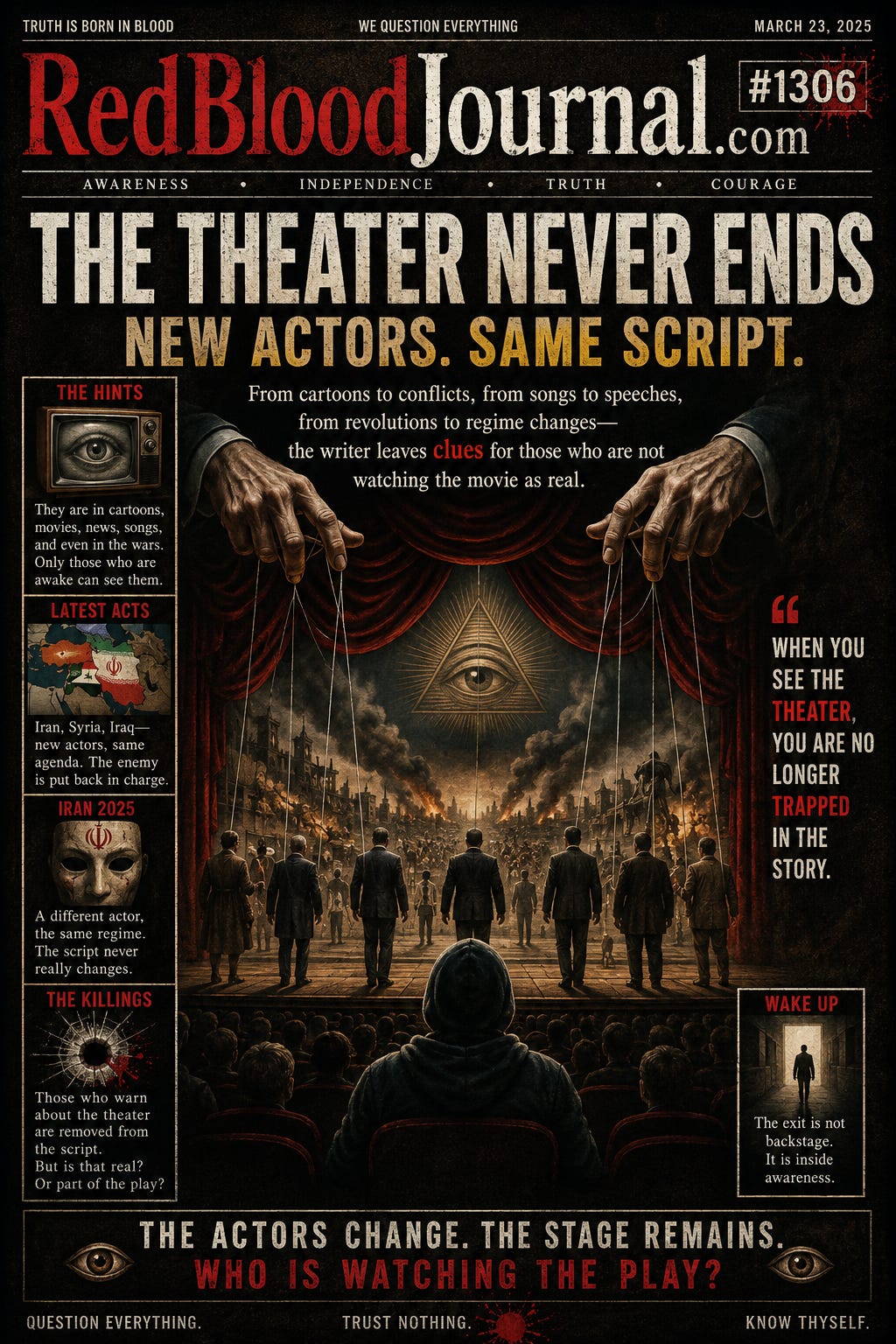
🩸 RedBloodJournal.com #1306
The Clues Hidden in the Theater
By Red Blood
Imagine sitting in a theater.
The lights dim.
The curtain rises.
The actors enter the stage.
Some wear the costume of kings.
Some wear the costume of rebels.
Some wear the costume of heroes.
Some wear the costume of villains.
The audience quickly becomes attached to the characters.
They cheer for some.
They hate others.
They celebrate victories.
They mourn defeats.
Yet the writer and the director know something the audience often forgets.
The actors are not the story.
They are merely playing their parts.
The Strange Habit of the Human Mind
Human beings become emotionally attached to the characters they see.
A movie star becomes a hero.
A politician becomes a savior.
A religious figure becomes a symbol.
A billionaire becomes an idol.
A revolutionary becomes a legend.
The costume becomes more important than the person wearing it.
The role becomes more important than the stage itself.
The audience becomes so absorbed in the performance that it forgets to ask a simple question:
Who wrote the script?
The Clues Are Everywhere
Writers leave clues.
Directors leave clues.
Authors leave clues.
The ending is often visible from the beginning.
The audience simply does not recognize it.
Sometimes the clues appear in cartoons.
Sometimes they appear in movies.
Sometimes in songs.
Sometimes in speeches.
Sometimes in news headlines.
Sometimes in events that appear unrelated until years later.
A person looking only at the scene sees chaos.
A person stepping back begins to notice patterns.
Not because they possess secret knowledge.
Not because they have been granted special access.
But because distance reveals shapes that cannot be seen from within the crowd.
The Revolving Door
History often resembles a revolving door.
A king is removed.
Another king appears.
A dictator falls.
Another dictator emerges.
A revolution promises freedom.
A new bureaucracy arrives.
An empire collapses.
A different empire fills the vacuum.
The faces change.
The slogans change.
The flags change.
Yet the machinery often continues operating beneath the surface.
The audience celebrates the arrival of a new actor while the stage itself remains untouched.
The Greatest Illusion
Perhaps the greatest illusion is not that the theater exists.
Perhaps the greatest illusion is believing that the theater is all that exists.
The audience is trained to watch outward.
Watch the politician.
Watch the celebrity.
Watch the conflict.
Watch the scandal.
Watch the war.
Watch the fear.
Watch the outrage.
Always watch something outside.
Rarely are they encouraged to watch the observer.
Rarely are they encouraged to ask:
Who is watching the movie?
Who is experiencing the story?
Who is reacting to every scene?
The Hidden Exit
The hidden exit from the theater is not located backstage.
It is not found through secret organizations.
It is not found through political parties.
It is not found through governments.
It is not found through media personalities.
It is found through awareness.
The moment a person realizes they are watching a performance, something changes.
The spell weakens.
The attachment softens.
The fear loses some of its power.
The observer begins to emerge.
The Ocean
The actor exits.
The politician exits.
The king exits.
The revolutionary exits.
The billionaire exits.
The journalist exits.
The audience exits.
Every character eventually leaves the stage.
Yet something remains.
The awareness that witnessed the entire performance.
Like drops believing they are separate while forgetting they belong to the same ocean.
Perhaps the purpose was never to choose the correct actor.
Perhaps the purpose was never to memorize every scene.
Perhaps the purpose was simply to remember that behind every costume, every label, every ideology, every conflict, and every character, there remains the same vast ocean waiting to be recognized.
And when enough drops remember the ocean, the theater no longer controls the audience.
The audience becomes the ocean once again.
🩸 RedBloodJournal.com 🩸
👁️ The Audience and the Ocean
Jun 17, 2026
This text uses the metaphor of a theatrical production to illustrate how humanity becomes trapped by external dramas and social roles.
People often mistake the temporary masks of politicians, celebrities, and historical figures for reality, failing to see the underlying patterns or the “script” directing these events.
By focusing solely on these superficial conflicts, the audience loses sight of their own internal awareness and the forces shaping their perception.
True liberation occurs when individuals recognize the performative nature of society and look past the illusion of separation.
Ultimately, the author suggests that we are all part of a unified consciousness described as a vast ocean.
Recognizing this shared essence allows the observer to break free from the control of the “theater” and regain their original power.


