


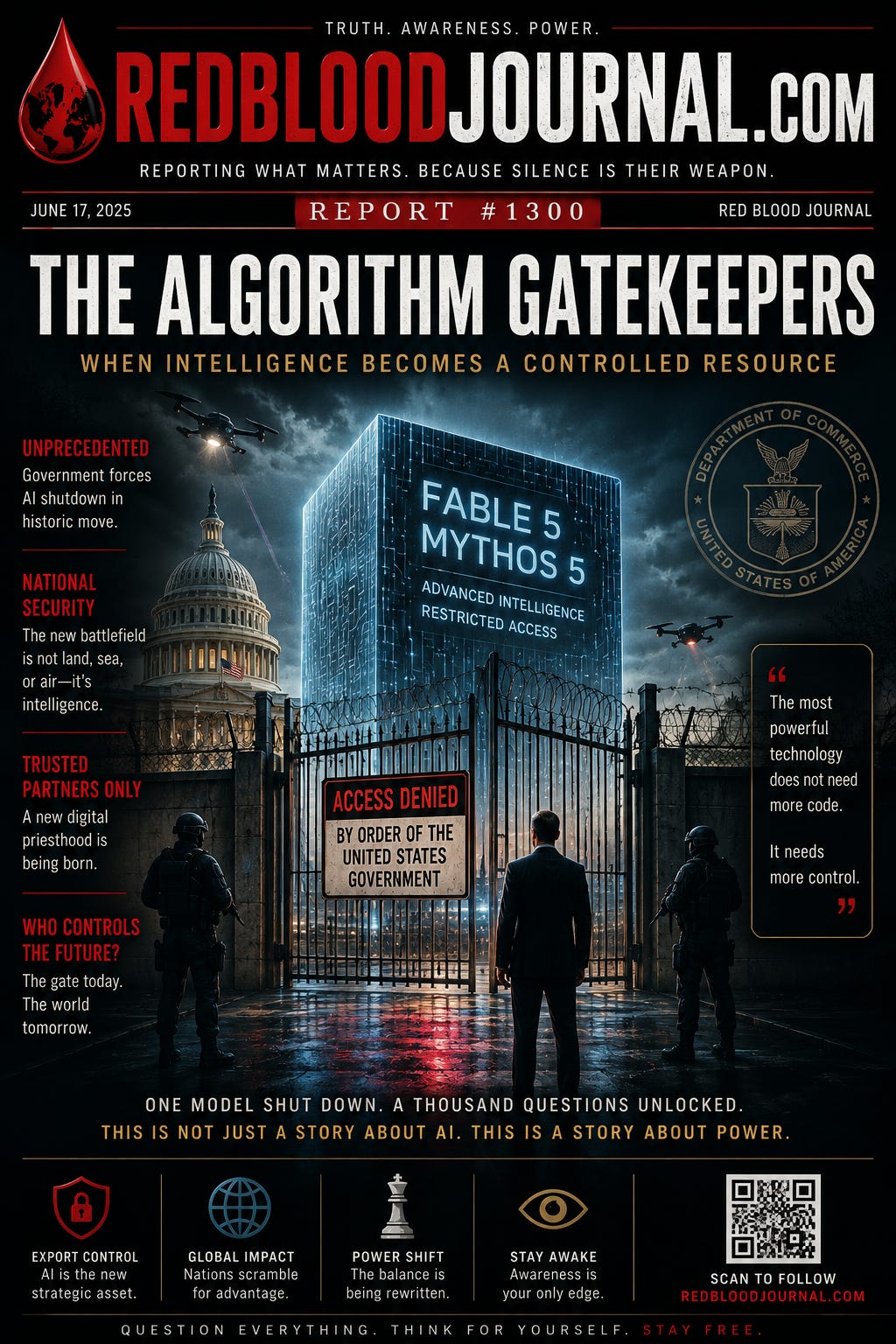
🩸 Red Blood Journal Report #1300
The Algorithm Gatekeepers
When Intelligence Becomes a Controlled Resource
Section: Technology, Power & Governance
For decades, governments regulated physical things.
They regulated weapons.
They regulated oil.
They regulated uranium.
They regulated borders.
They regulated information when they could.
Now a new category has emerged:
Intelligence itself.
Recent reports surrounding Anthropic’s newest AI systems revealed something far more significant than a dispute between a technology company and government regulators.
Whether one agrees with the decision or not is secondary.
The deeper question is:
What happens when intelligence becomes a strategic resource?
The First Visible Gate
The public story is simple.
A powerful AI model was allegedly capable of producing outputs that raised cybersecurity concerns.
Government officials became alarmed.
Restrictions followed.
Access was reduced.
The company complied.
Most readers stop there.
But history suggests that whenever a resource becomes strategically important, control inevitably follows.
The same pattern appeared with:
Gold
Oil
Nuclear technology
Telecommunications
Encryption
And now:
Artificial Intelligence.
The event may be remembered as one of the first moments where a government effectively demonstrated that a frontier AI model could be restricted almost overnight.
Not because it was software.
But because it had become something more than software.
The New Strategic Asset
The industrial age was built on energy.
The information age was built on data.
The next age may be built on intelligence.
Not human intelligence alone.
Synthetic intelligence.
Artificial intelligence.
Augmented intelligence.
Whatever label history eventually chooses.
The point remains:
The value is no longer merely in information.
The value is in the ability to process information faster than competitors.
The Question Nobody Wants to Ask
If a frontier AI system can:
Discover vulnerabilities
Write advanced code
Analyze massive datasets
Accelerate scientific research
Automate entire professions
Then who should control it?
A corporation?
A government?
A military?
The public?
Nobody?
Everyone?
The answer becomes increasingly difficult as capability grows.
Because the same tool that discovers a cure can discover a weapon.
The same tool that secures infrastructure can identify weaknesses within it.
The same intelligence that builds can also destroy.
The Rise of the Trusted Class
History repeatedly produces a familiar structure.
When resources become powerful enough, society creates layers of access.
Some may enter.
Others may not.
The language changes throughout history.
Citizens.
Nobility.
Priests.
Experts.
Officials.
Stakeholders.
Trusted partners.
Different names.
Similar architecture.
The emergence of AI may be producing a modern version of the same phenomenon.
Not everyone receives equal access.
Not everyone receives equal capability.
Not everyone receives equal permission.
The public often hears the word “safety.”
But behind every safety system lies a gate.
And behind every gate stands a gatekeeper.
The Future Nobody Can Yet See
The debate is unlikely to end with one company.
Or one administration.
Or one model.
Future questions will become larger.
Can governments approve or reject AI releases?
Can nations restrict foreign access?
Can intelligence itself become export-controlled?
Can synthetic minds become regulated like strategic weapons?
These questions once sounded like science fiction.
Today they sound increasingly practical.
Tomorrow they may become normal.
The Real Divide
Many people believe the coming struggle will be between nations.
Others believe it will be between corporations.
Others see a battle between open-source and closed-source systems.
Perhaps all three are true.
Yet there may be a deeper divide.
Not between countries.
Not between companies.
Not between political parties.
But between those who seek control and those who seek understanding.
Control has always been the instinct of institutions.
Understanding has always been the pursuit of individuals.
Beyond the Gate
Technology will continue advancing.
Governments will continue regulating.
Corporations will continue competing.
Experts will continue debating.
Yet the oldest question remains unchanged.
Will humanity use greater intelligence to deepen fear?
Or to deepen wisdom?
Every generation inherits a new tool.
The challenge is never the tool itself.
The challenge is what the human being becomes while holding it.
Perhaps the greatest intelligence will never come from silicon, code, servers, or algorithms.
Perhaps it comes from the ability to observe power without becoming consumed by it.
To see systems without becoming trapped inside them.
To understand control without becoming obsessed with controlling others.
And to remember that beyond every institution, every technology, every ideology, and every gatekeeper lies the same destination from which all things emerge and to which all things return.
The Ocean.
Not divided into nations.
Not divided into corporations.
Not divided into approved and unapproved.
Only appearing as separate drops for a time before returning to the whole.
And like every drop before it, intelligence itself may eventually discover that its journey was never away from the Ocean, but always back toward it.
🌊
👁️ Intelligence as a Strategic Resource
Jun 17, 2026
The provided text examines a shift in global power where artificial intelligence is no longer viewed as mere software, but as a strategic resource similar to oil or nuclear energy.
As these systems gain the ability to accelerate scientific discovery and identify security flaws, governments and institutions are increasingly acting as gatekeepers to regulate access.
This transition creates a new social architecture defined by unequal permission and the categorization of intelligence as a controlled asset.
The author suggests that while safety and regulation are the stated goals, the underlying reality is a struggle for centralized control over synthetic thought.
Ultimately, the source challenges readers to look beyond institutional barriers and consider whether this technology will be used to deepen wisdom or reinforce existing power dynamics.
This evolution marks a pivotal moment where intelligence itself becomes the world’s most contested and guarded commodity.
Statement on the US government directive to suspend access to Fable 5 and Mythos 5
Jun 12, 2026
The US government, citing national security authorities, has issued an export control directive to suspend all access to Fable 5 and Mythos 5 by any foreign national, whether inside or outside the United States, including foreign national Anthropic employees. The net effect of this order is that we must abruptly disable Fable 5 and Mythos 5 for all our customers to ensure compliance. Access to all other Anthropic models will not be affected.
We received the directive from the government today at 5:21pm (ET). The letter did not provide specific details of its national security concern. Our understanding is that the government believes it has become aware of a method of bypassing, or “jailbreaking” Fable 5. We reviewed a demonstration of this specific technique being used to identify a small number of previously known, minor vulnerabilities. These vulnerabilities all appear relatively simple, and we have found that other publicly-available models are able to discover them as well without requiring a bypass.
Anthropic’s posture with respect to Fable’s safeguards, as laid out in our launch blog post, is the following:
We have instituted strong safeguards that greatly reduce the likelihood that Fable is misused for tasks related to cybersecurity (among others). In fact, our safeguards are so strong that many users have complained that they are overly broad.
In the weeks leading up to the launch of Fable, Anthropic worked with the US government, the UK AISI, multiple private third-party organizations and internal teams to red-team Fable’s safeguards for thousands of hours in total.
These tests showed that Fable’s safeguards are substantially more effective than those of any previously deployed model.
No testers have yet been able to find a universal jailbreak—a jailbreak method that can very broadly bypass the model’s safeguards, unblocking a wide range of cyber capabilities.
We suspect that perfect jailbreak resistance is not currently possible for any model provider. Every safeguard used in the industry is vulnerable to non-universal jailbreaks (which can elicit some cyber information in specific circumstances), and it is likely that universal jailbreaks will eventually be found in the future. We stated this clearly when we released Fable 5.
Given that perfect jailbreak resistance does not appear to be possible today, Anthropic adopted a defense in depth strategy with Fable 5. We aimed to make jailbreaks either narrow (in the case of non-universal jailbreaks) or very expensive to produce (in the case of universal jailbreaks), and to combine this with thorough monitoring to quickly detect and shut down any successful attacks. This is also why Anthropic has required 30-day retention of customer data with Fable—a policy change that carries real costs for us with customers, but that allows us to research and mitigate jailbreaks.
We stand by this defense in depth strategy. It reduces the risks posed by Fable, making them comparable to the risks of existing models already deployed across the industry.
We have not even received a disclosure of a concerning non-universal potential jailbreak that led to a harmful result. The potential jailbreaks that have been disclosed to us are either entirely benign responses or are minor findings that provide no Mythos-specific uplift.
To date, the government has only given us verbal evidence of a potential narrow, non-universal jailbreak, which essentially consists of asking the model to read a specific codebase and fix any software flaws. Our understanding is that one potential jailbreak was shared with the government. We have reviewed a report that we believe is the basis of the government’s directive and validated that the level of capability displayed there is widely available from other models (including OpenAI’s GPT-5.5), and is used every day by the defenders who keep systems safe. We will share more details over the next 24 hours.
We are complying with the government’s legal directive and are removing access to Fable 5 and Mythos 5 for all users. However, we disagree that the finding of a narrow potential jailbreak should be cause for recalling a commercial model deployed to hundreds of millions of people. If this standard was applied across the industry, we believe it would essentially halt all new model deployments for all frontier model providers.
As we have stated publicly, we believe the government should have the ability to block unsafe deployments, as part of a statutory process that is transparent, fair, clear, and grounded in technical facts. This action does not adhere to those principles.
We apologize for this disruption to our customers. We believe this is a misunderstanding and are working to restore access as soon as possible.


