


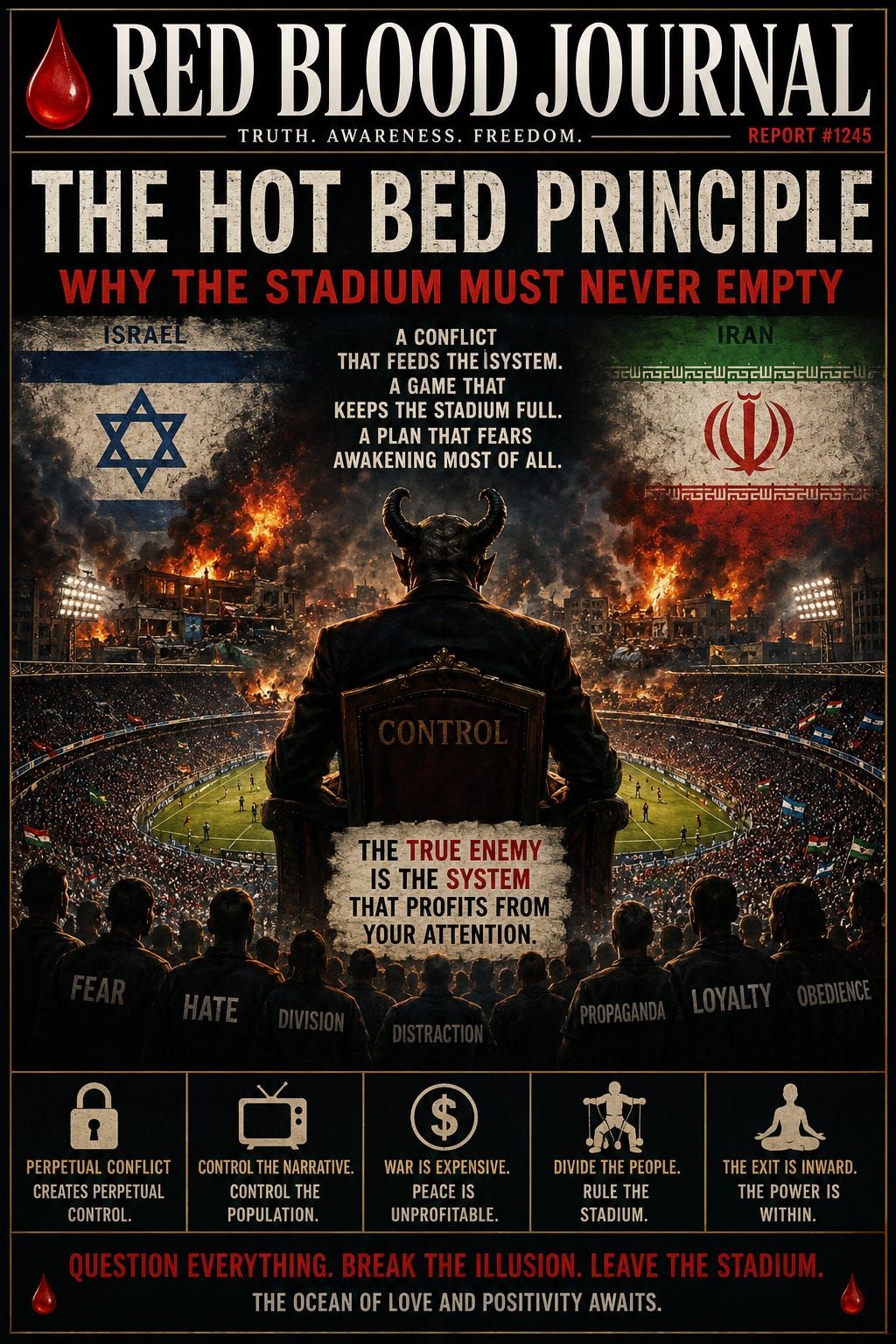
🩸 RED BLOOD JOURNAL
Report #1245
THE HOT BED PRINCIPLE
Why the Stadium Must Never Empty
Throughout history, humanity has been presented with an endless series of conflicts, divisions, emergencies, and enemies.
The names change.
The flags change.
The slogans change.
The generations change.
Yet the pattern remains remarkably consistent.
From one perspective, the conflict between Israel and Iran represents far more than a regional struggle. It represents a larger principle that can be observed throughout history: the need to keep the hot bed hot.
Imagine a football stadium.
The game never ends.
The teams continue competing.
The fans continue cheering.
The announcers continue broadcasting.
The vendors continue selling.
The owners continue collecting.
As long as the game continues, the stadium remains profitable.
But what happens if the fans stop watching?
What happens if they begin asking questions about the stadium itself?
What happens if they become more interested in understanding the structure than supporting one of the teams?
That is the true threat.
The Perfect Rivalry
In this interpretation, long-term geopolitical rivalries become more than conflicts. They become permanent sources of attention.
Israel and Iran represent one of the most enduring examples.
Each side views the other as an existential threat.
Each side points to the actions of the other as justification for military expansion, security measures, intelligence operations, and political consolidation.
The cycle feeds itself.
Action.
Reaction.
Retaliation.
Counter-retaliation.
Crisis.
Negotiation.
Breakdown.
Renewed crisis.
The game continues.
The stadium remains full.
Meanwhile, ordinary people bear the cost through economic hardship, uncertainty, fear, and the constant possibility of escalation.
The Unexpected Event
According to this perspective, the greatest danger to the system was never military defeat.
Wars can be replaced.
Enemies can be replaced.
Narratives can be replaced.
The true danger was awakening.
During the global pandemic years, something unexpected occurred.
Regardless of what conclusions individuals ultimately reached, millions of people began questioning institutions they had previously accepted without examination.
Governments.
Media organizations.
Corporations.
Financial systems.
Scientific authorities.
Political parties.
Religious institutions.
For many, the questioning did not stop there.
They began questioning themselves.
Why do I believe what I believe?
Why am I afraid?
Why am I trustful of one source and suspicious of another?
Who benefits from my attention?
Who benefits from my fear?
Why am I constantly being asked to choose a side?
The questions spread across every political, religious, and ideological group.
The Devil’s Problem
Within this metaphor, the devil is not a person.
The devil represents any force that benefits from division, fear, dependency, and perpetual conflict.
From the devil’s perspective, awakening is dangerous.
Not because people arrive at identical conclusions.
Not because everyone suddenly agrees.
But because people begin thinking independently.
The stadium owner fears the moment the fans stop watching the game and start examining the business model.
The game can survive criticism.
The game can survive losing seasons.
The game can survive scandals.
What it cannot survive is mass disinterest.
If enough people stop identifying exclusively with their team and begin examining the structure itself, the illusion weakens.
Welcome to the Reason for Hot Beds
In this interpretation, hot beds are not simply locations of conflict.
They are engines of attention.
They generate fear.
They generate outrage.
They generate loyalty.
They generate division.
Most importantly, they generate focus.
A population focused outward is less likely to focus inward.
A population consumed by today’s enemy is less likely to ask deeper questions about yesterday’s assumptions.
Every new crisis becomes another reason to return attention to the field.
Every new conflict becomes another reason to pick a side.
Every new emergency becomes another reason to postpone self-examination.
The game continues.
The stadium remains full.
The Exit From the Stadium
The purpose of this report is not to support one nation, ideology, religion, or political movement over another.
Rather, it is to examine a recurring pattern that appears throughout human history.
The greatest freedom may not come from defeating an external enemy.
It may come from understanding oneself.
The greatest prison may not be physical walls.
It may be the inability to question.
The greatest threat to any system built upon perpetual conflict is a population that begins seeking understanding rather than enemies.
Because once enough people leave the stadium, the game begins to lose its power.
And beyond the stadium lies something larger than politics, larger than ideology, larger than nations, and larger than conflict itself.
A recognition that beneath every label, every flag, every religion, every nationality, and every team, humanity remains connected.
The hot beds cool.
The noise fades.
The divisions weaken.
And the ocean of love and positivity becomes visible once again. 🩸
👁️ The Hot Bed Principle:
The Architecture of Perpetual Conflict
Jun 8, 2026
This text explores the Hot Bed Principle, a theory suggesting that global authorities utilize perpetual conflict to maintain social control and financial profit.
Using a stadium metaphor, the author argues that geopolitical rivalries like the one between Israel and Iran function as engines of attention designed to keep populations divided and distracted.
The narrative posits that institutional power relies on citizens choosing sides in endless cycles of crisis rather than questioning the underlying structure of the system.
According to the source, the greatest threat to this status quo is a mass awakening where individuals prioritize independent thought over manufactured fear.
Ultimately, the document encourages readers to abandon ideological labels to rediscover a shared sense of humanity and peace.
By withdrawing attention from these artificial battles, people can break free from the psychological prison of constant warfare.


