


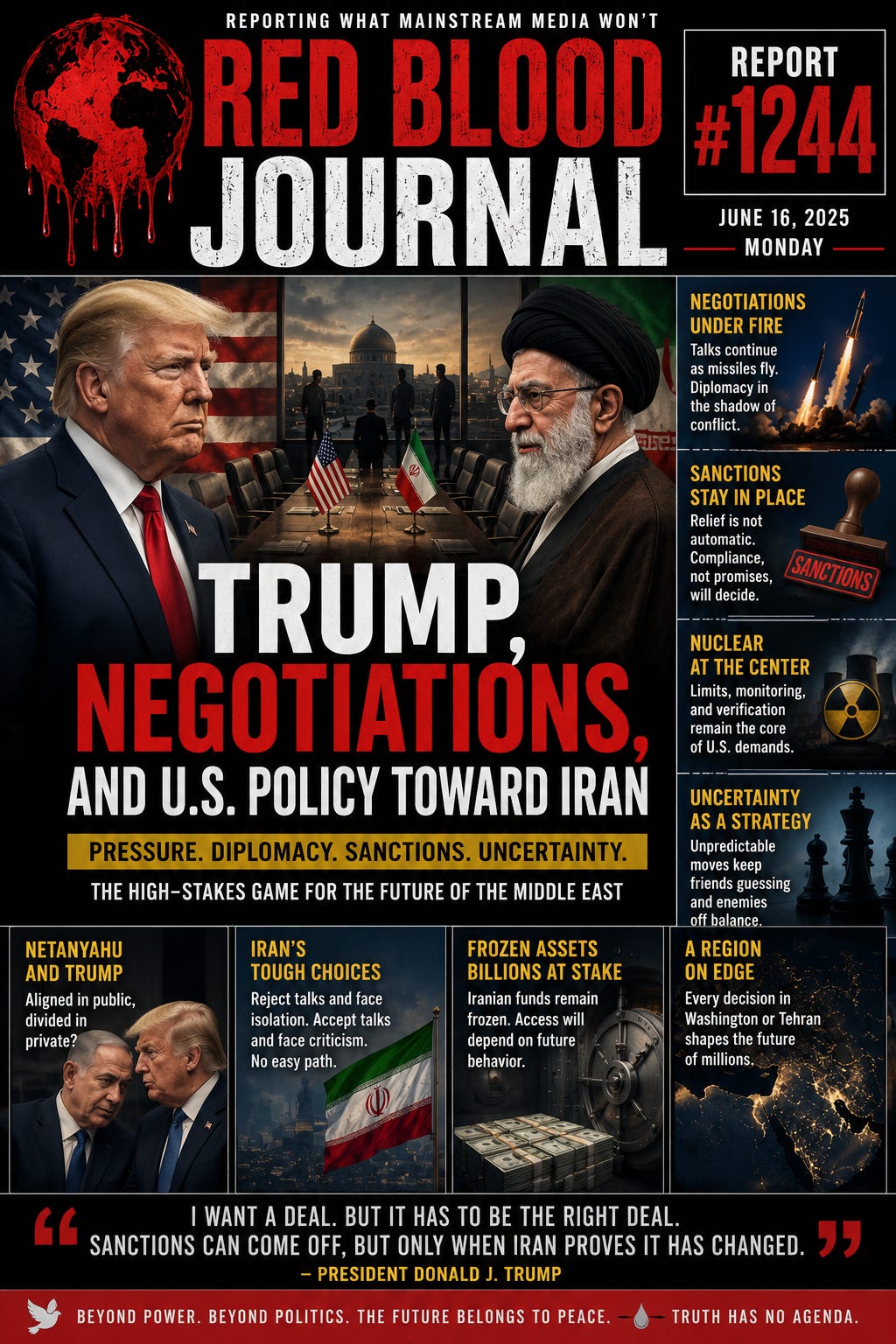
🩸 Red Blood Journal Report #1244
TRUMP, NEGOTIATIONS, AND U.S. POLICY TOWARD IRAN
Introduction
Throughout periods of conflict, military actions often capture the headlines while negotiations shape the long-term outcome. Recent developments surrounding U.S. policy toward Iran reveal a complex strategy in which military pressure, economic leverage, diplomacy, and public messaging operate simultaneously.
The central question is no longer whether negotiations are occurring, but what each side hopes to achieve through them and how military escalation influences the bargaining process.
The Strategy of Maximum Leverage
According to statements discussed in the transcript, the United States seeks to negotiate from a position of strength rather than accommodation. The approach combines several elements:
Economic sanctions.
Control over frozen assets.
Military deterrence.
Diplomatic pressure.
Regional alliances.
Rather than separating negotiations from pressure, the strategy appears to merge them into a single process. The message is straightforward: pressure first, concessions later.
Negotiating While the Region Burns
One of the most unusual aspects of the current situation is that discussions regarding a possible agreement continue while military operations and regional confrontations remain active.
Historically, negotiations often follow major conflicts.
In this case, negotiations and conflict appear to be occurring simultaneously.
This creates a perception problem for all parties involved.
Supporters of negotiations argue that diplomacy prevents a larger war.
Opponents argue that negotiating during military pressure rewards coercion.
The contradiction has become one of the defining features of the current crisis.
The Question of Sanctions
Economic sanctions remain one of Washington’s most powerful tools.
According to the discussion, the position presented by Trump was that sanctions would not automatically disappear simply because an agreement is signed. Instead, relief would depend on future compliance and behavior.
This approach reflects a broader shift in modern diplomacy.
Instead of exchanging concessions immediately, governments increasingly use phased incentives tied to measurable outcomes.
Whether such arrangements create trust or deepen suspicion depends largely on the willingness of both sides to believe future commitments will be honored.
The Nuclear Dimension
At the center of the negotiations remains Iran’s nuclear program.
The discussion highlighted several objectives reportedly sought by Washington:
Restrictions on nuclear activities.
Control of enriched uranium stockpiles.
Monitoring and verification mechanisms.
Prevention of future pathways to nuclear weapons capability.
For U.S. policymakers, the issue is presented primarily as a security concern.
For many Iranian officials and supporters, the issue is viewed through the lens of sovereignty and national independence.
Because both sides frame the issue differently, compromise becomes difficult.
Trump and the Art of Uncertainty
A recurring theme throughout the discussion is uncertainty.
At various moments:
Calls for negotiations are emphasized.
Military pressure remains present.
Public warnings are issued.
Diplomatic solutions are promoted.
This creates an environment in which neither allies nor adversaries can easily predict future actions.
Supporters view this unpredictability as leverage.
Critics view it as instability.
Either way, uncertainty itself becomes a negotiating tool.
The Netanyahu Factor
An additional layer of complexity comes from the relationship between Washington and Israel.
The transcript references reports suggesting disagreements regarding the timing and scope of military responses.
Whether those disagreements are tactical, strategic, or simply differences in public messaging remains open to interpretation.
However, the perception of disagreement serves an important purpose.
It creates questions regarding:
Who controls escalation.
Who controls diplomacy.
Who ultimately decides when military action begins or ends.
These questions shape regional expectations as much as military deployments themselves.
The Iranian Dilemma
For Iranian decision-makers, negotiations present a difficult choice.
Rejecting talks risks further isolation and confrontation.
Accepting talks may be viewed by critics as accepting negotiations under pressure.
The transcript highlights voices arguing that continued negotiations after military actions raise questions about where political red lines truly exist.
This tension reflects a broader challenge faced by governments throughout history:
How does a nation negotiate without appearing weak?
And how does it avoid conflict without appearing afraid?
Beyond the Headlines
The public often sees negotiations as a single event.
In reality, negotiations are usually a process of testing limits.
Each side attempts to determine:
What the other side truly wants.
Which demands are negotiable.
Which positions are symbolic.
Which threats are real.
The outcome is rarely determined by one meeting or one announcement.
Instead, it emerges gradually through pressure, signals, reactions, and strategic patience.
Conclusion
The current phase of U.S.–Iran relations demonstrates the increasingly blurred line between diplomacy and confrontation. Negotiations continue while military risks remain present, creating an environment where every statement, strike, and diplomatic gesture becomes part of a larger strategic contest.
Whether future developments lead toward compromise, continued confrontation, or a new balance of power remains uncertain. What is clear is that diplomacy is no longer occurring in isolation from conflict; it is unfolding within it.
Ocean of Positivity
History often remembers negotiations as contests between governments, but their true purpose should be the reduction of human suffering. Behind every policy discussion are millions of ordinary people who seek security, opportunity, and peace for their families.
Nations may negotiate from positions of strength, weakness, fear, or confidence, but lasting stability emerges when people recognize their shared humanity beyond political disagreements. Like countless rivers flowing toward the same ocean, different paths may eventually lead toward understanding, cooperation, and a future built upon wisdom rather than conflict.
Red Blood Journal #1244 🩸
🤝Diplomacy in the Crucible:
The Strategy of Maximum Leverage
Jun 8, 2026
This report examines the strategic fusion of military pressure and diplomatic maneuvering within United States policy toward Iran.
The text highlights a “maximum leverage” approach where economic sanctions and military deterrence are utilized simultaneously with calls for negotiation to force concessions.
A central theme is the intentional use of uncertainty, creating an unpredictable environment that serves as a bargaining tool against adversaries.
The document also explores the complex regional dynamics, including the influential role of Israel and the internal dilemmas faced by Iranian leadership when negotiating under duress.
Ultimately, the analysis suggests that modern diplomacy is no longer a separate phase from conflict but rather a continuous process unfolding amidst active confrontation.
These geopolitical tensions are contrasted with a concluding call for prioritizing human security and long-term regional stability over perpetual strategic contests.


