


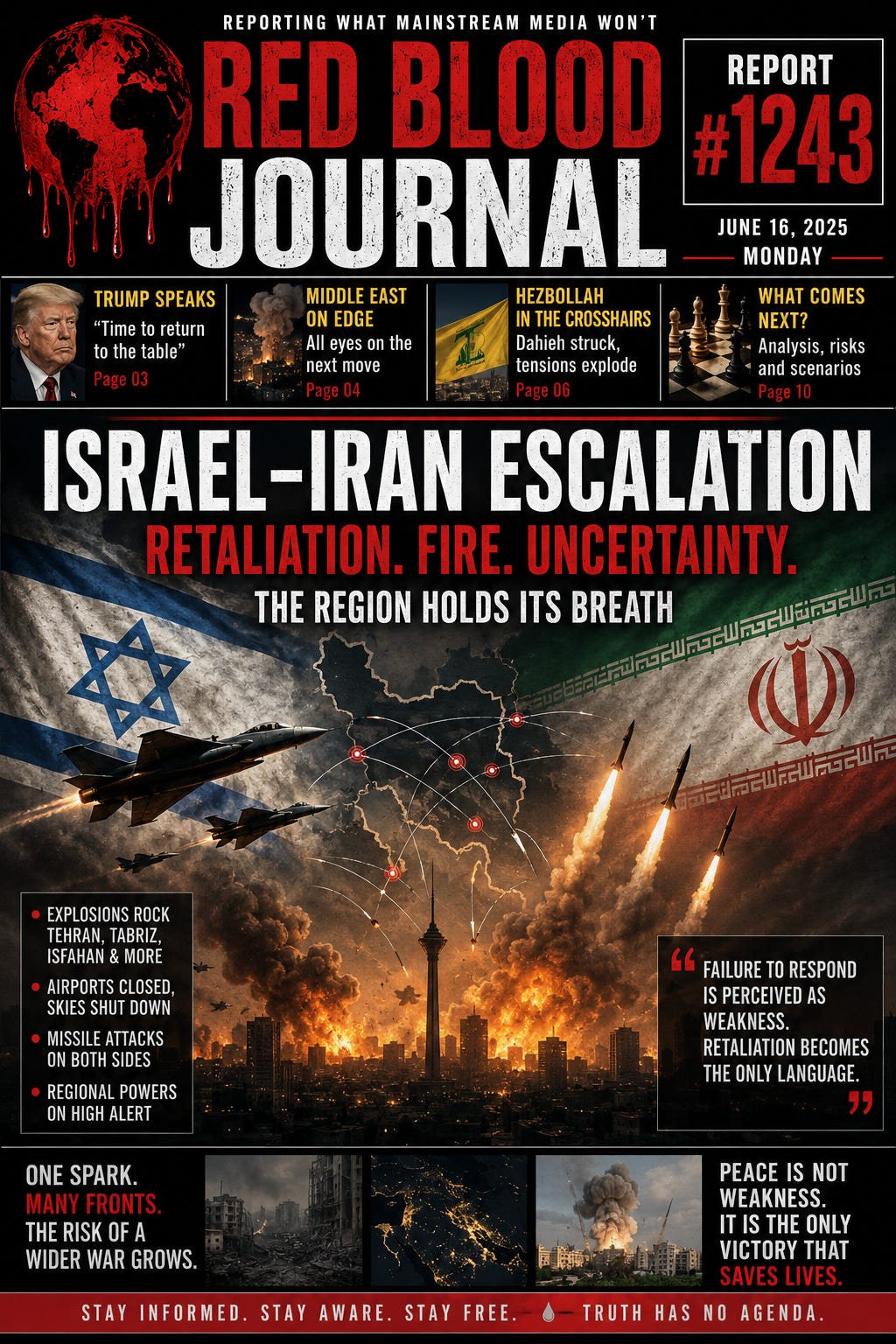
🩸Red Blood Journal Report #1243
ISRAEL–IRAN ESCALATION, RETALIATION, AND THE RISK OF REGIONAL CONFLICT
Introduction
The latest exchange of military strikes between Israel and the Islamic Republic of Iran represents more than another chapter in a long-running rivalry. It highlights the increasing danger that localized confrontations can evolve into a broader regional conflict involving multiple states, proxy organizations, strategic infrastructure, and global powers.
Recent events demonstrate how fragile ceasefires can become when neither side believes deterrence has been restored. Once retaliation becomes the primary language of communication, every strike creates pressure for another response, and every response creates justification for further escalation.
The Collapse of the Ceasefire
Reports described a series of explosions across multiple Iranian locations, followed by announcements from Israel that military targets in western and central Iran had been struck. These operations were presented as a response to Iranian missile attacks launched earlier against Israeli territory.
What emerged was a familiar cycle:
One side launches attacks.
The other side responds.
Each side claims self-defense.
Escalation becomes the new normal.
The danger of this pattern is that both parties can simultaneously believe they are acting defensively while the overall conflict continues to expand.
The Expanding Battlefield
The confrontation is no longer limited to Israel and Iran.
The conflict now touches:
Lebanon through Hezbollah.
Syria through military logistics and regional alliances.
Yemen through missile activity.
Iraq through militia networks.
Gulf states through energy and security concerns.
The United States through diplomatic and military involvement.
As more actors become connected to the conflict, the probability of miscalculation increases dramatically.
History shows that large wars often begin not because leaders seek them, but because events move faster than leaders can control.
The Logic of Retaliation
Both sides operate under a similar strategic principle:
Failure to respond may be interpreted as weakness.
This creates a dangerous incentive structure.
Israel seeks to demonstrate deterrence.
Iran seeks to demonstrate resilience.
Regional allies seek to maintain credibility.
Domestic audiences expect strength.
Under these conditions, restraint becomes politically difficult even when military escalation may not serve long-term interests.
The result is a situation where each side believes escalation is necessary while simultaneously claiming to seek stability.
The Infrastructure Dimension
Modern conflicts are no longer fought only on traditional battlefields.
Potential targets now include:
Airports.
Energy facilities.
Petrochemical infrastructure.
Communication networks.
Transportation systems.
Military command centers.
Attacks on such facilities can create consequences far beyond military objectives.
Energy disruptions affect global markets.
Transportation disruptions affect civilians.
Infrastructure damage affects entire populations regardless of political affiliation.
The modern battlefield increasingly blurs the distinction between military and civilian consequences.
The Role of Perception
Wars are fought not only with weapons but with narratives.
Every side seeks to shape public perception by presenting its actions as defensive and justified.
Citizens often receive competing explanations from governments, media organizations, analysts, and independent observers.
As a result, perception becomes almost as important as military outcomes.
A missile strike may achieve one military objective while generating a completely different political consequence.
Victory in the information domain increasingly influences events on the ground.
The Risk of Miscalculation
One of the greatest dangers in any regional confrontation is the belief that escalation can be precisely controlled.
History repeatedly demonstrates that conflicts often expand through unintended consequences.
A strike intended as a warning may be interpreted as a declaration of war.
A symbolic response may trigger a disproportionate reaction.
A localized confrontation may activate alliances and commitments that neither side originally intended to involve.
The larger the number of participants, the greater the probability of strategic miscalculation.
The Human Cost
Lost amid military statistics and geopolitical analysis are ordinary people.
Families in Israel, Iran, Lebanon, and neighboring countries ultimately bear the greatest burden.
Regardless of political systems, ideologies, or national identities, civilians experience:
Fear.
Economic uncertainty.
Displacement.
Loss of loved ones.
Disruption of everyday life.
Every missile launched carries consequences that extend far beyond military calculations.
Conclusion
The current Israel–Iran confrontation represents a critical moment in a broader regional struggle that has been developing for years. The cycle of attack and retaliation illustrates how quickly fragile stability can disappear when strategic deterrence breaks down.
Whether the region moves toward a larger war or returns to a temporary equilibrium will depend on decisions made not only in Tehran and Jerusalem, but across the wider network of states and organizations connected to the conflict.
History will judge military victories and political calculations, but future generations will judge whether opportunities for de-escalation were recognized before the cycle became impossible to stop.
Ocean of Positivity
Beyond governments, borders, alliances, and conflicts exists a deeper reality: ordinary human beings seeking safety, dignity, and peace. Nations may disagree, leaders may compete, and conflicts may rise and fall, but humanity remains connected by a common desire to live, learn, build families, and leave a better world behind.
The greatest victory is not the defeat of an opponent but the reduction of suffering. The strongest future is one built not on fear, but on understanding. Like drops returning to the same ocean, all people ultimately share a common destiny within the larger human family.
Red Blood Journal #1243 🩸
🩸The Retaliation Cycle:
Israel, Iran, and the Fragility of Peace
Jun 8, 2026
The provided text examines the escalating military tensions between Israel and Iran, highlighting how persistent cycles of retaliation threaten to ignite a broad regional war.
It describes a dangerous strategic environment where both nations feel compelled to demonstrate strength and deterrence, even as their actions increase the likelihood of strategic miscalculation.
The conflict is no longer contained to two actors, as it now involves a complex web of proxies and global powers affecting critical infrastructure and international markets.
Beyond the geopolitical analysis, the source emphasizes the devastating human cost and the role of information warfare in shaping public perception.
Ultimately, the report concludes that true stability requires prioritizing de-escalation and shared humanity over the continuous pursuit of military dominance.


