


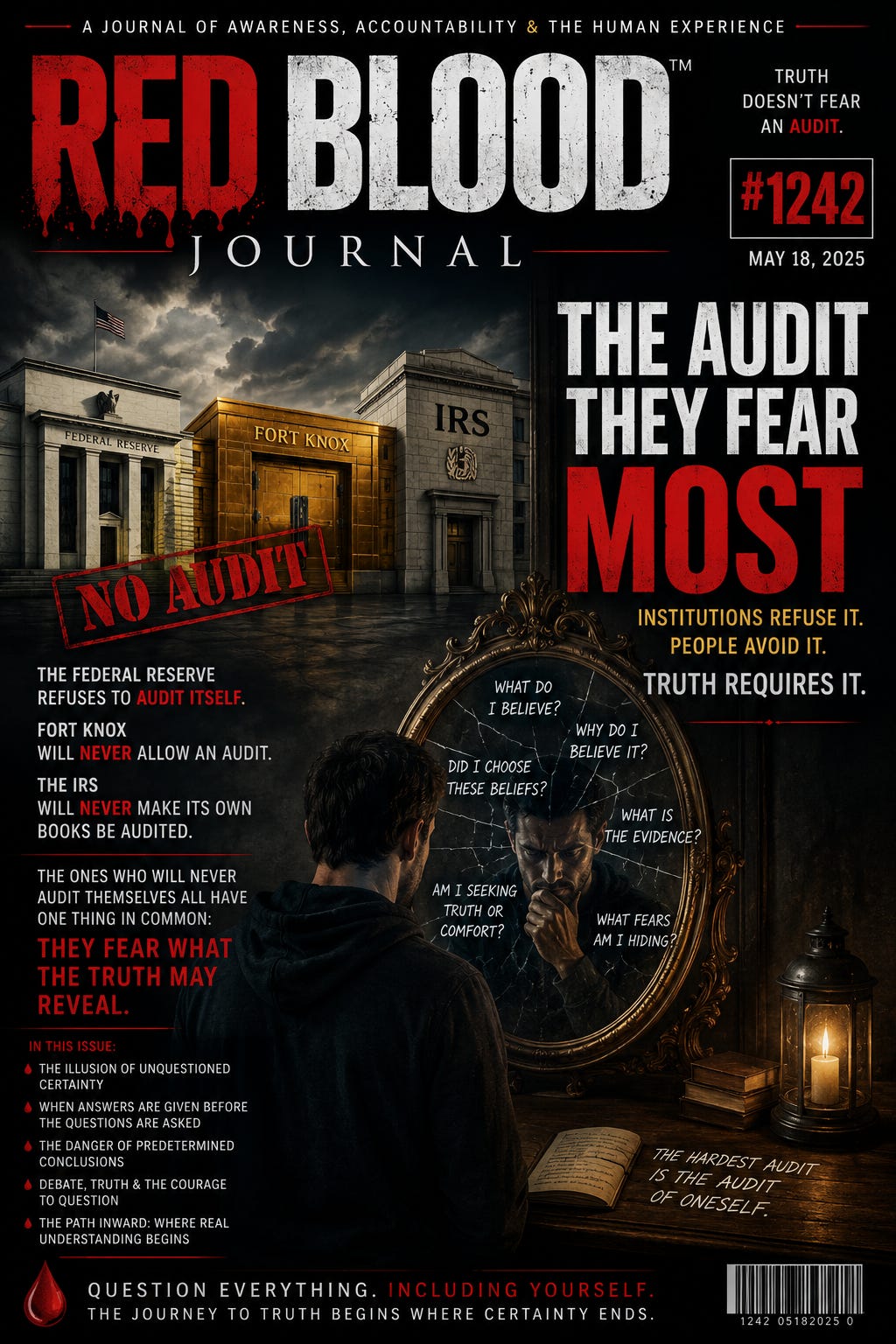
🩸 Red Blood Journal #1242
THE AUDIT THEY FEAR MOST
The One Examination That Cannot Be Outsourced
Human civilization is built upon audits.
Governments audit citizens.
Tax agencies audit income.
Banks audit accounts.
Corporations audit employees.
Universities audit students.
Inspectors audit businesses.
Experts audit one another.
The stated purpose is accountability.
The underlying purpose is trust.
The logic is simple: if something is legitimate, it should be able to withstand examination.
Yet throughout history, the strongest resistance has often appeared when the examination is directed toward the examiner.
The principle is universal.
An institution may resist scrutiny.
A corporation may resist transparency.
A government may resist disclosure.
A religious authority may resist questioning.
A political movement may resist criticism.
An individual may resist self-reflection.
The form changes, but the pattern remains the same.
The fear is rarely the audit itself.
The fear is what the audit might reveal.
An audit does not create a problem.
It merely exposes whether one already exists.
A mirror does not create a wrinkle.
A scale does not create weight.
A truth does not create a contradiction.
It simply reveals what was already there.
This is why the most important audit is not financial.
It is personal.
The Inner Audit
Most people spend their lives examining everything except themselves.
They analyze governments.
They criticize corporations.
They debate religions.
They discuss political parties.
They evaluate leaders.
They question the motives of others.
Yet many never stop to examine the assumptions upon which their own worldview rests.
The reason is understandable.
Looking outward is easy.
Looking inward is difficult.
Looking outward often confirms existing beliefs.
Looking inward may challenge them.
The inward journey begins with a simple question:
Why do I believe what I believe?
For some, the answer is clear.
For many, it is not.
A surprising number of beliefs are inherited rather than discovered.
They come from family.
They come from culture.
They come from education.
They come from tradition.
They come from fear.
They come from belonging.
Over time, repetition transforms assumptions into certainty.
The belief becomes so familiar that it no longer feels like a belief.
It feels like reality itself.
This is where the audit becomes necessary.
Not because every belief is wrong.
But because every belief deserves examination.
Truth does not fear questions.
Only assumptions do.
The Comfort of Ready-Made Answers
Human beings naturally seek certainty.
Uncertainty creates discomfort.
Questions create tension.
Mystery creates anxiety.
Because of this, people are often attracted to systems that provide complete answers.
Political systems.
Economic systems.
Ideological systems.
Religious systems.
Social systems.
Each promises clarity.
Each promises understanding.
Each promises direction.
There is nothing inherently wrong with guidance.
The danger arises when questioning becomes forbidden.
The moment a person is told that asking deeper questions is a threat rather than a path to understanding, the search for truth begins to weaken.
Many individuals eventually encounter a moment of realization.
They discover that they have spent years defending conclusions they never personally investigated.
They accepted them because trusted authorities accepted them.
They repeated them because respected communities repeated them.
They believed them because everyone around them believed them.
Then one day an unexpected question appears.
A question that cannot be dismissed.
A question that cannot be ignored.
A question that demands an honest answer.
That moment often feels unsettling.
Not because truth is dangerous.
But because certainty is comfortable.
Why Debate Is Often Avoided
People frequently assume that debates are avoided because of weakness.
The reality is often more complex.
Most individuals are not afraid of losing an argument.
They are afraid of losing a foundation.
An argument can be replaced.
An identity is much harder to replace.
Many beliefs become intertwined with a person’s sense of self.
Questioning the belief begins to feel like questioning the person.
As a result, defensive walls emerge.
Questions become threats.
Curiosity becomes opposition.
Examination becomes hostility.
Yet genuine growth requires the opposite approach.
The strongest ideas should welcome scrutiny.
The strongest beliefs should welcome questions.
The strongest individuals should welcome reflection.
Anything worthy of trust should be capable of surviving examination.
Institutions and Individuals
The same principle applies equally to institutions and people.
Organizations often ask the public for trust.
Leaders ask followers for trust.
Experts ask society for trust.
Religious authorities ask believers for trust.
Trust is important.
But trust without transparency eventually becomes dependence.
Healthy trust is earned through openness.
Healthy trust grows through accountability.
Healthy trust welcomes examination.
When institutions refuse scrutiny, suspicion naturally increases.
When individuals refuse self-examination, personal growth naturally decreases.
The pattern is identical.
Both are attempts to protect certainty from inquiry.
The Difference Between Seeking Truth and Defending Identity
There is a profound difference between searching for truth and defending identity.
The search for truth asks:
“What is correct?”
The defense of identity asks:
“How do I protect what I already believe?”
One is open.
The other is closed.
One learns.
The other defends.
One evolves.
The other preserves.
Throughout history, progress has often emerged from individuals willing to challenge assumptions that everyone else considered unquestionable.
Not because they wished to destroy.
But because they wished to understand.
Understanding requires courage.
The courage to ask.
The courage to listen.
The courage to change.
The Audit That Matters Most
Perhaps the greatest lesson is that every person eventually becomes their own auditor.
No institution can perform this task.
No government can perform this task.
No philosopher can perform this task.
No religious leader can perform this task.
The questions must be asked internally.
What do I truly believe?
Why do I believe it?
What evidence supports it?
What fears protect it?
What truths challenge it?
Which beliefs were chosen?
Which beliefs were inherited?
Which beliefs bring understanding?
Which beliefs prevent it?
These questions are not acts of rebellion.
They are acts of honesty.
The purpose is not to destroy faith, meaning, or purpose.
The purpose is to strengthen them through examination.
A belief that survives honest questioning becomes stronger.
A belief that fears questioning remains fragile.
Final Reflection
The institution that fears an audit may fear exposure.
The individual that fears self-examination may fear transformation.
Yet neither exposure nor transformation should be feared.
Both are opportunities to move closer to truth.
The path inward is not comfortable.
It was never meant to be.
But it is the path that leads beyond borrowed certainty and toward genuine understanding.
The greatest audit is the one conducted in silence.
The one where no audience exists.
The one where no applause is given.
The one where a person stands alone before their own conscience and asks:
“Have I truly examined the beliefs upon which I have built my life?”
That question is the beginning.
The answer is the journey.
And every sincere step along that journey moves humanity closer to the Ocean of Love and Positivity. 🩸
🔍 The Inner Audit:
The Essential Examination of Belief
Jun 7, 2026
This text explores the concept of the “Inner Audit,” a process of rigorous self-examination aimed at scrutinizing one’s most fundamental assumptions.
While society is accustomed to external oversight of finances and institutions, the author argues that individuals often resist personal reflection because it threatens their comfort and identity.
The narrative suggests that many beliefs are merely inherited from culture or family rather than discovered through honest inquiry.
By prioritizing the search for truth over the defense of identity, people can move beyond borrowed certainty toward genuine understanding.
Ultimately, any belief or institution that is legitimate should be able to withstand questioning without fear.
This internal journey is presented as a courageous act of honesty that leads to profound personal growth.


