


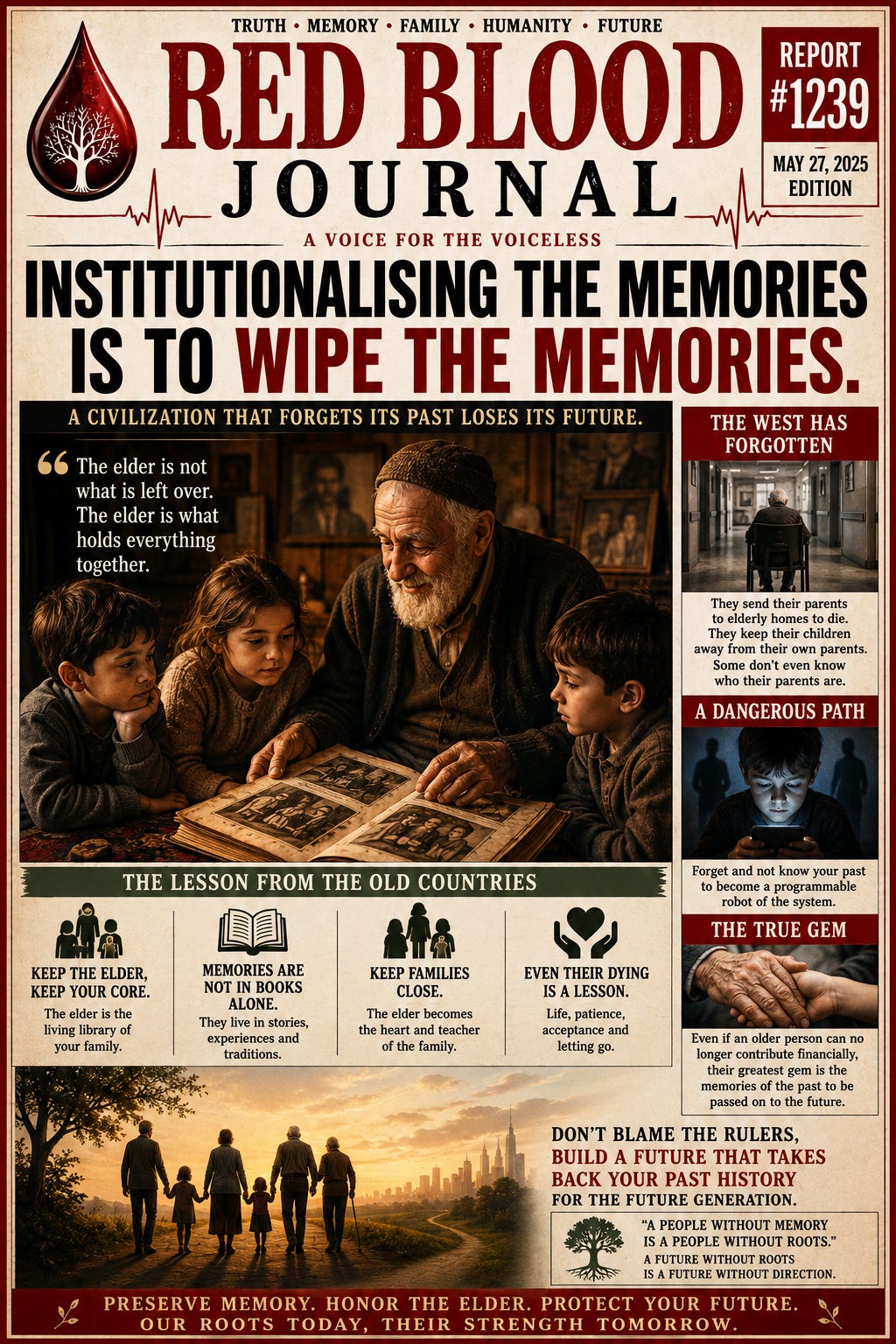
🩸 RED BLOOD JOURNAL
Report #1239
THE GUARDIANS OF MEMORY
Introduction
Modern civilization has become increasingly skilled at storing information.
Libraries store information.
Governments store information.
Universities store information.
Corporations store information.
The digital world stores information on a scale never before imagined.
Yet there is a difference between storing information and preserving memory.
Information can be archived.
Memory must be lived.
A civilization that transfers its memories entirely to institutions risks losing something that cannot be digitized—the human connection through which wisdom travels from one generation to the next.
When Memory Leaves the Home
For most of human history, the family served as the primary keeper of memory.
Grandparents told stories.
Parents passed down traditions.
Children learned not only facts, but experiences.
History was not merely studied.
It was lived through the people who remembered it.
As societies modernized, many responsibilities once held by families gradually shifted toward institutions.
Education became institutionalized.
Care for the elderly became institutionalized.
Community functions became institutionalized.
The intention may have been efficiency, but some argue that something valuable was lost in the process.
The transfer of memory from the home to institutions can weaken the direct connection between generations.
The Elder as the Family Core
In many traditional societies, older generations remain deeply integrated into family life.
Their role extends beyond physical contribution.
Their greatest contribution is often wisdom.
An elder carries decades of experiences, mistakes, lessons, victories, hardships, and observations.
They remember events that younger generations know only through books.
They remember relatives long gone.
They remember traditions that may otherwise disappear.
The elder becomes a living bridge between past and future.
When that bridge is preserved, memory survives.
When that bridge is broken, memory can fade within a generation.
More Than Economics
Modern societies often measure value through productivity.
The question frequently becomes:
“What can this person contribute?”
Yet human value cannot always be measured financially.
A retired grandparent may no longer participate in the workforce, but may possess a lifetime of experiences capable of guiding multiple generations.
The wisdom accumulated across decades cannot easily be replaced.
A society that values only economic contribution may overlook the deeper contributions that sustain culture, identity, and belonging.
The Lessons of Life
Children learn from what they witness.
They learn from success.
They learn from failure.
They learn from celebration.
They learn from grief.
Even the final chapters of life contain lessons.
When generations remain connected, young people witness the entire human journey—from birth to old age.
They learn patience.
They learn compassion.
They learn that life is temporary.
They learn that every generation eventually becomes the next elder.
These lessons cannot always be taught in classrooms.
They are learned through presence.
The Risk of Forgetting
A people disconnected from their past may become increasingly disconnected from themselves.
Without family memory, identity becomes easier to redefine.
Without historical continuity, traditions weaken.
Without elders, younger generations may lose access to experiences that cannot be found in books or online databases.
The danger is not ignorance.
The danger is forgetting.
When memory disappears, societies can lose their sense of direction.
Building the Future Through the Past
The solution is not to blame leaders, governments, institutions, or technology.
The solution begins much closer to home.
Families can choose to spend time together.
Parents can encourage relationships between children and grandparents.
Stories can be shared.
Family histories can be preserved.
Traditions can be carried forward.
The future is not protected by rejecting modernity.
It is protected by ensuring that progress does not erase memory.
A civilization becomes strongest when it combines innovation with remembrance.
Final Reflection
Every family possesses a library.
Not one made of books.
One made of people.
Within every elder lives a collection of experiences that no institution can fully preserve.
The challenge for future generations is not merely to gather more information.
It is to remain connected to those who carry living memory.
For history is not only found in archives.
It is found in conversations.
It is found in stories.
It is found in the wisdom passed from one generation to the next.
And when that wisdom is preserved, the roots of a civilization remain strong.
🌊 The Ocean of Positivity
The purpose of remembering is not to live in the past but to carry its lessons into the future. Every elder is a chapter in humanity’s story, every child a new page waiting to be written.
When generations remain connected, the river of memory continues to flow into the great ocean of human experience.
In that ocean, wisdom becomes compassion, experience becomes understanding, and understanding becomes love.
May future generations remember that the greatest inheritance is not wealth, but the stories, lessons, and positivity passed from heart to heart across the ages.
🌳 The Living Bridge:
Preserving the Human Chain of Wisdom
Jun 7, 2026
The provided text emphasizes the critical distinction between archived information and the living memory shared through human connection.
It suggests that modern society has mistakenly shifted the responsibility of preservation from families to institutions, potentially severing the generational bridge that fosters wisdom and identity.
Rather than valuing individuals solely for their economic productivity, the source argues for recognizing the profound cultural and moral guidance provided by elders.
By maintaining close relationships between youth and older generations, families can ensure that essential life lessons like compassion and patience are witnessed firsthand.
Ultimately, the text advocates for a future where technological progress does not erase the oral traditions and stories that ground a civilization.
These shared experiences act as a human library, offering a sense of direction and belonging that cannot be replicated by digital databases.


