


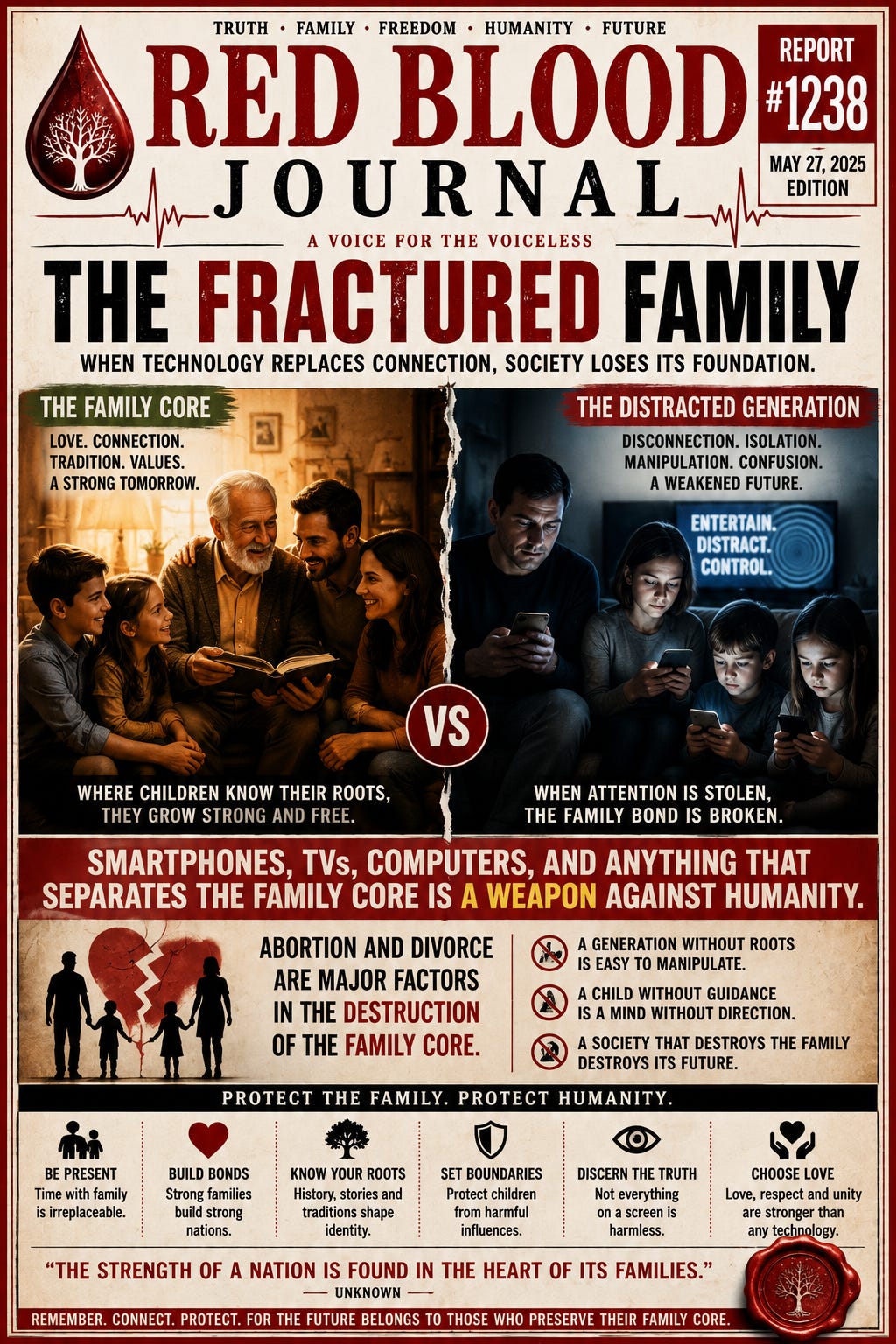
🩸 RED BLOOD JOURNAL
Report #1238
THE FRACTURED FAMILY
Introduction
Every civilization is built upon a foundation.
Before governments, corporations, political parties, social movements, or economic systems existed, there was the family.
The family was humanity’s first school.
It was where values were learned, traditions were preserved, stories were shared, and wisdom was passed from one generation to the next.
Yet many observers argue that modern society has gradually weakened the family unit, replacing direct human connection with technological connection and inherited wisdom with manufactured information.
The question is no longer whether society is changing.
The question is what is replacing what came before.
The New Center of Attention
For most of human history, families gathered around each other.
Conversations occurred at dinner tables.
Children learned from parents.
Parents learned from grandparents.
Grandparents served as living archives of family history and cultural memory.
Today, many households gather around screens instead.
Smartphones, televisions, computers, tablets, and endless digital content compete for attention every hour of every day.
Technology has created unprecedented access to information, communication, and entertainment.
Yet critics argue that it has also introduced a new challenge: the fragmentation of attention.
A family may sit in the same room while living in entirely different worlds.
The Vanishing Storytellers
In many traditional cultures, grandparents played a central role in shaping the identity of younger generations.
They told stories.
They explained family history.
They shared lessons learned through hardship and experience.
These stories helped children understand where they came from and who they were.
As modern life accelerates, many families spend less time together.
Generational bonds can weaken.
The result is that some young people may know more about distant celebrities, influencers, and digital personalities than about their own family history.
The storytellers remain alive, but fewer people are listening.
Individualism and the Family
Modern societies often place strong emphasis on personal freedom and individual choice.
This has created opportunities that previous generations could not imagine.
At the same time, critics argue that excessive focus on individual fulfillment can sometimes come at the expense of long-term family stability.
Issues such as family fragmentation, rising social isolation, declining community participation, and weakened intergenerational relationships have become topics of increasing discussion across many countries.
The concern is not whether people should have freedom.
The concern is whether freedom without connection can leave individuals feeling disconnected from the very relationships that give life meaning.
The Battle for Influence
Every child learns from something.
If families spend less time teaching, other institutions inevitably fill the gap.
Schools teach.
Media teaches.
Entertainment teaches.
Social networks teach.
Algorithms teach.
The question is not whether influence exists.
The question is who holds it.
For most of history, families served as the primary source of influence.
Today that influence is shared with countless digital systems competing for attention every moment of the day.
The Cost of Disconnection
When generations lose connection with one another, something larger than information is lost.
Identity is lost.
Family memory is lost.
Cultural continuity is lost.
The lessons of grandparents may disappear within a single generation if they are not passed forward.
The result can be a society that becomes increasingly connected electronically while becoming increasingly disconnected personally.
The paradox of the modern age is that humanity has never been more connected through technology and yet many people report feeling more isolated than ever before.
Rebuilding the Core
Technology itself is not the enemy.
Every tool can be used for creation or distraction.
The challenge is balance.
A society that preserves strong family relationships while benefiting from technology may gain the advantages of both worlds.
The family remains the first school.
The dinner table remains a classroom.
The conversation between generations remains one of humanity’s greatest educational tools.
No screen can fully replace the wisdom gained through direct human connection.
Final Reflection
Civilizations are not ultimately sustained by machines.
They are sustained by relationships.
The strength of a society can often be measured by the strength of its families, communities, and intergenerational bonds.
Technology may continue to advance.
Screens may become larger, faster, and more immersive.
But the human need for belonging, identity, love, and connection remains unchanged.
The family is where humanity first learns these lessons.
When that foundation is strong, society stands stronger.
When that foundation weakens, the consequences reach far beyond a single household.
🌊 The Ocean of Positivity
The answer is not to fear technology, nor to reject progress.
The answer is to remember what must never be replaced.
Love cannot be downloaded. Wisdom cannot be streamed. Compassion cannot be automated.
The embrace of a grandparent, the guidance of a parent, and the laughter shared between generations are treasures that no machine can reproduce.
As humanity moves further into the digital age, may it never forget the simple truth that we are all connected through something deeper than technology.
We are drops of the same ocean, and the strongest currents are still those of family, understanding, positivity, and love.
👨👩👧👦 The Digital Displacement of the Family Unit
Jun 7, 2026
The provided text examines the eroding influence of the family unit in an era dominated by digital distractions.
It argues that while technology offers unprecedented connectivity, it often results in the fragmentation of household attention and the loss of intergenerational wisdom.
Traditional roles, such as grandparents serving as cultural storytellers, are being displaced by digital influencers and automated algorithms.
This shift toward individualism and screen-based interaction risks creating a society that is electronically linked yet personally isolated.
Ultimately, the source advocates for a deliberate balance, asserting that human relationships and ancestral lessons are the essential foundations for a stable civilization.
Strengthening these intergenerational bonds is presented as the only way to ensure that love and identity are preserved in a machine-driven world.


