


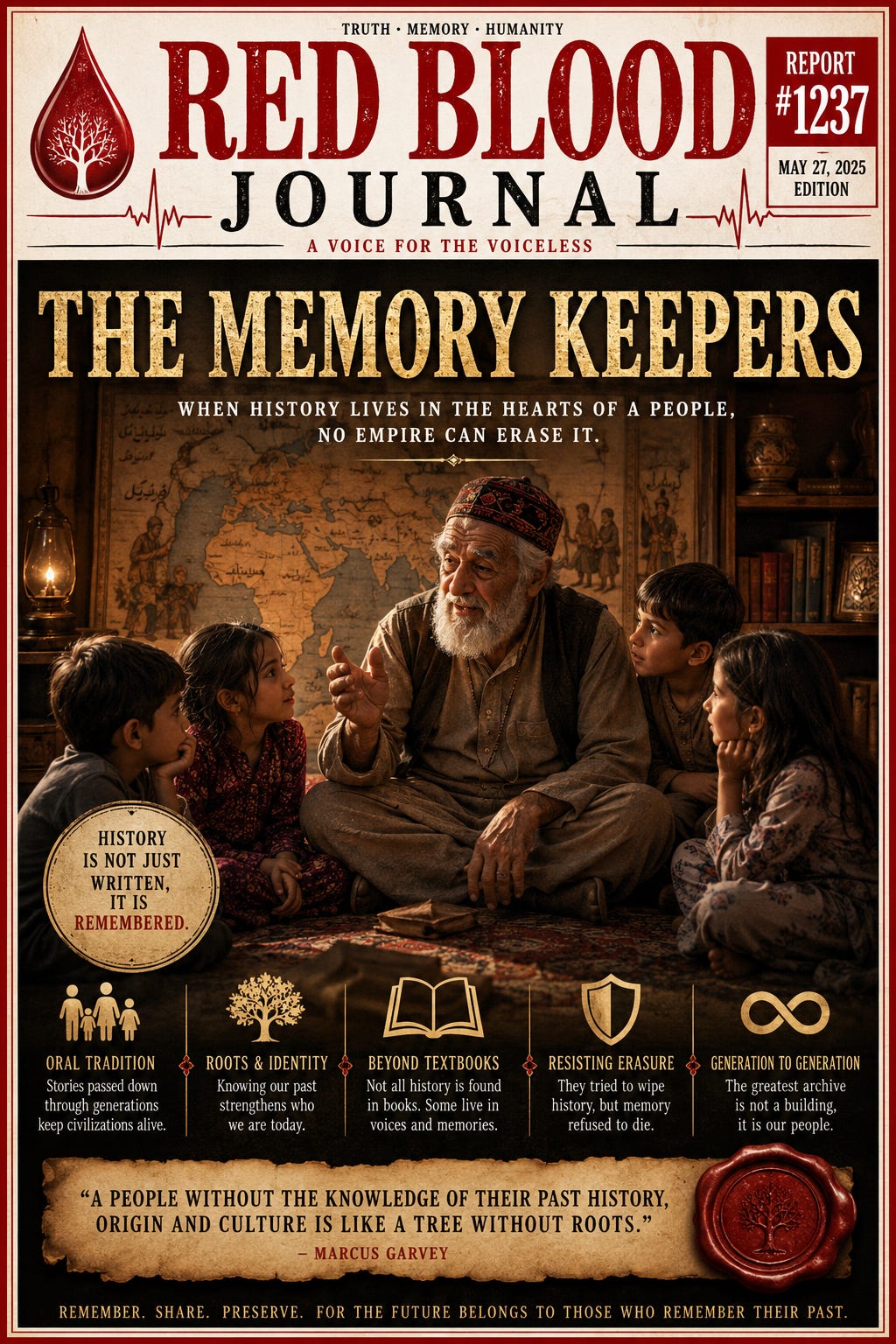
🩸 RED BLOOD JOURNAL
Report #1237
THE MEMORY KEEPERS
Introduction
Throughout history, empires have risen and fallen, governments have changed, borders have moved, and ruling systems have been replaced. Yet one force has consistently survived these transformations: memory.
Long before modern schools, universities, and state-approved curricula existed, humanity passed its knowledge from one generation to the next through stories, traditions, and shared experiences. History lived in the voices of elders and in the memories of families rather than in official institutions.
Today, much of the modern world places its trust in formal education systems as the primary source of historical knowledge. Yet an important question remains: What happens when institutions decide which parts of history deserve attention and which parts are forgotten?
The Disappearing Past
Many modern societies have witnessed a gradual reduction in historical depth within public education. Students often learn broad summaries of major events but spend little time exploring the cultural experiences, struggles, traditions, and lessons that shaped previous generations.
As societies become increasingly focused on the present, historical memory can become fragmented. Events that once defined civilizations may be reduced to a few paragraphs in a textbook. Ancient traditions that guided communities for centuries may be overlooked entirely.
The result is not necessarily ignorance, but distance—a growing separation between people and the historical experiences that formed their ancestors.
The Oral Libraries
In many Middle Eastern societies, including Iran and neighboring regions, another form of education continues to exist alongside formal schooling.
Grandparents tell stories to grandchildren.
Families pass down legends, historical events, cultural lessons, and collective memories through conversation.
A child may hear stories that were once told to a grandparent, who heard them from another grandparent before them. Through this process, memory travels across generations, often surviving political upheavals, revolutions, wars, and regime changes.
These elders become living libraries.
No institution issues them a diploma.
No government certifies their knowledge.
Yet they preserve pieces of history that might otherwise disappear.
History Beyond Governments
Governments change.
Curricula change.
Political priorities change.
What one generation considers essential history, another generation may consider irrelevant.
Yet oral memory often survives these changes because it belongs to families rather than institutions.
A nation can experience multiple political systems within a century, but stories told around dinner tables and family gatherings can remain remarkably consistent.
For many cultures, this continuity creates a sense of identity that exists independently of whoever happens to hold power.
The Power of Remembering
Historical memory provides more than information.
It provides context.
When people remember where they came from, they often develop a stronger understanding of who they are.
When cultures remember their victories and mistakes, they gain reference points that help them navigate the future.
Memory can act as a safeguard against manipulation because it allows people to compare present narratives with inherited experiences.
A society with historical memory possesses an internal compass.
A society without memory may depend entirely upon whichever narrative is currently being presented.
The Struggle Over History
Throughout history, rulers have understood the importance of controlling narratives.
Every empire, kingdom, ideology, and political movement has attempted to shape how future generations understand the past.
The reason is simple.
Whoever influences the interpretation of history often influences the direction of the future.
The struggle is therefore not merely over territory, economics, or politics.
It is also a struggle over memory itself.
The Memory Keepers
The true guardians of history are often not politicians, professors, or institutions.
They are grandparents.
They are elders.
They are storytellers.
They are the ordinary people who preserve memories through daily conversation and pass them forward without expectation of reward.
While books may disappear and governments may change, memory survives when it is carried by human beings.
Perhaps that is why some of the oldest cultures on Earth continue to retain a strong sense of identity despite centuries of conquest, occupation, and political transformation.
Their greatest archive was never a building.
It was their people.
Final Reflection
Civilizations survive not only because they build monuments, armies, or governments.
They survive because they remember.
The stories carried from one generation to the next become bridges across time, connecting the living with those who came before them.
When memory is preserved, identity survives.
When identity survives, culture survives.
And when culture survives, humanity remains connected to its roots no matter how many times the world around it changes.
In the end, perhaps the greatest library ever created is not made of stone, paper, or digital records.
It is the human heart carrying memory forward through the endless generations of life.
🌊 The Ocean of Positivity
Beyond all divisions, governments, ideologies, and eras exists a deeper ocean that belongs equally to every human being.
In that ocean, memory is not used to create hatred or separation, but understanding. The purpose of remembering is not to remain trapped in the past, but to carry forward wisdom, compassion, and love.
As every generation adds its experience to the great ocean of human knowledge, may humanity learn to remember not only its struggles, but also its shared connection.
For we are all drops from the same ocean, learning, growing, and eventually finding our way back to the waters of positivity, understanding, and love.
📜 The Human Heart:
An Eternal Library of Ancestral Memory
Jun 7, 2026
This text explores how human memory acts as a resilient, living archive that survives even when governments and official institutions fail.
While formal education often simplifies history or serves political agendas, oral traditions passed down by elders and families preserve the authentic cultural identity of a people.
These “memory keepers” protect ancestral wisdom through storytelling, creating a bridge across generations that resists external manipulation.
Ultimately, the source suggests that a society’s internal compass is rooted in these personal narratives rather than state-approved curricula.
By maintaining this connection to the past, humanity ensures that culture and identity endure through times of radical change.
This process fosters a deeper global understanding by emphasizing shared experiences and the wisdom of the human heart.


