


🩸 RED BLOOD JOURNAL
#1235
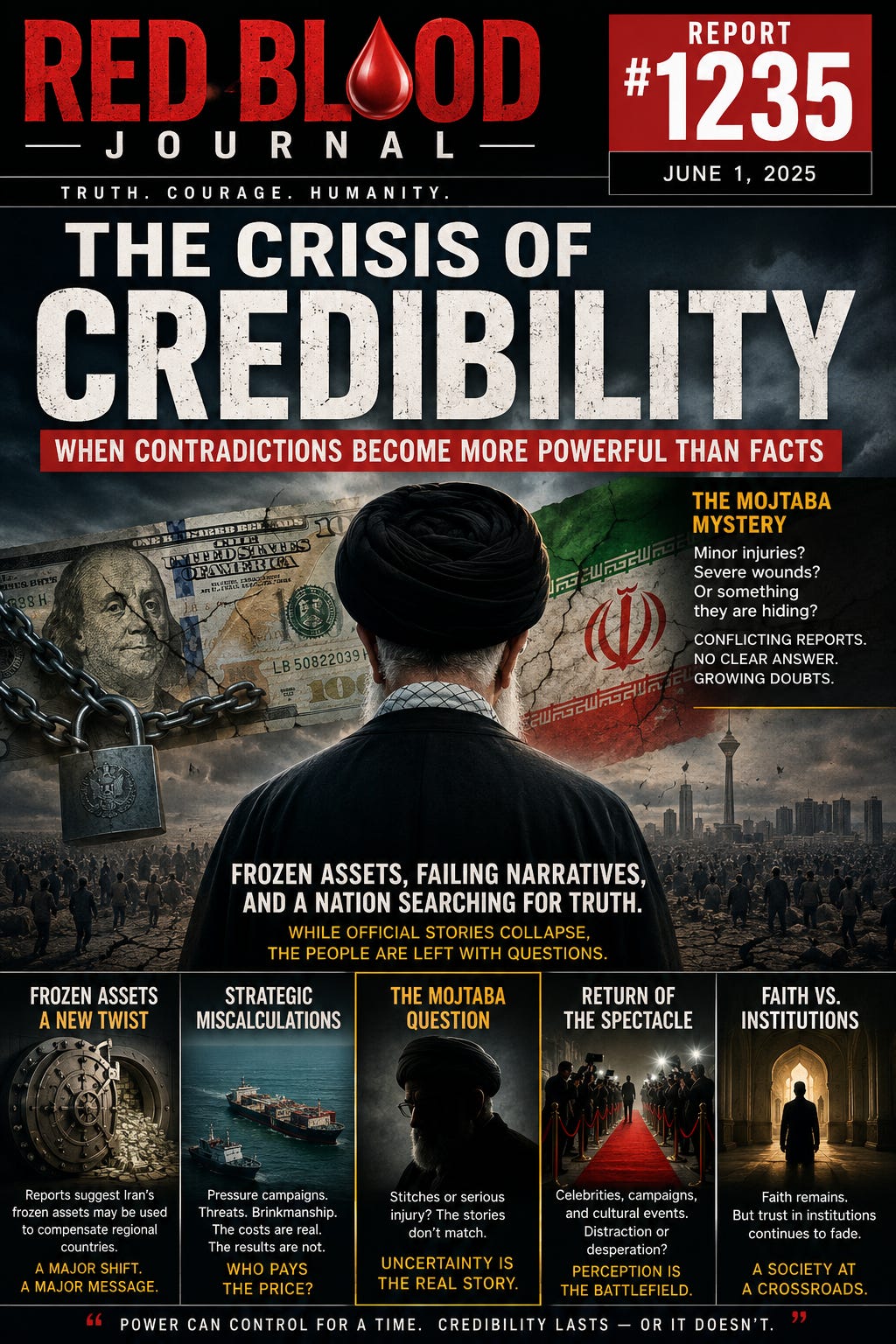
THE CRISIS OF CREDIBILITY
When Contradictions Become More Powerful Than Facts
Executive Summary
Political systems can survive economic hardship.
They can survive sanctions, military pressure, diplomatic isolation, and even periods of social unrest.
What becomes increasingly difficult to survive is a crisis of credibility.
When public trust begins to erode, every official statement is questioned, every explanation is challenged, and every event produces competing narratives.
The defining issue is no longer what happened.
The defining issue becomes whether the public believes what it is being told.
The Frozen Assets Question
For years, many observers believed that negotiations between Iran and the United States would eventually lead to the release of frozen Iranian assets.
The expected sequence appeared straightforward:
Negotiations would lead to agreements.
Agreements would lead to sanctions relief.
Sanctions relief would unlock billions of dollars in blocked funds.
Recent reports, however, have suggested a different possibility.
Rather than being returned to Tehran, portions of those assets could potentially be directed toward compensating regional states for damages allegedly connected to Iranian military actions.
Whether such proposals are ultimately implemented is less important than what they represent.
The assumption that negotiations automatically produce financial rewards can no longer be taken for granted.
The Cost of Strategic Miscalculation
Throughout history, governments have often overestimated their leverage while underestimating the resilience of their opponents.
Actions designed to create pressure can produce unintended consequences.
Policies intended to strengthen negotiating positions can instead create additional vulnerabilities.
The greatest burden is frequently carried by ordinary citizens who ultimately pay the economic and social costs of decisions made by political leadership.
The Mojtaba Khamenei Mystery
Perhaps no issue better illustrates the current credibility crisis than the contradictory reports surrounding Mojtaba Khamenei.
One official account suggested that he sustained only minor injuries and was released from medical care after receiving a small number of stitches.
A separate account claimed that his injuries were severe enough for amputation to be considered before doctors intervened.
These accounts present dramatically different versions of the same event.
At the same time, Mojtaba Khamenei’s limited public visibility has fueled widespread speculation.
Several competing theories have emerged:
He suffered only minor injuries.
He was seriously wounded.
His true condition is being concealed.
The public is receiving incomplete information.
No independently verified evidence has resolved the matter.
The significance of this issue extends beyond the individual himself.
The larger question is why citizens are confronted with multiple contradictory narratives and left unable to determine which version is accurate.
When confidence in official information declines, uncertainty itself becomes a political force.
The Politics of Absence
History contains numerous examples of leaders and successors disappearing from public view during periods of uncertainty.
Supporters interpret absence as security.
Critics interpret absence as weakness.
Observers interpret absence as evidence that something remains undisclosed.
The longer uncertainty persists, the more difficult it becomes to preserve public confidence.
Perception often becomes as important as reality.
Foreign Pressure and Internal Legitimacy
International actors continue to influence events.
The United States, Israel, regional governments, and global institutions all play important roles in shaping the strategic environment.
Yet history repeatedly demonstrates that external pressure alone rarely determines the fate of political systems.
The decisive factor is usually domestic legitimacy.
Governments endure when citizens continue to believe in their institutions.
When that belief weakens, external pressures become increasingly effective.
The Return of Spectacle
Periods of declining public confidence often produce a greater emphasis on symbolism, celebrity appearances, public campaigns, and highly visible cultural events.
Such efforts are generally intended to project stability, confidence, and normalcy.
Supporters view these campaigns as signs of resilience.
Critics view them as attempts to distract from deeper structural problems.
Regardless of interpretation, both sides recognize the importance of perception in modern politics.
Faith, Institutions, and Public Sentiment
One of the most significant developments of recent years has been the growing distinction between faith and institutions.
Many citizens continue to maintain strong spiritual beliefs and personal values.
At the same time, increasing numbers appear willing to question organizations that claim authority in the name of those beliefs.
This distinction may prove increasingly important.
A society can maintain its faith while losing confidence in institutions.
A society can preserve its values while demanding accountability from those who govern.
The Real Battlefield
Much attention is directed toward military power, sanctions, intelligence operations, diplomacy, and geopolitical strategy.
Yet the most important battlefield may exist elsewhere.
It exists in public confidence.
Military strength can defend borders.
Economic resources can purchase time.
Political authority can compel compliance.
Trust, however, cannot be commanded.
Trust must be earned.
Once lost, it becomes extraordinarily difficult to restore.
Conclusion
Every political system eventually confronts a moment when its greatest challenge is no longer external.
The fundamental question becomes:
Do the people still believe?
If public confidence remains strong, governments can survive immense challenges.
If confidence disappears, even powerful institutions begin to weaken.
The conflicting narratives surrounding leadership, negotiations, foreign policy, and national direction all point toward the same underlying issue.
A growing crisis of credibility.
History consistently demonstrates that credibility is among the most valuable assets any government possesses—and among the most difficult to recover once lost.
Final Reflection
Governments rise.
Governments fall.
Policies change.
Leaders come and go.
Yet beyond politics, beyond ideology, and beyond temporary struggles lies a deeper human search for meaning, dignity, truth, and understanding.
Perhaps the future will not be shaped by those who divide humanity into competing camps, but by those who recognize what unites it.
Beyond every border, every religion, every political movement, and every ideology, humanity remains connected.
Drops from the same vast ocean.
An ocean of positivity, compassion, understanding, and love.
⚖️ The Crisis of Credibility:
Erosion of Institutional Trust
Jun 7, 2026
The provided text explores a profound crisis of institutional credibility within a political system, specifically focusing on the erosion of public trust.
By examining contradictory reports regarding Mojtaba Khamenei’s health and shifting expectations over frozen assets, the source highlights how conflicting narratives create a climate of uncertainty.
It argues that while governments can withstand economic sanctions or external pressure, they struggle to survive when citizens no longer believe official information.
The analysis emphasizes that domestic legitimacy and the distinction between personal faith and institutional authority are the ultimate deciders of a regime’s longevity.
Ultimately, the text posits that transparency and truth are more vital for stability than military strength or symbolic public spectacles.
Crucially, it concludes that restoring faith is the most difficult challenge a leadership can face once the bond with its people is broken.


