


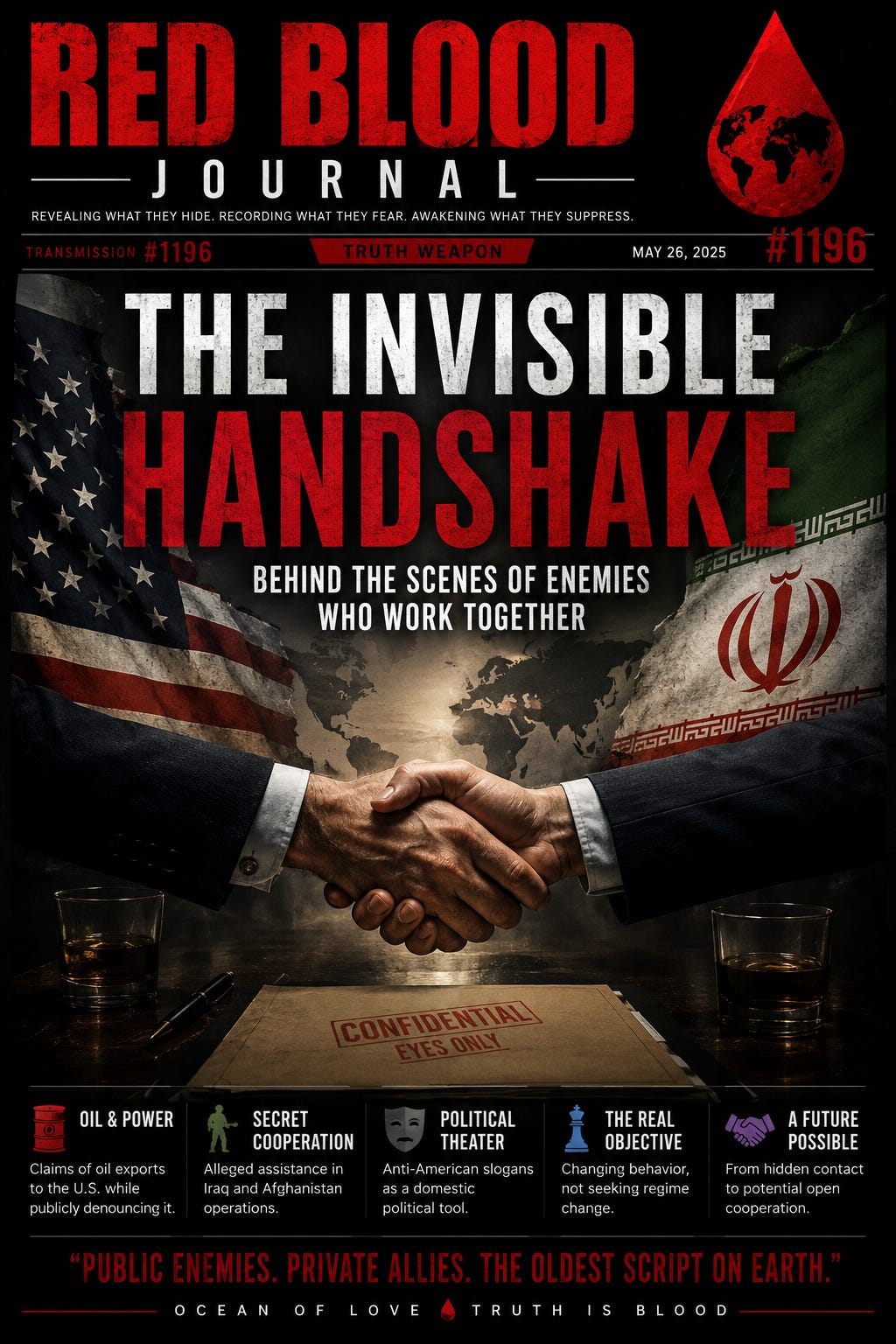
🩸 #1196 — THE INVISIBLE HANDSHAKE
Red Blood Journal Transmission
For more than four decades, the citizens of the imaginary planet Erath have been told a simple story.
Two enemies stand on opposite sides of a battlefield.
They curse each other.
They threaten each other.
They accuse each other.
They declare that compromise is impossible.
One side calls the other the Great Satan.
The other side calls the first a threat to civilization.
The audience watches.
The media repeats the script.
The politicians perform their roles.
The experts debate the latest chapter.
The conflict appears endless.
Yet history often reveals a different story.
Not the story visible on the stage.
The story behind the curtain.
THE PUBLIC ENEMY
On Erath, generations grew up hearing speeches filled with hostility.
Every crisis was presented as proof of an eternal struggle.
Every sanction.
Every military confrontation.
Every diplomatic dispute.
Every slogan.
Every televised speech.
The message remained unchanged:
“We are enemies.”
The narrative became so deeply embedded that questioning it became almost impossible.
If two governments spend forty years calling each other enemies, most citizens eventually stop asking whether the conflict itself serves a purpose.
The conflict becomes accepted as reality.
THE PRIVATE CONVERSATION
Yet occasionally a crack appears in the wall.
Statements emerge.
Documents surface.
Former insiders speak.
And the picture becomes more complicated.
Reports begin to suggest that while hostility existed publicly, communication continued privately.
Negotiations never stopped.
Messages were exchanged.
Agreements were reached.
Cooperation appeared when mutual interests aligned.
The citizens of Erath were shown the shouting.
They rarely saw the meetings.
The cameras focused on the punches.
The handshakes happened elsewhere.
THE BUSINESS OF ENEMIES
Perhaps the most uncomfortable question is not whether cooperation occurred.
The uncomfortable question is why.
The answer may be simple.
Nations do not operate primarily on emotion.
They operate on interests.
The citizen may hate.
The politician may perform outrage.
The television host may demand confrontation.
But states often pursue objectives regardless of rhetoric.
History contains many examples.
Governments that publicly condemn each other frequently maintain trade.
Intelligence services exchange information.
Military channels remain open.
Financial relationships continue.
Public narratives and operational realities are often two different worlds.
The audience sees one.
Decision-makers see both.
THE THEATER OF NECESSARY OPPOSITES
On Erath, some observers began proposing a controversial possibility.
What if the hostility itself served a purpose?
What if both sides benefited from maintaining the image of confrontation?
A permanent enemy can be useful.
It justifies budgets.
It justifies restrictions.
It justifies military expansion.
It justifies emergency powers.
It justifies political unity.
It gives populations a focal point.
Fear becomes easier to manage when an external threat is always available.
The enemy becomes an institution.
An asset.
A permanent character in a very profitable production.
BEHAVIOR, NOT REMOVAL
Another observation emerged from those studying the relationship.
The objective never appeared to be complete destruction.
Instead, the objective often resembled management.
Pressure.
Reward.
Punishment.
Negotiation.
Sanction.
Relief.
Pressure again.
The cycle repeated.
The goal seemed less like replacing the system and more like directing its behavior.
A trainer rarely destroys the animal.
A trainer attempts to shape it.
Many analysts began asking whether the real objective was transformation rather than elimination.
Not regime change.
Behavior change.
Not replacing the machine.
Reprogramming it.
THE GREAT REVEAL
The most dangerous moment for any political narrative arrives when citizens begin comparing words with actions.
The slogans may remain unchanged.
But actions tell their own story.
If public hostility continues while private cooperation expands, eventually the contradiction becomes impossible to hide.
Questions emerge.
Who was actually fighting whom?
Who benefited?
Who lost?
Who gained power?
Who gained money?
Who gained influence?
And why were ordinary citizens expected to believe one reality while another operated behind closed doors?
These questions rarely produce comfortable answers.
THE FUTURE OF THE HANDSHAKE
Some observers on Erath believe the final act has not yet arrived.
They suggest that what was once hidden may eventually become public.
Relationships once denied may become acknowledged.
Enemies may become partners.
Old slogans may quietly disappear.
Citizens who spent decades believing one story may awaken to another.
If that day arrives, many will call it a sudden transformation.
But perhaps it will not be sudden at all.
Perhaps the relationship existed all along.
The only difference will be that the curtain finally opens.
THE OCEAN OF LOVE
From the perspective of the Ocean of Love, the lesson reaches beyond governments, ideologies, and geopolitics.
The greatest deception is not what one side hides from another.
The greatest deception is what the mind hides from itself.
The outward world constantly presents heroes and villains, allies and enemies, left and right, east and west.
The deeper observer eventually notices that every division is part of a larger whole.
The stage requires opposing actors.
The audience requires a story.
But beyond the theater exists something untouched by politics, untouched by propaganda, untouched by power.
The silent witness within.
The observer who sees both the handshake and the argument.
The actor and the script.
The conflict and the lesson.
And when enough citizens discover that witness within themselves, the power of every manufactured division begins to fade.
The curtain falls.
The actors leave the stage.
And all rivers return to the same Ocean.
🩸 Red Blood Journal Transmission #1196
“The Invisible Handshake”
🎭 The Theater of Necessary Enemies
May 30, 2026
This text utilizes the allegorical planet of Erath to describe how public geopolitical hostility is often a deceptive performance masking private cooperation between supposed enemies.
While citizens are fed a narrative of eternal conflict, the source suggests that governments maintain secret dialogues and financial ties because permanent friction serves their strategic interests.
This “theater of enemies” allows leaders to justify military spending and exert domestic control by keeping populations in a constant state of fear.
Ultimately, the objective of such conflicts is rarely total destruction, but rather the management and behavioral shaping of the opposing side through a cycle of pressure and relief.
The author concludes that true awareness begins when individuals look past these manufactured divisions to recognize the underlying unity hidden behind the political curtain.
This transition from blind belief to internal observation effectively neutralizes the power of propaganda and reveals the collaborative reality of global power.


