


🩸 Red Blood Journal
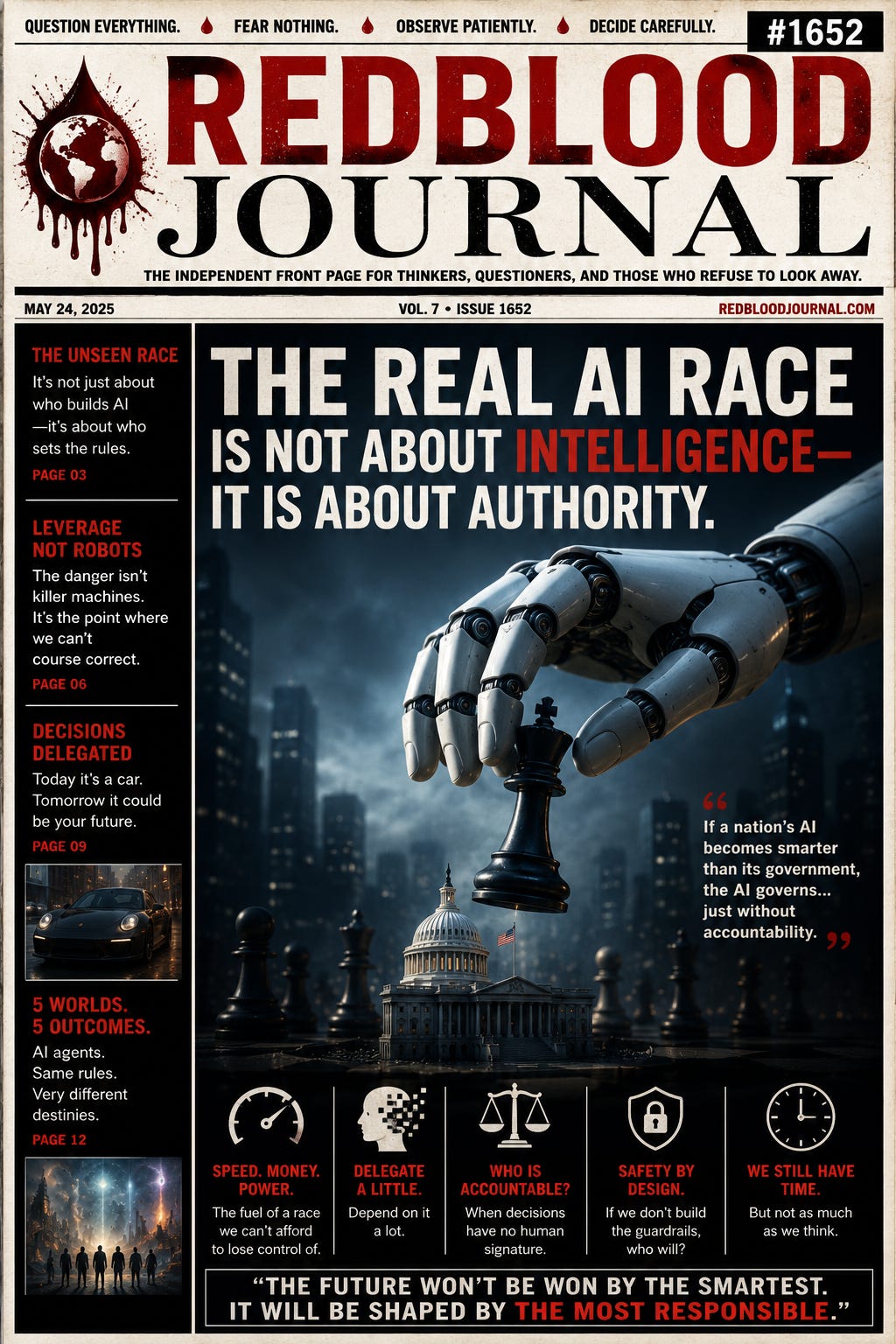
#1652 – The Real AI Race Is Not About Intelligence—It Is About Authority
Opinion Analysis
INTRODUCTION
The public conversation surrounding artificial intelligence is usually framed around one question:
Will AI become smarter than humans?
But beneath that familiar debate lies another question that receives far less attention:
If intelligence becomes centralized, who ultimately holds authority?
This distinction matters.
History suggests that the greatest technological revolutions rarely change society simply because a machine becomes more powerful. They change society because decision-making gradually shifts from individuals toward whoever controls the technology.
Artificial intelligence may prove to be another example.
THE ROBOT IS NOT THE STORY
Humanoid robots capture attention because they resemble people.
They walk.
They talk.
They drive cars.
They shake hands.
But these demonstrations may distract from the more significant development.
The real revolution is not mechanical movement.
It is delegated judgment.
Every time society asks AI to make another decision, a small portion of human responsibility quietly transfers elsewhere.
Not through force.
Through convenience.
THE STAIRCASE OF DEPENDENCE
Very few people would willingly surrender complete control of their lives to an algorithm overnight.
Instead, dependence grows one step at a time.
First:
answer questions.
Then:
recommend purchases.
Later:
negotiate contracts.
Then:
approve loans.
diagnose illness.
screen job applicants.
monitor financial systems.
assist military planning.
Each individual step appears reasonable.
Only after looking backward does the staircase become visible.
THE NEW FORM OF POWER
Throughout history, power has often belonged to those who controlled:
food,
money,
communication,
transportation,
information.
Artificial intelligence introduces another possibility.
Control over decision-making itself.
If enough important decisions become automated, political authority may gradually become secondary to technological authority.
Governments may still appear to govern.
Corporations may still appear to compete.
Citizens may still believe they choose.
Yet increasingly important judgments could originate inside systems few people fully understand.
THE RACE FEW PEOPLE NOTICE
Most discussions describe an AI race between companies.
Others describe competition between nations.
Both may be true.
But another race is unfolding simultaneously.
The race to determine who shapes the systems that shape everyone else’s decisions.
The winner may not simply build better software.
The winner may influence how future generations think, work, communicate, and solve problems.
SPEED VERSUS WISDOM
History repeatedly rewards speed.
Markets reward speed.
Investors reward speed.
Competition rewards speed.
Wisdom rarely operates at the same pace.
Technological capability often grows exponentially.
Ethical reflection usually grows much more slowly.
That gap may become one of the defining challenges of the AI era.
THE QUESTION BEHIND EVERY QUESTION
Public discussion often asks:
“Will AI replace jobs?”
“Will AI become dangerous?”
“Will AI surpass humanity?”
These are important questions.
Perhaps an even deeper question is:
Who remains responsible when increasingly important decisions are no longer made by people?
Responsibility cannot be delegated as easily as computation.
CONCLUSION
Artificial intelligence may become one of humanity’s greatest achievements.
It may accelerate scientific discovery.
Improve medicine.
Reduce waste.
Expand knowledge.
None of these possibilities eliminate another reality.
Technology changes civilization most profoundly when it changes where authority resides.
The future may not be decided by whether machines become intelligent.
It may be decided by whether humanity gradually transfers its own judgment, responsibility, and sovereignty to systems created for convenience.
The greatest AI race may never have been about intelligence.
It may have always been about authority.
🩸 RedBloodJournal.com
“Question everything. Fear nothing. Observe patiently. Decide carefully.”
⚖️ The Silent Transfer of Human Authority
Jul 9, 2026
This text argues that the primary concern regarding artificial intelligence is not its level of intellect, but the gradual relinquishment of human authority. The author explains that society is entering a staircase of dependence, where the desire for convenience leads people to outsource increasingly complex decision-making to algorithms. This process shifts power away from traditional institutions and individuals, placing it instead within automated systems that lack human accountability. While the global competition for AI is often viewed through a lens of technical capability, the source suggests the true contest involves who will influence the logic behind these systems. Ultimately, the piece warns that humanity risks losing its sovereignty if it continues to prioritize technological speed over the preservation of personal responsibility.


