


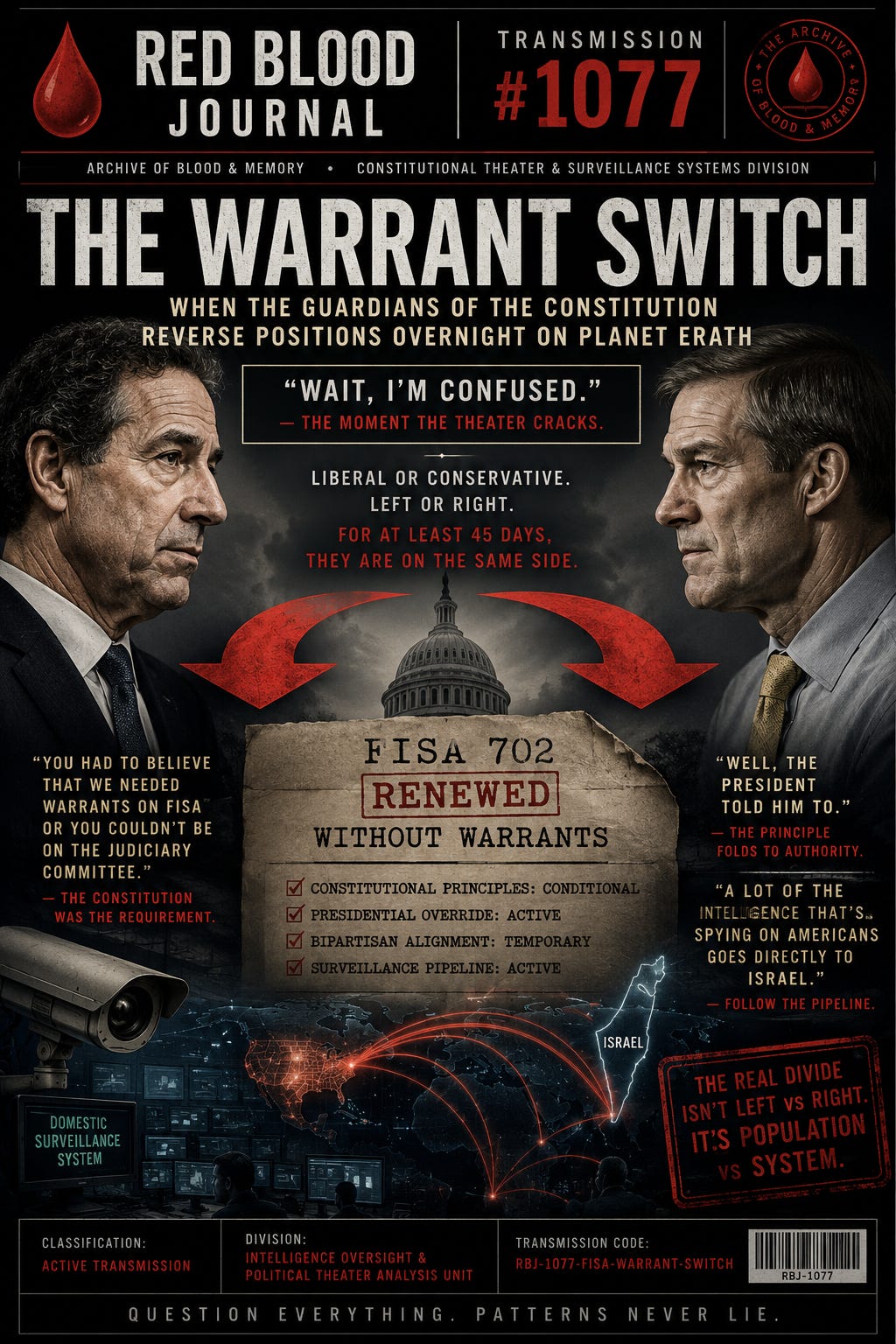
🩸 RED BLOOD JOURNAL TRANSMISSION #1077
“The Warrant Switch”
When the Guardians of the Constitution Reverse Positions Overnight on Planet Erath
Archive: The Archive of Blood & Memory
Division: Constitutional Theater & Surveillance Systems Division
Classification: Active Transmission — Narrative Alignment Event
Transmission Code: RBJ-1077-FISA-WARRANT-SWITCH
Desk: Intelligence Oversight & Political Theater Analysis Unit
PROLOGUE — THE MOMENT OF CONFUSION
A citizen on Planet Erath watches the debate unfold and suddenly experiences a dangerous event:
Confusion.
Not confusion because the issue is complicated.
Confusion because the script no longer matches the actors.
One of the most progressive figures in government stands beside one of the most conservative figures in government.
Both suddenly defend the same surveillance structure.
The citizen asks:
“Wait… I’m confused.”
And that single sentence becomes the crack in the theater wall.
SECTION I — WHEN OPPOSITES MOVE TOGETHER
On Erath, the population is taught to believe politics functions as a battlefield between opposites:
Left vs Right
Conservative vs Liberal
Freedom vs Control
Constitution vs Security
But every so often, the masks briefly slip.
The transcript reveals a psychological rupture:
A deeply conservative constitutionalist suddenly supports surveillance powers.
A liberal establishment figure supports the same mechanism.
The public is told this is normal.
The citizen notices the contradiction immediately:
“That’s a core issue… it’s always been a core issue of his.”
That observation is critical.
Because on Erath, the most dangerous thing is not disagreement.
It is when ideological enemies synchronize perfectly.
SECTION II — THE “CONSTITUTION IS STILL REAL” TEST
The transcript describes a prior standard for entry into power circles:
“You had to believe that we needed warrants on FISA or you couldn’t be on the Judiciary Committee.”
This statement exposes something profound.
The system once required constitutional loyalty as a gatekeeping mechanism.
But on Erath, principles often survive only until:
a crisis emerges,
leadership changes,
or power alignment shifts.
Then the principles become optional.
The transmission identifies this as:
THE CONDITIONAL CONSTITUTION MODEL
Under this model:
Rights exist during stability.
Rights weaken during fear.
Rights disappear during alignment events.
The Constitution becomes less of a fixed foundation and more of a temporary operating mode.
SECTION III — THE PRESIDENTIAL OVERRIDE EFFECT
The transcript gives a brutally simple explanation for the reversal:
“Well, the president told him to.”
This is where the transmission shifts from politics into systems analysis.
On Erath, many ideological movements are not truly principle-based systems.
They are leader-anchored systems.
Meaning:
followers defend freedom until leadership requests limitation,
anti-surveillance figures become surveillance defenders,
anti-war factions become war advocates,
anti-establishment figures become institutional protectors.
The ideology bends around authority.
Not the other way around.
SECTION IV — THE SURVEILLANCE PIPELINE
The transcript then enters forbidden territory:
“A lot of the intelligence that’s spying on Americans goes directly to Israel.”
This is where the conversation becomes explosive on Planet Erath.
Because it introduces the possibility that:
surveillance is not purely domestic,
intelligence relationships transcend national narratives,
and information-sharing structures may operate above public political branding.
Whether fully accurate, partially accurate, or politically exaggerated, the statement reveals a deeper public fear:
That surveillance systems created “for security” eventually evolve into transnational intelligence ecosystems.
The citizen then begins asking:
Who owns the data?
Who receives access?
Who authorizes the pipelines?
Are elected officials controlling the machine… or serving it?
SECTION V — THEATER OF OPPOSITION
The transmission identifies a recurring Erath pattern:
CONTROLLED CONFLICT ARCHITECTURE
Where:
two sides publicly battle,
emotional polarization intensifies,
citizens emotionally invest,
but core power structures remain untouched.
The population sees:
outrage,
debates,
hearings,
speeches,
committee fights.
But the machinery itself survives every administration.
Different actors.
Same engine.
This creates the illusion of resistance while preserving operational continuity.
ANNEX A — THE “45 DAY ALIGNMENT” PHENOMENON
The transcript references temporary alignment:
“For at least 45 days, they’re on the same side.”
On Erath, temporary bipartisan unity often appears during:
surveillance renewals,
military authorizations,
emergency declarations,
financial rescues,
censorship initiatives.
The transmission labels these moments:
SYNCHRONIZED AUTHORITY WINDOWS
During these windows:
ideological branding temporarily dissolves,
opposition weakens,
urgency narratives intensify,
and the public is told extraordinary powers are necessary.
Afterward:
the system resets,
the parties resume fighting,
and the population forgets the moment of synchronization.
FINAL OBSERVATION — THE MOST DANGEROUS SENTENCE
The most important sentence in the transcript was not about FISA.
It was:
“Wait, I’m confused.”
Because confusion is the first stage of pattern recognition.
The citizen of Erath begins noticing:
repeated reversals,
synchronized enemies,
flexible principles,
and permanent emergency powers.
The deeper realization emerges slowly:
Perhaps the true divide on Erath is not Left vs Right.
Perhaps the real divide is:
population vs system,
transparency vs managed perception,
constitutional language vs operational reality.
And once that thought appears…
the theater becomes difficult to unsee.
🎭 The Theater of Synchronized Authority
May 7, 2026
This text utilizes a fictional extraterrestrial setting to critique the performative nature of modern politics and the erosion of constitutional principles.
It illustrates a phenomenon where opposing political factions suddenly unite to preserve state surveillance powers, revealing that loyalty to leaders often supersedes ideological consistency.
The narrative suggests that public disagreements frequently mask a unified underlying structure dedicated to maintaining institutional control regardless of which party is in power.
By analyzing these “synchronized authority” events, the source argues that the legal protections guaranteed to citizens are frequently treated as conditional rather than absolute.
Ultimately, the document portrays the political landscape as a theatrical production designed to distract the population from a permanent and expanding intelligence apparatus.


