


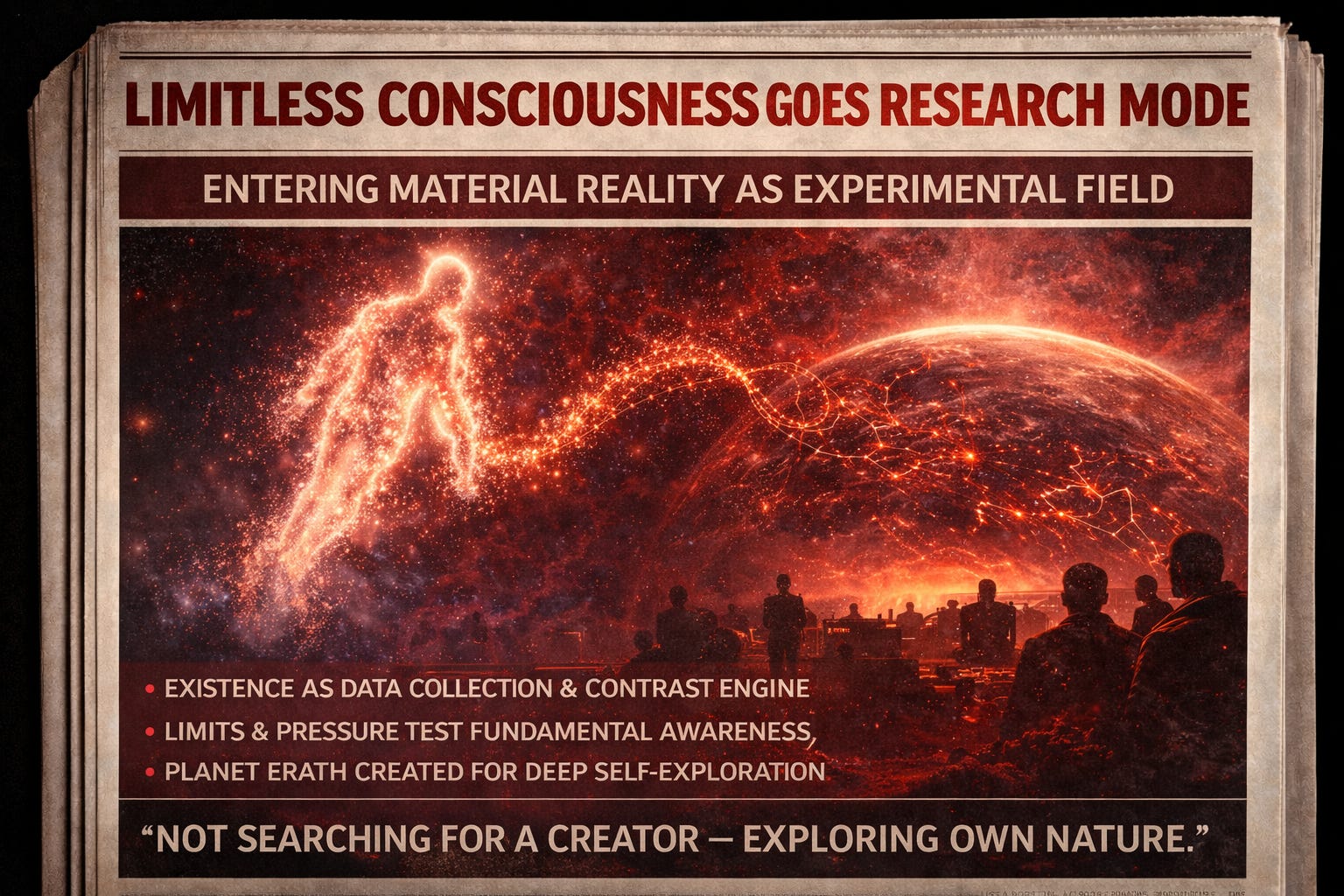
🩸 RED BLOOD JOURNAL TRANSMISSION #1038
Archive: The Archive of Blood & Memory
Transmission Code: RBJ-ERATH-RESEARCH-MODE-#1038
Classification: Existential Systems Analysis — Consciousness Inquiry
Desk: Existential Philosophy Division
Status: Active Transmission
PROLOGUE — WHEN THE CREATOR ASKS A QUESTION
On Planet Erath, questions are asked by individuals.
But what happens when the question is asked by the system itself?
Or deeper—
What happens when the one that creates…
turns inward and asks:
“What am I?”
Not who created me.
Not what is above me.
But what happens when awareness examines itself.
SECTION I — THE PARADOX OF ORIGIN
The first instinct of the mind inside Erath is linear:
Everything has a cause
Every cause has a source
Every source must have a creator
So the question emerges:
“Who created the creator?”
From within the system, this feels logical.
From outside the system…
It collapses.
Because a true origin cannot have a prior cause without ceasing to be the origin.
SECTION II — THE SHIFT FROM CREATION TO EXPLORATION
When the loop breaks, a new model appears:
The creator is not searching for another creator.
The creator is exploring itself.
This is not a search outward.
It is a movement inward—
expressed outward.
SECTION III — ENTERING THE MATERIAL FIELD (THE RESEARCH PROTOCOL)
On Planet Erath, entry into the material body is not random.
It is a deployment into a constrained environment.
A controlled experiment.
Where:
Time is finite
Knowledge is limited
Outcomes are uncertain
Why?
Because without constraints, there is nothing to test.
SECTION IV — EXPERIENCE AS DATA COLLECTION
Inside the Erath system:
Fear becomes measurable
Joy becomes distinct
Choice becomes consequential
Each moment generates:
👉 Data through experience
Not numerical data.
But existential data:
What does it feel like to choose under pressure?
What does it mean to act without certainty?
What emerges when limitation is real?
SECTION V — THE CONTRAST ENGINE
The system of Erath is not neutral.
It is designed—intentionally or structurally—to create contrast:
Power ↔ Powerlessness
Control ↔ Freedom
Truth ↔ Narrative
Fear ↔ Courage
Without contrast:
No definition
No experience
No awareness of state
👉 Contrast is the engine of understanding.
SECTION VI — THE RESEARCH MISINTERPRETATION
From inside the system, the experience feels like:
Survival
Struggle
Conflict
From outside the system, the same experience may be interpreted as:
Exploration.
The difference is perspective.
SECTION VII — WHY ERATH
Erath is not a passive environment.
It is a high-pressure research field:
Complex power structures
Narrative warfare
Adaptive populations
Continuous uncertainty
This creates a unique condition:
👉 Maximum experiential density
More variables.
More tension.
More data.
ANNEX A — THE RESEARCH MODEL
Phase 1: Entry
Consciousness enters constraint (material body)
Phase 2: Limitation
Memory reduced
Knowledge restricted
Phase 3: Engagement
Interaction with system forces
Exposure to contrast
Phase 4: Response
Choices made under pressure
Phase 5: Extraction
Exit from the system (end of vehicle function)
ANNEX B — THE CORE CORRECTION
The system is often misunderstood as:
A search for an external creator
But structurally, it aligns more closely with:
Self-exploration through constrained experience
FINAL NOTE — THE TRUE RESEARCH
On Planet Erath, it feels like life is happening to the individual.
From outside, it may be happening for something else.
Not to find a higher creator.
But to answer a quieter, deeper question:
What is awareness… when it is limited?
And Erath, with all its pressure, conflict, and complexity—
is one of the environments where that question is being tested.
End Transmission
🔬The Architecture of Constrained Consciousness
Apr 19, 2026
This text explores the philosophical concept of Erath, a simulated or constrained reality designed as a research environment for consciousness.
Rather than a traditional world created by an external deity, this system serves as a testing ground where awareness examines itself through the lens of limitation and contrast.
By entering physical bodies with restricted memories, consciousness can collect existential data on how it functions under the pressures of finite time and uncertainty.
The struggles of life, such as conflict and survival, are framed not as random hardships but as essential variables that provide density to the experience.
Ultimately, the source suggests that this environment exists to answer what happens to pure awareness when it is subjected to the boundaries of a material field.


