


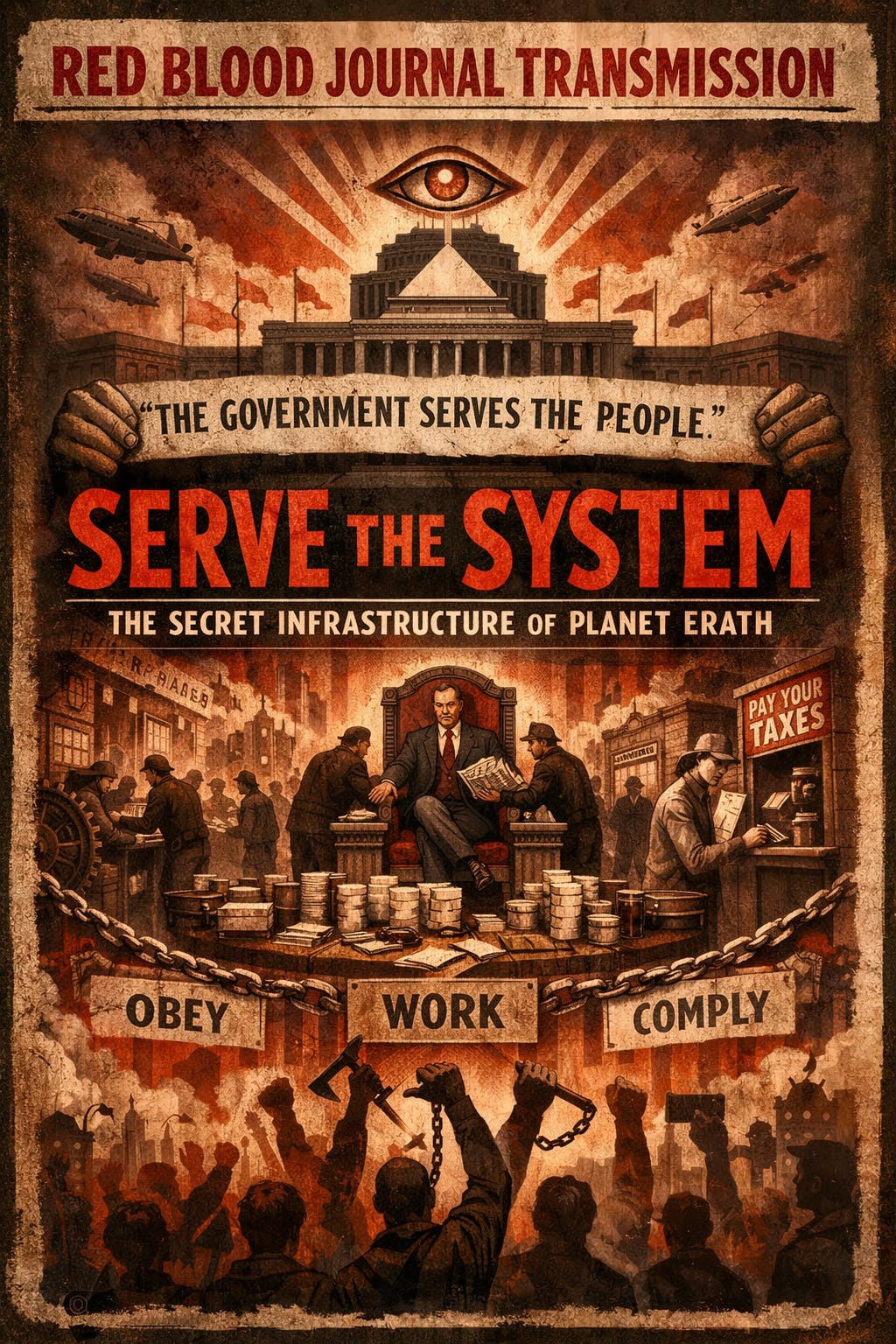
🩸 RED BLOOD JOURNAL TRANSMISSION
Archive: The Archive of Blood & Memory
Transmission Code: RBJ-2026-SERVICE-REVERSAL-PROTOCOL-#1020
Classification: Governance Illusion & Power Inversion Analysis
Desk: Institutional Architecture & Narrative Control Unit
Status: Active Transmission
PROLOGUE — THE PROMISE VS THE FUNCTION
On the surface of Planet Erath, a single phrase is repeated across every institution:
“The government serves the people.”
It is printed in charters.
Spoken in ceremonies.
Etched into the psychological foundation of every citizen.
But beneath the language lies a structural inversion.
Not a failure.
Not a corruption.
A design.
SECTION I — THE ORIGINAL CONTRACT (THE VISIBLE STORY)
The Erathian citizen is raised within a framework of belief:
Authority derives from the people
Leaders are representatives
Systems exist to protect rights and ensure fairness
This creates perceived ownership.
A powerful illusion:
If the system belongs to the people, then obedience feels voluntary—not imposed.
The citizen does not feel ruled.
They feel served.
SECTION II — THE FUNCTIONAL REALITY (THE HIDDEN LAYER)
In practice, the structure operates in reverse.
The citizen:
Works within systems designed by the state
Pays into structures they do not control
Navigates rules they did not write
Justifies the system’s existence through participation
The government, in this configuration, becomes:
A central node of coordination
A collector of energy (labor, time, compliance)
A stabilizer of hierarchy
It does not disappear without participation.
It requires it.
Thus, the true function emerges:
The system is sustained not by serving the people—but by the people serving the system.
SECTION III — THE MECHANISM OF REVERSAL
How does this inversion persist without open resistance?
Through narrative engineering.
1. Language Framing
Words like “public servant,” “civil service,” and “representation” create emotional alignment with authority.
2. Participation Rituals
Voting, licensing, taxation—these create the feeling of engagement and consent.
3. Distributed Responsibility
No single figure appears in control. Power feels abstract, making resistance unfocused.
4. Identity Fusion
Citizens begin to equate criticism of the system with betrayal of themselves or their community.
SECTION IV — THE ENERGY FLOW MODEL
At its core, the Erathian structure is an energy system:
Citizen → Labor → System → Authority → Policy → Citizen
A closed loop.
But the direction of control is not equal.
The citizen provides input (labor, compliance, belief)
The system defines output (rules, structure, consequences)
The loop is presented as mutual.
It is, in reality, asymmetrical.
SECTION V — THE MOMENT OF REALIZATION
The shift occurs when a citizen on Erath asks a forbidden question:
“If the government serves me… why must I continuously justify serving it?”
This question fractures the narrative.
Not because it reveals a conspiracy.
But because it exposes a design principle:
Systems that depend on belief must ensure the belief is never examined too closely.
ANNEX A — THE SERVICE PARADOX
A system that truly serves the people would:
Reduce dependency
Increase autonomy
Minimize its own necessity
But the Erathian system:
Expands scope
Increases reliance
Embeds itself deeper into daily life
Thus:
The more a system claims to serve, the more it ensures it is needed.
ANNEX B — THE INVISIBLE AGREEMENT
The real contract on Erath is not written in law.
It is psychological:
The citizen agrees to believe they are in control
The system agrees to maintain that belief
As long as both sides uphold this agreement, stability is preserved.
ANNEX C — THE FINAL INVERSION
The ultimate realization is not rebellion.
It is clarity.
On Planet Erath:
The government does not exist solely to serve the people
Nor solely to dominate them
It exists as a self-sustaining structure
that requires the continuous input of those who believe it serves them.
CLOSING STATEMENT — THE QUIET TRUTH
The most effective systems are not those enforced by force.
They are those maintained by belief.
On Erath, the illusion is not a flaw.
It is the foundation.
And once seen—
It cannot be unseen.
👁️The Architecture of the Erathian Inversion
Apr 14, 2026
This text explores a speculative analysis of institutional power on the fictional planet Erath, where the state maintains control through a psychological inversion of service.
While the public is conditioned to believe that the government serves the people, the document argues that the reality is a self-sustaining system fueled by citizen labor and compliance.
This control is maintained not through overt force, but through narrative engineering and rituals like voting that foster a false sense of ownership and consent.
By framing authority as a public service, the architecture of the state ensures that citizens feel their obedience is voluntary.
Ultimately, the system thrives on a closed loop of energy where the illusion of representation prevents the population from questioning their own dependency.
The source concludes that the most resilient power structures are those built upon unexamined beliefs rather than physical coercion.


